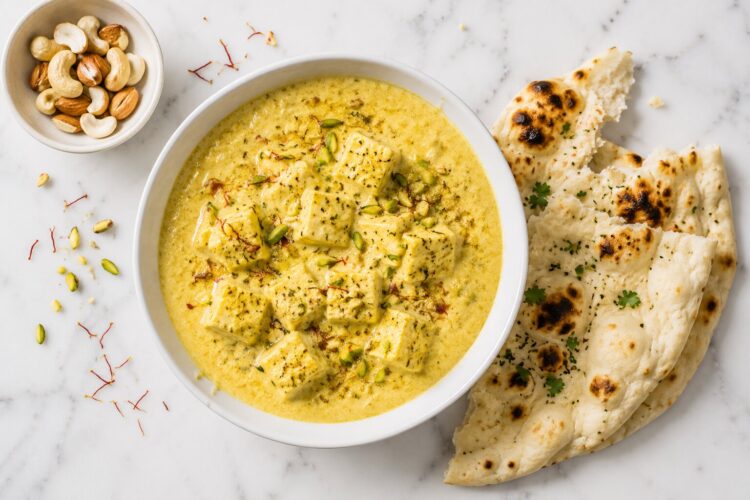
The word shahi means royal. And this dish absolutely earns the title — not because it is elaborate or complicated, but because of what happens when you taste it.
That first spoonful of soft paneer coated in a pale golden, aromatic sauce — subtly sweet from the cashews and almonds, gently floral from the cardamom and saffron, with the characteristic herbal depth of kasuri methi blooming in the background — is genuinely different from any other Indian curry. It has a restraint and elegance that bold, tomato-heavy curries do not have. It is the kind of dish that makes people pause mid-conversation.
Mughlai Shahi Paneer is the jewel of North India’s Mughlai culinary tradition — the cooking heritage of the Mughal Empire that shaped so much of the Indian subcontinent’s most refined, aromatic food. And unlike many restaurant versions that rely heavily on cream, butter, and ghee to achieve their richness, this recipe proves that extraordinary depth of flavor is already present in the cashews, almonds, and aromatics themselves.
This recipe uses whole milk instead of heavy cream and oil instead of butter — and the result is a dish that is lighter on the waistline without sacrificing a single note of the complex, layered flavor that makes Shahi Paneer extraordinary. It is also naturally gluten-free, making it suitable for a wider range of diners.
What Makes This a Mughlai Dish?
Mughlai cuisine traces its roots to the Persian-influenced cooking tradition of the Mughal emperors who ruled the Indian subcontinent from the 16th to 19th centuries. Their court kitchens — the bawarchikhanas of the royal palace — developed a cooking style characterized by:
- Generous use of nuts — cashews, almonds, pistachios — ground into creamy pastes that form sauce bases
- Fragrant whole spices — cardamom, cinnamon, cloves, mace — used to perfume the cooking fat before other ingredients are added
- Saffron — the most prestigious spice in Mughal cuisine, used both for its golden color and its distinctive floral aroma
- Dairy richness — yogurt, milk, and cream used to create silky, pale-colored gravies that are less sharp than tomato-based curries
- Restraint with heat — Mughlai dishes are aromatic and complex rather than aggressively spicy; the flavor comes from layering not from chili heat
Shahi Paneer is the quintessential expression of this tradition in a vegetarian dish. Every ingredient has historical precedent — the nut paste, the saffron, the whole spices, the dairy sauce — and together they produce something that feels genuinely regal.
Shahi Paneer: With Tomatoes vs. Without
This is one of the most common points of confusion in Indian cooking. There are two distinct schools:
| Version | Base | Color | Flavor | Authenticity |
|---|---|---|---|---|
| With tomatoes | Tomato + nut paste | Orange-red | Tangy, bolder | Modern adaptation |
| Without tomatoes (this recipe) | Pure nut paste + dairy | Pale gold/white | Gentle, sweet-savory, floral | More traditionally Mughlai |
The tomato version is more common at North Indian restaurants today — tomatoes add body, natural acidity, and a vibrant color that photographs well and appeals to modern palates trained on tomato-based curries.
The no-tomato version, however, is closer to the original Mughlai preparation. The absence of tomato allows the subtler flavors — the nuttiness of cashews and almonds, the sweetness of onion slowly cooked into the paste, the delicate floral note of saffron — to take centre stage without competing with acidic sharpness.
This recipe follows the traditional no-tomato approach. It requires no more effort than the tomato version — simply a different understanding of where the flavor comes from.
The Lighter Version: What Changes and Why It Still Works
Traditional Shahi Paneer uses ghee as the cooking fat, heavy cream in the sauce, and sometimes malai (clotted cream) for extra richness. Each of these adds significant calories. Here is what this recipe does differently and why it still produces an outstanding result:
| Traditional | This Recipe | Why It Works |
|---|---|---|
| Ghee or butter | Neutral oil (avocado or sunflower) | The nut paste provides richness regardless of fat used |
| Heavy cream | Whole milk | Whole milk with the nut paste creates sufficient creaminess |
| Full-fat yogurt | Low-fat yogurt | The nuts carry the body; the yogurt adds tang and texture |
| ~600-700 kcal/serving | ~350-400 kcal/serving | Significantly lighter without sacrificing flavor |
The key insight is that the richness in Shahi Paneer comes primarily from the nut paste — the cashews and almonds are already high in fat and produce a naturally creamy, thick sauce. The traditional additions of cream, ghee, and butter amplify this richness, but they are not the source of it. Remove them and adjust technique (particularly tempering yogurt carefully to prevent curdling) and the dish remains luxurious.
Ingredients (Serves 4)
For the Nut-Onion Paste
- ⅓ cup raw cashews, soaked in hot water for 30 minutes, drained
- ¼ cup blanched almonds, soaked in hot water for 30 minutes, skin removed, drained
- ¼ cup + 2 tablespoons water (for blending)
- 1 medium yellow onion, roughly chopped
- 1-inch piece fresh ginger, roughly chopped
- 5 garlic cloves
- 2 green chilies (adjust for heat preference)
- 2 green cardamom pods, seeds only
Whole Spices for Tempering
- 1 tablespoon neutral oil (avocado oil, sunflower, or refined coconut)
- ⅛ teaspoon asafoetida (hing) — use certified gluten-free hing if required
- 1 bay leaf (tej patta)
- 1 teaspoon cumin seeds
- 2 cloves
- 3 black peppercorns
- 1-inch cinnamon stick
For the Sauce
- ½ cup low-fat yogurt, whisked completely smooth
- 1 cup whole milk (or dairy-free milk for vegan adaptation)
- 400 grams fresh paneer, soaked in warm water for 20 minutes, cubed
- A generous pinch of saffron threads (12-15 strands), lightly crushed
- ½ teaspoon garam masala
- ½ teaspoon cardamom powder
- 2 teaspoons kasuri methi (dried fenugreek leaves), crushed between palms
- Salt to taste
Optional Garnish
- A few saffron strands soaked in 1 tablespoon warm milk
- Crushed pistachios (the classic Mughlai finishing touch)
- Fresh coriander or mint leaves
- A small swirl of cream for serving (omit for lighter version)
Key Ingredient Notes
Why Both Cashews AND Almonds?
Most Shahi Paneer recipes use only cashews. This recipe uses both cashews and almonds — and the combination is important.
Cashews are creamy, fatty, and blend into a smooth, rich paste that forms the backbone of the sauce. Blanched almonds add a slightly more complex, earthy nuttiness and a subtle bitterness that counterbalances the sweetness of the cashews and the milk. Together they produce a sauce with more depth and complexity than either alone.
The blanching and skin removal from almonds is not optional for texture. Almond skins contain tannins that can make the sauce slightly grainy and bitter if left in. After a 30-minute hot soak, the skins slip off with a gentle squeeze — it takes 3-4 minutes and dramatically improves the final result.
Saffron: The Defining Ingredient
Saffron (kesar) is what marks this as truly Mughlai rather than simply a creamy paneer curry. Its contribution is twofold: the characteristic pale golden color that shifts the sauce from white to a warm, honey-like hue, and a delicate floral aroma unlike any other spice.
Crush the threads lightly between your fingers before adding them — this helps release the color and fragrance. The color develops over the 60-90 seconds it is in the hot sauce; do not rush this stage.
Good-quality saffron matters enormously here. A tiny pinch of genuine saffron from Kashmir or Iran produces remarkable results; an equivalent amount of poor-quality or adulterated saffron produces almost nothing. If your saffron threads are not deeply fragrant and do not immediately release an orange-red color when crushed, consider replacing them.
Paneer: Soaking Makes the Difference
Soaking cubed or whole paneer in warm water for 20 minutes before use is one of the most impactful techniques in Indian cooking. It does three things:
- Removes the surface sourness that commercial paneer sometimes carries
- Makes the paneer softer and more pliable — less likely to become rubbery when added to the hot sauce
- Allows the paneer to absorb the sauce flavor more readily during the final simmering stage
This is especially important when using refrigerated or store-bought paneer. Homemade fresh paneer is already soft enough that soaking is less critical — but it still helps.
Asafoetida (Hing): Small Amount, Large Impact
Asafoetida is used in a tiny quantity (⅛ teaspoon) but its contribution is significant — it adds a background savoury depth and onion-like character that bridges the nut paste and the dairy components. Importantly, it also aids digestion of the nut-heavy sauce, which is why Mughlai recipes traditionally included it.
For those with gluten sensitivities, check the packaging carefully. Many commercial hing brands use wheat flour as a carrier. Certified gluten-free asafoetida is available — look for brands that use rice flour as the carrier instead.
How to Make Mughlai Shahi Paneer: Step-by-Step
Stage 1 — Soak and Prepare (30 Minutes Passive)
Place the cashews in one bowl and the blanched almonds in another. Cover both generously with hot (not boiling) water. Set aside for 30 minutes — this is the prep window where you can prepare all the other ingredients.
Simultaneously, place the paneer in a shallow dish and cover with warm water. Set aside.
After 30 minutes: drain the cashews. For the almonds, drain and squeeze each one between your thumb and finger — the skin will slide off. Discard skins, keep almonds.
Stage 2 — Make the Nut-Onion Paste
In a blender, combine the drained cashews and peeled almonds with ¼ cup water. Blend on high speed until the mixture is completely smooth and creamy — no visible pieces of nut remaining. This first blending produces a thick, ivory-colored paste.
Now add the roughly chopped onion, ginger, garlic, green chilies, and cardamom seeds. Add the remaining 2 tablespoons of water. Blend again until the entire mixture is a completely smooth, unified paste — no onion chunks, no fibrous ginger pieces.
Pro tip: If your blender struggles with the thick nut paste, blend the nuts first with ¼ cup water, then add the aromatics and blend together. Smaller batches also blend more smoothly than one large batch.
Set the paste aside in a bowl. Whisk the yogurt separately until completely lump-free and smooth — this is essential to prevent curdling when it goes into the hot pan.
Stage 3 — Bloom the Whole Spices
Heat the oil in a wide, heavy-bottomed pan or kadai over medium heat. Once the oil shimmers, add all the whole spices at once: hing, bay leaf, cumin seeds, cloves, black peppercorns, and cinnamon.
Stir constantly for 30-45 seconds until the cumin seeds darken and sputter and the cinnamon and cloves release their warm fragrance. The kitchen should smell beautifully aromatic at this point.
Temperature check: If the cumin seeds go in and nothing happens for 10-15 seconds, the oil is not hot enough. If they turn black instantly, the oil is too hot. Aim for the seeds to sputter and pop within 5-8 seconds of hitting the oil.
Stage 4 — Cook the Nut-Onion Paste
Add the prepared nut-onion paste to the spiced oil. Stir immediately to combine it with the bloomed spices. The paste will sizzle and steam on contact with the hot pan.
Cook over medium heat, stirring regularly, for 6-8 minutes. During this time the paste will gradually change: it will darken from ivory to a warm golden color, thicken and pull away from the sides of the pan, and begin to smell nutty and cooked rather than raw and sharp. Eventually, the oil will begin to separate at the edges — small droplets of oil pooling around the paste.
This oil-separation moment is the signal that the paste is properly cooked. Do not move to the next step before this occurs. Under-cooked nut paste produces a sauce with a raw, starchy quality that no amount of additional simmering corrects.
Stage 5 — Temper in the Yogurt
Reduce the heat to the lowest setting. Add the whisked yogurt a tablespoon at a time, stirring vigorously and constantly after each addition. Adding yogurt too quickly to a hot pan causes it to split — the gradual addition with constant stirring prevents this by allowing the temperature to adjust incrementally.
Once all the yogurt is incorporated, increase heat slightly to low-medium and cook for 2-3 minutes, stirring continuously, until the yogurt is fully integrated and the sauce looks smooth and slightly thickened.
Stage 6 — Add Milk and Simmer
Pour in the whole milk gradually, stirring as you add it. The sauce will loosen and look quite fluid at this stage — this is correct. It will concentrate and thicken during the simmering time.
Reduce heat to the lowest setting. Simmer uncovered for 8-10 minutes, stirring every 2-3 minutes to prevent the milk from scorching at the bottom. The sauce should gradually thicken to a medium, pourable consistency — thick enough to coat the back of a spoon.
Stage 7 — Add Paneer and Saffron
Drain the soaked paneer and pat dry with a kitchen towel. Cut into 1-inch cubes.
Add the paneer cubes to the simmering sauce. Stir gently to coat each piece.
Crush the saffron threads lightly and add them directly to the sauce. Stir once and watch — within 60-90 seconds you will see the sauce begin to take on a warm golden hue as the saffron releases its color. This color shift is one of the most beautiful moments in cooking Mughlai dishes.
Simmer for 1-2 minutes.
Stage 8 — Finish and Serve
Add the garam masala and cardamom powder. Stir gently to distribute. Taste and adjust salt.
Remove from heat. Immediately add the crushed kasuri methi and stir through. The fenugreek perfume will bloom instantly in the heat of the dish.
If using a saffron milk garnish, drizzle it over the surface now for a beautiful golden streaking effect. Scatter crushed pistachios for the authentic Mughlai garnish.
Serve immediately while the surface is still glistening and the saffron color is at its most vivid.
What to Serve with Mughlai Shahi Paneer
Classic Mughlai pairings:
- Butter naan or garlic naan — the most indulgent pairing; soft bread absorbs the silky sauce completely
- Peshwari naan — the slightly sweet, nut-filled naan is a particularly good match for the Mughlai flavour profile
- Plain steamed basmati rice — the delicate fragrance of good basmati complements the saffron and cardamom without competition
- Jeera rice — cumin-scented rice adds another aromatic layer
- Laccha paratha — the flaky layers are excellent for scooping the thick, creamy sauce
Complete the spread:
- Cucumber Raita — cooling, refreshing contrast to the warm aromatic curry
- Kachumber salad — raw onion and tomato bring sharpness that cuts through the richness
- A simple dal alongside — Dal Makhani or Dal Tadka rounds out the meal nutritionally
Creative serving ideas:
- Use as a filling for Paneer Kathi Rolls — wrap in whole wheat roti or paratha with thin-sliced onion and coriander chutney
- Serve as a starter in small portions with triangles of naan for scooping — elegant party presentation
Variations Worth Exploring
Full Traditional Version (with Cream and Ghee)
Replace the neutral oil with 1 tablespoon of ghee, substitute the whole milk with ½ cup of heavy cream added at the very end (off heat), and add a tablespoon of malai if available. The additional fat amplifies the richness significantly. This is the version for special occasions and dinner parties where calories are not a concern.
Vegan Mughlai Shahi Paneer
Replace paneer with firm tofu (pressed and cubed), yogurt with thick plain coconut yogurt, and whole milk with full-fat unsweetened oat milk or cashew milk. The nut paste itself is already dairy-free. The result is slightly different in texture but the aromatic complexity of the sauce is unchanged.
Shahi Mushroom (Mughlai Style)
Replace paneer with 400g of large button mushrooms or oyster mushrooms. Do not soak mushrooms before using — they absorb water readily. Add them in the last 5-6 minutes of cooking rather than at the saffron stage, as mushrooms release moisture that can thin the sauce if cooked too long.
Richer Nut Base
Use equal parts cashews, almonds, and walnuts for the paste — 2 tablespoons each. The walnuts add a deeper, slightly bitter complexity that works particularly well for those who find straight cashew sauce too sweet.
Expert Tips for the Best Mughlai Shahi Paneer
Remove every almond skin. Even small pieces of skin left in the paste create a slightly bitter, grainy texture in the finished sauce. The 3-minute effort of squeezing them off is completely worth it.
Whisk yogurt until genuinely smooth before adding. Any lumps in the yogurt will remain as lumps in the sauce. Use a fork or small whisk and take 30-45 seconds to make it truly smooth.
Add yogurt off-heat or on minimum heat, one tablespoon at a time. This is the technique that separates a smooth Mughlai sauce from a broken, curdled one. Patience at this stage is essential.
Do not add saffron to the nut paste. Many recipes instruct adding saffron while building the paste. Adding it to the finished sauce instead preserves the saffron’s delicate color and aroma — heat and acidity degrade saffron quickly.
Kasuri methi goes in last, off the heat. Its flavour compounds are volatile — high heat destroys them. Always add it at the very end, after the heat is off, and the residual warmth of the dish is sufficient to bloom it beautifully.
Storage and Reheating
Refrigerator: Store in an airtight container for up to 2 days. The sauce thickens significantly on cooling — add 2-3 tablespoons of warm milk or water when reheating and stir well.
Reheating: Warm gently on the stovetop over low heat, stirring regularly. Avoid high heat — the milk-based sauce can separate if boiled.
Freezer: The sauce (without paneer) freezes well for up to 1 month. Paneer becomes very firm and grainy after freezing and thawing — it is always better to freeze the sauce separately and add freshly made or soaked paneer when reheating.
Nutrition Information Per Serving (Approximate — 1 of 4)
| Nutrient | Amount |
|---|---|
| Calories | ~350-400 kcal |
| Protein | 18-22g |
| Carbohydrates | 14g |
| Fat | 26g |
| Saturated Fat | 10g |
| Fiber | 3g |
| Calcium | ~580mg |
| Iron | 2mg |
| Sugar | 6g |
Significantly lower than traditional cream-based versions (typically 520-650 kcal) while maintaining the full flavour profile.
Frequently Asked Questions
Q1. What is the difference between Shahi Paneer and Paneer Butter Masala?
Both are creamy paneer curries but they belong to different culinary traditions and have distinct flavor profiles. Paneer Butter Masala is a Punjabi dish built on a tomato base with butter, cream, and kasuri methi — it is tangy, orange-colored, and bold. Mughlai Shahi Paneer has no tomatoes — it is built on a nut paste and dairy base, producing a pale golden, gently sweet-savory, subtly floral sauce. Shahi Paneer is softer and more refined; Paneer Butter Masala is richer and more assertive.
Q2. Can I make this recipe without nuts for a nut allergy?
Yes, with significant adjustment. Replace the entire cashew-almond paste with a combination of 3 tablespoons of white poppy seeds (khus khus) soaked in hot water for 2 hours and blended smooth, plus 2 tablespoons of thick coconut cream. The poppy seed paste provides some of the body and thickness that the nuts would have given. The flavor profile will be different — less nutty, slightly more neutral — but the dish is still very good.
Q3. Why did my sauce curdle when I added the yogurt?
Curdling happens when yogurt hits a pan that is too hot. To prevent it: reduce the heat to the lowest possible setting before adding yogurt, whisk the yogurt until completely smooth before adding, and add it in very small amounts (tablespoon by tablespoon) rather than pouring it all in at once. Each tablespoon should be fully incorporated before the next is added. If curdling has already occurred, an immediate blending of the sauce in a high-speed blender can sometimes smooth it out.
Q4. Can I use store-bought paneer for this recipe?
Yes — most commercial paneer works perfectly with the soaking technique described. Submerge the paneer (whole or cubed) in warm water for 20 minutes before adding to the sauce. This softens refrigerator-cold, dense commercial paneer and removes any surface sourness. If the commercial paneer is particularly firm, you can increase the soaking time to 30-40 minutes. Homemade fresh paneer requires less soaking time and absorbs the sauce even more readily.
Q5. Is this recipe suitable for a weight-loss diet?
This lighter version — at approximately 350-400 kcal per serving compared to 520-650 kcal in the cream-and-ghee version — is significantly more diet-friendly than traditional Shahi Paneer. Paneer itself is a high-protein, relatively lower-carbohydrate food that supports satiety. The nut base contributes healthy monounsaturated and polyunsaturated fats. For a lower-calorie version, reduce the cashews by 2 tablespoons and substitute with 2 extra tablespoons of low-fat yogurt. The sauce will be slightly thinner but still flavourful.
A Royal Dish That Belongs in Your Regular Rotation
Mughlai Shahi Paneer is proof that cooking lighter does not mean cooking less. Remove the cream, replace the ghee with oil, and the flavor is still there — embedded in the nut paste, the aromatic spices, the saffron, the gently cooked kasuri methi. The dish remains what it has always been: regal, complex, and deeply satisfying.
Make it on a special evening. Make it when you want something that feels celebratory without spending hours in the kitchen. Make it when someone tells you that Indian food is too rich for them — and let this dish change their mind.
Try this Mughlai Shahi Paneer and share your experience in the comments below! Tell us whether you kept it fully light or added a touch of cream, which bread you served it with, and whether the saffron color shift happened in your pot too. We read every comment.
Pairs perfectly with: Butter Naan | Garlic Naan | Steamed Basmati Rice | Jeera Rice | Laccha Paratha | Cucumber Raita
Also explore: Shahi Paneer (Classic) | Paneer Butter Masala | Palak Paneer | Kadai Paneer | Malai Kofta