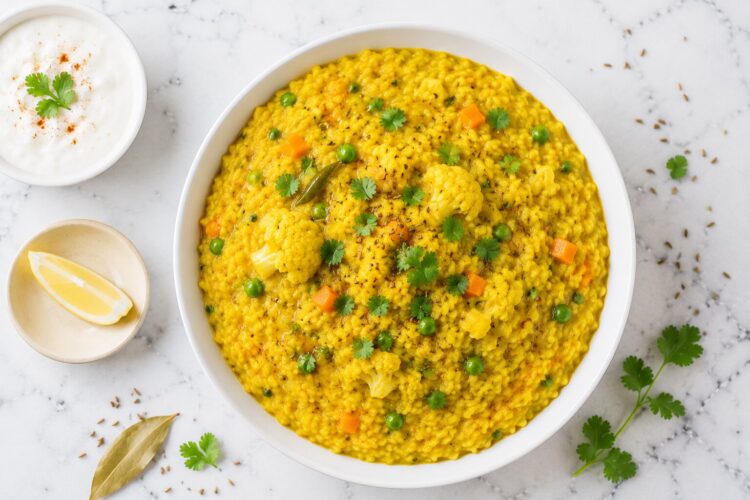
Every cuisine has its own version of the perfect one-pot meal — the dish that asks very little and gives back everything. In India, that dish is Khichdi.
Not the bland, watery khichdi you might have been given during childhood illness (though that version has its own important place). This is Masala Khichdi — the fully loaded, spiced, vegetable-packed version that is hearty enough for hungry adults, quick enough for busy weeknights, and nourishing enough to genuinely make you feel better from the inside out.
Khichdi (also spelled Khichri, Khichuri, or Kichdi) is one of India’s oldest documented foods — mentioned in texts as early as the 4th century BCE when traveller Megasthenes described a rice-and-pulse dish being eaten across the subcontinent. In 2023, the Indian government officially declared Khichdi as India’s National Food — acknowledging what Indian home cooks have known for centuries: there is nothing more fundamentally Indian, nothing more universally comforting, and nothing more nutritionally complete than a good bowl of khichdi.
Masala Khichdi elevates the classic by adding a proper aromatic base of whole spices, sautéed onions, tomatoes, and ginger-garlic — and mixing in a generous handful of seasonal vegetables. The result is a dish that is warming and filling on cold days, light and digestible on difficult ones, and deeply satisfying on any day that calls for something homemade and honest.
What Makes Masala Khichdi Different from Plain Khichdi?
Plain khichdi is the minimalist version — just rice, dal, turmeric, and water, cooked together until creamy and smooth. It is the dish of recovery, simplicity, and tradition.
Masala Khichdi takes that clean base and adds complexity:
| Feature | Plain Khichdi | Masala Khichdi |
|---|---|---|
| Base | Rice + dal + water | Rice + dal + spiced masala + vegetables |
| Vegetables | None or minimal | 1–1.25 cups mixed vegetables |
| Onion & tomato | Absent | Essential — forms the masala |
| Whole spices | Cumin at most | Cumin, bay leaf, cinnamon, cloves, cardamom |
| Spice level | Very mild | Mildly spiced, adjustable |
| Flavour | Neutral, clean | Layered, aromatic, savory |
| Fat used | Optional ghee | Ghee essential for flavour |
| Best occasion | Illness, fasting recovery | Everyday lunch, dinner, one-pot meals |
| Consistency | Porridge-like | Medium to porridge — adjustable |
| Prep time | 15 minutes | 30 minutes |
Both versions are correct and both have their place. But Masala Khichdi is the version you reach for when you want a proper meal rather than just a restorative bowl.
Why Khichdi Is One of India’s Most Nutritionally Complete Meals
This is not marketing language — it is nutrition science. The combination of rice and lentils in khichdi creates a complementary protein profile that is rare in plant-based cooking.
Rice is high in the amino acid methionine but low in lysine. Lentils are high in lysine but low in methionine. Together, they form a complete protein — providing all essential amino acids in meaningful quantities. This is why khichdi has fed the Indian subcontinent across millennia: it is genuinely nutritious in a way that neither ingredient alone can achieve.
Nutritional highlights per serving of Masala Khichdi (approximate):
| Nutrient | Amount | Benefit |
|---|---|---|
| Calories | ~332 kcal | Satisfying without being heavy |
| Protein | 11g | Complete protein from rice+dal combination |
| Carbohydrates | 55g | Slow-release from whole grain and legume |
| Fiber | 8g | Supports gut health and sustained energy |
| Vitamin A | 855 IU | From vegetables — eye and immune health |
| Vitamin C | 14mg | Antioxidant, iron absorption support |
| Iron | 3.5mg | ~19% daily value |
| Calcium | 81mg | Bone health |
| Potassium | 691mg | Heart and muscle function |
The addition of ghee is not indulgent — it is functional. The fat-soluble vitamins (A, D, E, K) present in the vegetables require dietary fat for absorption. A teaspoon of ghee also significantly improves the bioavailability of curcumin from turmeric. In traditional Ayurvedic medicine, khichdi with ghee is considered the perfect food for all body types (tridoshic) — balancing Vata, Pitta, and Kapha simultaneously.
Ingredients for Masala Khichdi (Serves 2–3)
The Rice and Dal
- ⅓ cup moong dal (split yellow mung lentils, husked)
- ⅓ cup rice — broken rice (khanda atta rice) for more porridge-like texture, or any regular short or medium-grain white rice for more defined grains
Rice choice matters: Broken rice cooks faster, absorbs more water, and produces a more unified, porridge-like texture — great for when you want something really comforting. Regular rice maintains more structure and gives the khichdi a slightly firmer bite closer to a pulao. Both are correct; choose based on the texture you prefer.
Whole Spices (the Aromatic Base)
- 1 tablespoon ghee (or neutral oil for vegan/dairy-free)
- ½ teaspoon cumin seeds
- 1 small Indian bay leaf (tej patta)
- ½-inch cinnamon stick
- 2 cloves
- 2 green cardamoms, lightly crushed
The Masala
- ⅓ cup onion, finely chopped (about 1 small-medium onion)
- 1 teaspoon ginger-garlic paste (or ½-inch ginger + 3-4 garlic cloves, freshly ground)
- ¼ to ⅓ cup tomato, finely chopped (1 small ripe tomato)
- 1-2 green chilies, finely chopped or slit
Spice Powders
- ¼ teaspoon turmeric powder
- ¼ teaspoon red chili powder (increase to ½ teaspoon for a spicier version)
- 1 pinch asafoetida (hing)
Vegetables (1 to 1.25 cups total, mixed)
Choose any combination:
- Carrot, diced small
- Green peas (fresh or frozen)
- Cauliflower florets, small
- French beans, finely chopped
- Potato, peeled and diced small
- Capsicum / bell pepper, diced
- Zucchini or brinjal (aubergine), diced — excellent additions
Finishing
- 2 cups water (for medium-firm consistency)
- Salt to taste
- 1 teaspoon ghee for finishing drizzle (optional but highly recommended)
- Fresh coriander leaves for garnish
Choosing Your Vegetables: A Seasonal Guide
One of Masala Khichdi’s greatest strengths is its flexibility. The vegetable combination can change with every season and whatever is in your refrigerator. Here is a seasonal guide:
Winter (Best Season for Khichdi):
- Cauliflower, green peas, carrots, French beans, spinach
- All cook beautifully and absorb the masala spices fully
Summer:
- Zucchini, capsicum, sweet corn, brinjal
- Lighter vegetables that cook quickly
Monsoon:
- Potatoes, onions, dried peas
- Heartier choices for cold, wet weather comfort food
Year-Round:
- Frozen mixed vegetables work perfectly when fresh options are limited
- Canned chickpeas or kidney beans can be added for extra protein
Vegetables to avoid:
- Leafy greens like spinach or methi — these should be added after pressure cooking as they turn bitter under pressure
- Very soft vegetables like cherry tomatoes or cucumber — they disintegrate completely
- Beets — they turn the entire khichdi purple (unless that is the goal)
Step-by-Step: How to Make Masala Khichdi
Step 1 — Rinse the Rice and Dal
Place the moong dal and rice in a bowl together. Add cold water, swirl, drain. Repeat 2-3 times until the water runs nearly clear. Set aside — do not soak unless you are cooking on the stovetop without a pressure cooker, in which case a 20-30 minute soak is recommended.
Step 2 — Bloom the Whole Spices
Heat the ghee in a 2-3 litre pressure cooker over medium heat. Once the ghee shimmers and smells nutty, add all the whole spices: cumin seeds, bay leaf, cinnamon, cloves, and cardamoms.
Stir continuously for 60-90 seconds until the cumin seeds darken slightly and sputter and the cinnamon and cloves release their fragrance into the ghee. The kitchen should smell warm and aromatic at this point — this is the signal that the spices have properly bloomed.
Critical: Never add the onions while the spices are still pale and quiet. The blooming happens quickly — watch carefully and add onions the moment the cumin turns dark brown and sputters actively.
Step 3 — Build the Masala
Add the finely chopped onions and stir to coat with the spiced ghee. Cook over medium heat for 4-5 minutes, stirring regularly, until the onions turn fully translucent and begin to just catch colour at the edges.
Add the ginger-garlic paste and stir continuously for 60-90 seconds until the sharp raw aroma gives way to a sweeter, cooked fragrance. This stage is complete when you can no longer smell raw garlic.
Add the chopped tomatoes and green chilies. Stir and cook for 2-3 minutes until the tomatoes soften, release their moisture, and begin breaking down into the onion base. The mixture should look glossy and combined — not like separate ingredients sitting together.
Step 4 — Add Vegetables and Spice Powders
Add all the chopped vegetables to the masala. Add the turmeric powder, red chili powder, and asafoetida. Stir thoroughly to coat every vegetable piece with the spiced masala. Cook for 1-2 minutes, stirring constantly.
Tip: Adding vegetables at this stage and sautéing briefly before the rice and dal go in allows the vegetables to absorb some of the masala flavour at the surface level, which adds depth to the final dish.
Step 5 — Add Rice, Dal, and Water
Add the rinsed rice and moong dal. Stir gently to mix everything together uniformly. Add 2 cups of water for a medium, well-defined consistency. For a softer, porridge-like khichdi (the pej or jau style), add 2.5 to 3 cups.
Add salt and stir once more to distribute evenly.
Water guide:
- 2 cups: Semi-firm, individual grains somewhat visible, not mushy
- 2.5 cups: Soft and cohesive, classic khichdi texture
- 3 cups: Flowing, porridge-like, traditional restorative style
Step 6 — Pressure Cook
Seal the pressure cooker. Cook on medium heat for 7-8 whistles (approximately 14-15 minutes). Once cooking is complete, turn off the heat and allow the pressure to release completely on its own — do not rush the release. The dal and rice continue cooking gently in the residual steam even after the flame is off, and forcing the release interrupts this.
Once the pressure has fully dropped, open the lid. Stir gently from the bottom. The khichdi should be creamy, unified, and aromatic. If it looks drier than expected, stir in ¼ cup of hot water.
Instant Pot method: Use the Porridge setting (High Pressure, 10 minutes) with 10 minutes natural pressure release. Increase water to 2.5 cups for this method.
Stovetop without pressure cooker: Soak rice and dal for 30 minutes. Cook the masala in a heavy pot as above, add all ingredients with 3 cups water, bring to a boil, cover, and simmer on low for 25-30 minutes, stirring every 8-10 minutes and adding hot water as needed.
Step 7 — Finish and Serve
Taste and adjust salt. If using ghee as a finishing drizzle — which is highly recommended — add 1 teaspoon directly over the plated khichdi just before serving. This final ghee adds shine, richness, and significantly improves the flavour.
Garnish with fresh coriander leaves. Serve immediately while hot.
What to Serve with Masala Khichdi
Khichdi is a complete meal in itself — protein, carbohydrates, vegetables, and fat all in one pot. But it is elevated further by the right accompaniments:
Classic accompaniments:
- Plain dahi (yogurt) — the most traditional pairing; its coolness and tang perfectly complement the warm spiced khichdi
- Papad — roasted or fried; provides the crunch that soft khichdi naturally lacks
- Mango pickle (aam ka achar) — the sharp, spiced brine cuts through the earthy richness beautifully
- Lime pickle — equally excellent; the citrus sharpness works wonderfully
For a more substantial meal:
- Cucumber raita alongside the khichdi — find the complete raita recipe on KitchenWhisper.in
- A simple kachumber salad (raw onion, tomato, cucumber, coriander)
- Roasted masala papad
- A small bowl of dal alongside the khichdi — a South Indian tradition (dal-khichdi combination)
Beverages:
- Chilled chaas (spiced buttermilk)
- Warm ginger chai for monsoon days
- Cold nimbu pani for summer
6 Masala Khichdi Variations Worth Making
1. Palak Masala Khichdi After opening the pressure cooker, stir in 1 cup of finely chopped fresh spinach while the khichdi is still hot. Cover and rest for 3 minutes — the residual heat wilts the spinach perfectly without overcooking it. Adds iron, folate, and a beautiful green colour.
2. Moong Dal + Toor Dal Khichdi Replace half the moong dal with toor dal (split pigeon peas). Use ¼ cup moong + ¼ cup toor for a more complex, earthier flavour with a creamier texture. Increase water by ¼ cup.
3. Oats Masala Khichdi (High Fiber) Replace the rice with rolled oats in a 1:1 ratio. The oats cook beautifully under pressure and produce a porridge-style khichdi that is significantly higher in soluble fiber and lower on the glycemic index — excellent for diabetics and anyone focused on heart health.
4. Rajasthani Style Masala Khichdi Add 2 tablespoons of finely chopped raw onion and 1 tablespoon of ghee directly after pressure cooking. Stir through and serve immediately. The raw onion adds a sharp freshness and the extra ghee makes this the most indulgent version.
5. Protein-Boosted Masala Khichdi Add ¼ cup of soaked and rinsed chana dal (split chickpeas) to the rice and moong dal. The chana dal adds a nuttier flavour, more protein, and a slightly chewier texture. Increase water by ¼ cup and add 1-2 extra whistles.
6. No-Onion, No-Garlic Version (Sattvic/Fasting) Skip onions, garlic, and ginger. Increase the whole spices slightly — add 1 more cardamom, an extra clove. The asafoetida (hing) takes over the savoury role that onion and garlic usually play. This version is suitable for Jain recipes, fasting periods, and sattvic diets.
Expert Tips for the Best Masala Khichdi
Use broken rice for the most authentic texture. Broken rice (also called rice flakes or khanda atta rice) produces the classic unified, slightly porridge-like khichdi texture. Regular rice produces a firmer, more defined result. Neither is wrong — it is a texture preference.
Bloom the spices fully before adding onions. Pale, quiet cumin seeds mean the spices have not opened. Wait until they darken and sputter — that sputtering sound is the essential oil releasing into the fat, which is the entire point of the blooming step.
Do not skip the ghee. Masala Khichdi made with only oil is perfectly edible. Masala Khichdi finished with ghee is extraordinary. The ghee adds a richness and nuttiness that makes the dish taste unmistakably like the version you remember from childhood or from a good restaurant.
Natural pressure release always. Forcing the pressure release prevents the final steam cooking that gives khichdi its unified, creamy texture. The extra 10 minutes of natural release is worth every second.
Add leafy greens after cooking, not before. Spinach, methi, and other leafy greens turn bitter and lose colour under pressure. Always stir them in after opening the cooker, using residual heat to wilt them.
Storage and Reheating
Refrigerator: Masala Khichdi thickens significantly as it cools and can become almost solid when refrigerated. Store in an airtight container for up to 2 days. When reheating, add 3-4 tablespoons of hot water, stir well, and warm on low heat until loosened back to serving consistency.
Reheating: Stovetop with added water gives the best result. Microwave with a splash of water covered with a damp paper towel also works. Avoid high heat — khichdi scorches quickly.
Freezer: Not recommended. The rice and dal texture after freezing and thawing becomes grainy and unpleasant.
Best fresh: Like all rice-based one-pot dishes, Masala Khichdi tastes best within an hour of making. Plan portions accordingly.
Frequently Asked Questions
Q1. What is the difference between Masala Khichdi and Vegetable Pulao?
Both are one-pot rice dishes with vegetables, but they differ fundamentally in texture and intent. Pulao is cooked with long-grain basmati rice that remains separate and defined — each grain distinct. Masala Khichdi uses rice and lentils cooked together until they partially break down into a unified, slightly sticky, creamy consistency. Pulao is festive and aromatic; khichdi is comforting and nourishing. Pulao takes care and technique; khichdi is forgiving and fast.
Q2. Can I make Masala Khichdi without a pressure cooker?
Yes. Soak the rinsed rice and moong dal in cold water for 30 minutes before cooking. Build the masala base in a heavy-bottomed pot exactly as described. Add all ingredients with 3 cups of water (more than the pressure cooker version). Bring to a boil, then cover and simmer on low heat for 25-30 minutes, stirring every 8-10 minutes and adding hot water as needed. The result is identical to the pressure-cooked version — it just takes slightly longer.
Q3. Is Masala Khichdi good for weight loss?
Yes, with appropriate portions. Masala Khichdi has approximately 332 calories per serving with 11 grams of protein and 8 grams of fiber — a combination that keeps you full for longer and reduces overall calorie intake through the day. The moong dal provides protein that supports muscle maintenance during weight loss, and the vegetables add micronutrients with very few calories. Skip the ghee drizzle or reduce it to ½ teaspoon to lower the calorie count further.
Q4. Can I add protein like paneer or chicken to Masala Khichdi?
Yes for both. For paneer: add 100g of cubed paneer in the last 2 minutes after opening the pressure cooker — stir through while the khichdi is still very hot. The residual heat warms the paneer without making it rubbery. For chicken: cut boneless chicken thighs into 1-inch pieces, add them with the vegetables before pressure cooking, and increase cooking to 8-9 whistles. The chicken will be fully cooked and tender.
Q5. Why did my khichdi come out too dry or too watery?
Too dry: The water ratio was too low, or the pressure cooker lost steam during cooking. Next time increase water by ¼ cup and check the pressure cooker seal before cooking. To fix now: stir in ¼ cup of hot water, cover, and rest on the lowest heat for 5 minutes.
Too watery: The water ratio was too high, or the vegetables released excess moisture during cooking. To fix: simmer uncovered on low heat for 5-7 minutes, stirring regularly, until excess moisture evaporates and the desired consistency is reached.
One Pot. Thirty Minutes. Everything You Need.
Masala Khichdi is proof that the most satisfying meals are often the simplest ones. One pressure cooker. A handful of pantry staples. Thirty minutes. And you have something that genuinely nourishes — warm, spiced, aromatic, complete.
It is the recipe for the Tuesday evening when you are tired and the refrigerator looks sparse. The Sunday lunch when you want something comforting without spending an hour at the stove. The monsoon dinner when nothing sounds better than something warm in a bowl.
Make it tonight. Share a photo in the comments. Tell us which vegetables you used and which accompaniment was the hit at your table.
For more comforting Indian recipes, explore our complete collection at KitchenWhisper.in — from Lasooni Dal Tadka to Cucumber Raita and everything in between.
Pairs perfectly with: Plain Dahi | Roasted Papad | Mango Pickle | Cucumber Raita | Kachumber Salad | Chaas
Also explore: Moong Dal Khichdi | Bajra Khichdi | Oats Khichdi | Palak Khichdi | Vegetable Pulao