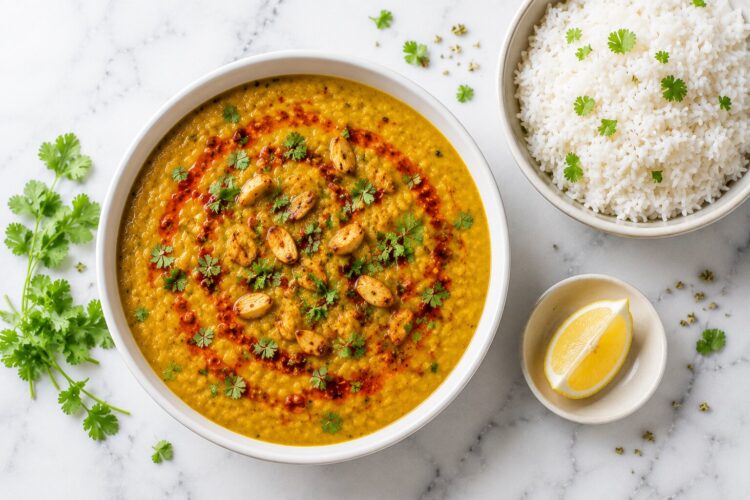
If there is one ingredient that can single-handedly transform a humble bowl of lentils into something extraordinary, it is garlic.
Not just a whisper of it. Not a clove or two quietly added to the background. In Lasooni Dal Tadka — the garlic lover’s definitive lentil dish — garlic is the entire point. It goes in during cooking and it comes back again in the tadka, twice as bold, twice as fragrant, twice as flavourful.
Lasooni (also spelled Lehsuni or Lahsuni) comes from lasoon or lehsun — the Hindi word for garlic. And dal tadka refers to a lentil dish finished with a flavoured tempering of spices in hot fat. Put them together and you have one of the most satisfying, deeply aromatic lentil dishes in the North Indian kitchen.
This is everyday dal, elevated. The kind that makes plain steamed rice taste like a complete meal. The kind that disappears from the pot before you have even finished serving it. The kind that has been making its way from dhaba kitchens and home stoves to restaurant menus for decades — because there is something about the combination of earthy toor dal and golden, nutty fried garlic that is genuinely irresistible.
This guide gives you everything: the full recipe with both cooking methods (pressure cooker and stovetop), the science behind the double-garlic technique, expert tips, all the variations worth trying, and a complete answer to every question home cooks ask about making dal tadka at home.
What Is Lasooni Dal Tadka? (And Why Is It Different from Regular Dal Tadka?)
Dal Tadka is one of the most made dishes in Indian kitchens — lentils cooked until soft and seasoned with a hot tempering of cumin, chilies, and aromatics poured over the top. It is a staple, a comfort food, an everyday essential.
Lasooni Dal Tadka takes everything good about regular dal tadka and amplifies the garlic element at every stage. Here is what makes it distinct:
| Feature | Regular Dal Tadka | Lasooni Dal Tadka |
|---|---|---|
| Garlic in dal | Sometimes added | Always added — 1 to 1.5 tablespoons |
| Garlic in tadka | Small amount | 1 additional teaspoon, specifically golden-fried |
| Garlic treatment | Quick sauté | Slowly golden-browned for nutty depth |
| Flavour profile | Balanced, aromatic | Boldly garlicky with nutty, rich notes |
| Kasuri methi | Optional | Added to tadka — essential |
| Tomato | Often included | Traditional version skips tomatoes |
| Best occasion | Everyday | Everyday + special meals |
| Dhaba association | Common | Strongly dhaba-associated dish |
The defining technique of Lasooni Dal is the double-garlic method: garlic cooks inside the lentils during pressure cooking, building a background savouriness that permeates every grain. Then fresh garlic goes into the hot ghee tadka and is cooked until just golden — releasing an entirely different set of aromatic compounds that are nuttier, deeper, and more complex than raw or simply sautéed garlic. These two garlic elements complement rather than repeat each other, creating a layered garlic flavour that is far more sophisticated than a simple garlic dal.
The Science of Garlic in Indian Cooking: Why It Tastes Different at Different Stages
Understanding why garlic behaves so differently at different cooking stages helps you make Lasooni Dal with genuine intention rather than just following steps mechanically.
Raw garlic contains a compound called allicin — sharp, pungent, and intensely spicy. This is the bite you get when you eat raw garlic. When garlic is cooked gently for a few minutes inside the pressure cooker with lentils, the allicin converts into gentler sulfur compounds that mellow into a soft, savory background note — warming and aromatic rather than sharp.
When garlic is fried in hot ghee until golden — as happens in the tadka — a completely different process occurs: the Maillard reaction browns the garlic and creates dozens of new aromatic compounds that are described as nutty, caramel-like, and richly savoury. This is the colour and smell of properly golden-fried garlic, and it is entirely different from both raw garlic and gently cooked garlic.
The Lasooni Dal tadka uses both stages: soft-cooked garlic inside the dal for savouriness, and golden-fried garlic in the tadka for nuttiness and depth. The result is garlic flavour with complexity — not just heat or sharpness, but a rounded, layered character that keeps pulling you back for another spoonful.
Why Ghee Makes a Difference in the Tadka
The traditional Lasooni Dal Tadka uses ghee (clarified butter) for the tempering rather than oil. This is not incidental — ghee and garlic are one of Indian cooking’s great flavour partnerships.
Ghee has a higher smoke point than butter (about 250°C / 482°F) and a richer, nuttier flavour derived from its milk solid content. When garlic is fried in hot ghee rather than oil, it absorbs the fat differently — picking up the ghee’s natural butteriness as it cooks. The result is a more rounded, less sharp garlic flavour in the tadka.
The smell of garlic sizzling in hot ghee is one of the most distinctive aromas in Indian cooking, and it is the moment this recipe truly comes to life. Pour that golden, sputtering tadka over the cooked dal and the fragrance alone makes the dish irresistible.
For a vegan version: Use coconut oil or a good-quality neutral oil. The flavour will be different but still excellent — coconut oil in particular pairs interestingly with garlic.
Ingredients for Lasooni Dal Tadka (Serves 4)
For Cooking the Dal
- ½ cup toor dal (arhar dal / pigeon pea lentils), rinsed thoroughly
- 1¼ to 1½ cups water (for pressure cooking)
- 1 to 1½ tablespoons garlic, finely chopped (about 5-6 medium cloves)
- ¼ cup onion, finely chopped
- 1-2 green chilies, slit or finely chopped
- ½ teaspoon turmeric powder
- 1 pinch asafoetida (hing)
- Salt to taste
For the Tadka (Tempering)
- 1½ to 2 tablespoons ghee (or neutral oil for vegan)
- 1 teaspoon garlic, finely chopped (about 2 small cloves)
- ½ teaspoon cumin seeds
- ½ teaspoon Kashmiri red chili powder (or sweet paprika for milder version)
- 1 pinch asafoetida (hing)
- ½ teaspoon kasuri methi (dried fenugreek leaves), crushed between palms
For Serving
- 1-2 tablespoons fresh coriander leaves, finely chopped
- ½ teaspoon lemon juice (optional — for brightness)
- Steamed basmati rice or jeera rice
- Roti, phulka, or naan
Key Ingredient Notes
Choosing the Right Dal: Toor Dal vs Alternatives
This recipe is built around toor dal (split pigeon peas) — the standard choice for most restaurant-style dal tadka preparations. Toor dal cooks to a naturally creamy, almost velvety consistency that holds the garlic flavour beautifully.
Can you use other lentils? Absolutely — with adjustments:
| Dal Type | Flavour | Texture When Cooked | Pressure Cook Time | Water Ratio |
|---|---|---|---|---|
| Toor Dal (default) | Earthy, mild | Creamy, slightly thick | 8-9 whistles | 1:2.5 |
| Yellow Moong Dal | Lighter, delicate | Smooth, thin | 4-5 whistles | 1:3 |
| Chana Dal | Nutty, rich | Grainy, chunky | 10-12 whistles | 1:3 |
| Masoor Dal (red) | Slightly sweet | Very smooth | 4-5 whistles | 1:2.5 |
| Mixed (toor + masoor) | Complex, rounded | Creamy-smooth | 7-8 whistles | 1:2.5 |
Mixing toor dal with masoor dal (red lentils) in a 50:50 ratio is a popular home cook’s variation that produces a slightly more complex flavour and an even silkier texture than toor dal alone.
Garlic: Fresh and Firm Only
The quality of garlic matters enormously in a dish where it is the hero ingredient. Use fresh garlic with firm, tightly packed cloves — not pre-minced jarred garlic (which has lost its essential oil potency) and not old garlic with soft or sprouting cloves (which tastes bitter). For the tadka especially, freshly chopped garlic fried in hot ghee produces a completely different result from anything pre-prepared.
How much garlic is correct? The recipe uses garlic in two stages: 1 to 1½ tablespoons during dal cooking (5-6 cloves) plus 1 teaspoon in the tadka (about 2 small cloves). This is the correct balance for a boldly garlicky dal that remains pleasant rather than overpowering. Reducing slightly is fine; increasing beyond this makes the dal acrid.
Asafoetida (Hing): Added Twice, Never Skipped
Asafoetida is used in both the dal and the tadka — and both additions serve different purposes. In the dal, it aids digestion and adds a background savouriness. In the tadka, it blooms instantly in the hot ghee and releases its characteristic smell that is distinctly associated with North Indian lentil dishes. This double-hing technique is a hallmark of proper dal cooking.
Kasuri Methi: The Finishing Touch
Dried fenugreek leaves (kasuri methi) added to the tadka is the ingredient that announces this as a North Indian restaurant-quality preparation. Its slightly bitter, herbal quality complements the nuttiness of the golden garlic and gives the finished dal a recognisable complexity. Always crush it between your palms before adding — this activates the essential oils and releases the full flavour.
How to Make Lasooni Dal Tadka: Step-by-Step
Stage 1 — Prepare and Rinse the Dal
Place the toor dal in a bowl and cover with cold water. Swirl, then drain. Repeat 3-4 times until the water runs clear. This rinsing removes excess starch and any surface impurities.
Optional but recommended: Soak the rinsed dal in cold water for 30-60 minutes before cooking. Soaking reduces pressure cooking time by 2-3 whistles and produces a more uniformly cooked, creamier result. If time allows, always soak.
Stage 2 — Pressure Cook the Dal with Garlic
Add the rinsed (and soaked, if applicable) toor dal to a 2-litre stovetop pressure cooker. Add the finely chopped onion, 1 to 1½ tablespoons of finely chopped garlic, slit green chilies, turmeric powder, and a pinch of asafoetida.
Pour in 1¼ to 1½ cups of water. For unsoaked dal, use the higher quantity (1½ cups). For soaked dal, use 1¼ cups.
Seal the pressure cooker and cook on medium heat for 8-9 whistles (approximately 10-12 minutes). Turn off the heat and allow the pressure to release completely on its own — never force the release, as the dal is still cooking in the residual steam even after the flame is off.
Once the pressure is fully released, open the lid. The dal should be completely soft — a single grain should crush between your fingers with zero resistance. If there is any firmness remaining, re-seal and cook for 2-3 more whistles.
Instant Pot method: Cook on High Pressure for 8-10 minutes with a 10-minute natural pressure release, then quick release the remaining pressure.
Stovetop without pressure cooker: Soak dal for at least 2 hours, then simmer covered in a deep pot with 3 cups of water for 35-45 minutes until completely soft, stirring occasionally and adding water as needed.
Stage 3 — Mash and Season the Dal
Use a ladle, a whisk, or the back of a large spoon to mash the cooked dal vigorously. You want approximately 70-80% of the lentils broken down into a smooth, creamy base — with some texture remaining from the un-mashed portion. This is the characteristic consistency of dal tadka: not completely smooth like a puree, not chunky like a stew, but somewhere satisfyingly in between.
Add salt to taste and stir well. Check the consistency: the dal should be pourable and slightly fluid — if it has thickened too much during pressure cooking, add hot water gradually (not cold water, which can make the dal seize) until it reaches a flowing, medium consistency. Set aside.
Stage 4 — Make the Sizzling Garlic Tadka
This stage moves quickly once it starts. Have everything measured and ready before you heat the ghee.
Heat the ghee in a small, heavy tadka pan or small steel ladle over medium heat. Once the ghee is liquid and shimmering, add the cumin seeds. They should sizzle and pop within 5-10 seconds — if they don’t, the ghee is not hot enough; wait another 30 seconds.
Once the cumin seeds are sputtering actively, add the 1 teaspoon of finely chopped garlic. Stir immediately and continuously. The garlic will begin to colour within 20-30 seconds. Watch it carefully.
You want the garlic to turn a light, even golden colour — the colour of raw honey. Not pale (undercooked, raw-tasting) and absolutely not brown or dark (bitter and acrid). This narrow window is where Lasooni Dal earns its name — properly golden garlic has a nutty sweetness that is one of the most irresistible flavours in all of Indian cooking.
Turn off the heat the moment the garlic reaches golden. The residual heat of the ghee will continue cooking it for another 15-20 seconds.
With the heat off, immediately add the Kashmiri red chili powder, a pinch of asafoetida, and the crushed kasuri methi. Stir vigorously. The spices will bloom in the hot ghee and turn a vibrant, deep red — this colour is what creates the beautiful red streaks in the finished dal.
Stage 5 — Combine and Serve
Pour the entire sizzling tadka directly over the dal in one confident, dramatic movement. Stir immediately to distribute the tadka throughout the dal.
Garnish generously with chopped fresh coriander. If you want a touch of brightness, squeeze half a teaspoon of lemon juice over the top just before serving — this is optional in the traditional version but adds a pleasant lift that many home cooks love.
Serve immediately while hot — the flavour is at its peak in the first 10-15 minutes after the tadka is added. The kasuri methi continues to perfume the dal as it sits, but the ghee begins to absorb into the dal quickly.
Lasooni Dal: Dhaba-Style vs. Restaurant-Style vs. Home-Style
One of the reasons this dish is so universally loved is that it adapts naturally to different cooking contexts:
Dhaba Style: Bold, slightly rough, heavily garlicked, often with a char from the tempering pan. The garlic may be slightly more browned than golden. A generous hand with ghee. Served in a deep katori with a mountain of fresh coriander. This is the version that made the dish famous.
Restaurant Style: The version in this recipe — cleaner, more precisely seasoned, golden garlic at the exact right moment, kasuri methi in the tadka, lemon juice optional at the table. Presented in a copper bowl with a small swirl of ghee on top.
Home Style: More flexible — sometimes with tomatoes added during pressure cooking for tanginess, sometimes with a little garam masala stirred in at the end, sometimes made thinner for mixing with rice, sometimes thicker for eating with roti. This is the version that belongs in your weekly rotation.
All three are correct. All three are delicious.
Variations Worth Exploring
Lasooni Moong Dal Tadka
Replace toor dal with split yellow moong dal. Moong dal cooks faster (4-5 whistles), has a lighter, more delicate flavour, and is considered easier to digest — making it particularly good for children, elderly family members, or anyone recovering from illness. Reduce water to 1 cup for pressure cooking and increase garlic slightly to compensate for moong’s milder flavour.
Lasooni Masoor Dal
Use red masoor dal instead of toor dal. Masoor cooks very quickly (4-5 whistles without even soaking), produces a silky, smooth-textured dal, and has a slightly sweeter, earthier flavour than toor. The golden garlic tadka contrasts beautifully with masoor’s more delicate base.
Tomato Lasooni Dal
Add 1 medium ripe tomato (roughly chopped) to the pressure cooker along with the lentils and garlic. The tomato cooks down completely during pressure cooking and adds a gentle tanginess that brightens the finished dal. Particularly good in summer when toor dal can taste slightly flat.
Smoky Lasooni Dal (Dhungar Method)
After combining the tadka with the dal, place a small piece of burning charcoal in a foil cup in the centre of the dal pot. Drizzle 3-4 drops of ghee directly on the coal and cover immediately for 2 minutes. The smoke infuses the dal with a tandoor-like smokiness that is extraordinary. This technique is used in upscale restaurant kitchens and is surprisingly easy to replicate at home.
Spinach Lasooni Dal (Dal Palak Lasooni)
Add 1 cup of washed, roughly chopped fresh spinach to the cooked, mashed dal and stir over low heat for 3-4 minutes until wilted and incorporated. The spinach adds nutrition, a beautiful green hue, and an earthy note that pairs extremely well with the garlicky tadka. Proceed with the tadka as normal.
What to Serve with Lasooni Dal Tadka
The classic pairings:
- Steamed basmati rice — the lightest, most traditional pairing; the separate, fluffy grains are perfect for mixing with the flowing dal
- Jeera rice — cumin-scented rice adds another aromatic dimension without competing with the garlic
- Plain phulka or roti — for everyday meals; the thin unleavened bread is ideal for scooping
- Butter naan — for a richer, more indulgent version of the meal
- Paratha — particularly good with the thicker consistency variation of this dal
For a complete thali:
- Lasooni Dal as the main lentil dish
- A dry sabzi: jeera aloo, bhindi do pyaza, or gobhi sabzi
- Cucumber raita for cooling contrast
- Papad and mango pickle for crunch and tang
- Steamed rice and one roti per person
Expert Tips for the Best Lasooni Dal
Rinse the dal thoroughly. Three to four rinses are not excessive — surface starch on unwashed lentils makes the cooked dal look cloudy and slightly muddy in flavour. Properly rinsed dal cooks cleaner and tastes cleaner.
Never rush the garlic in the tadka. This is the single most critical technique in the recipe. Medium heat, constant stirring, and unwavering attention. The window between perfect golden garlic and burnt, bitter garlic is literally 15-20 seconds at medium heat. If you are distracted or cooking on high heat, burnt garlic will ruin the entire dish.
Turn off the heat before adding dry spices to the tadka. Red chili powder, hing, and kasuri methi added to actively simmering ghee will scorch in seconds. The residual heat of the turned-off pan is enough to bloom them perfectly without risk.
Pour the tadka from a height. When combining the tadka with the dal, pour from 10-15 cm above the surface — this creates a dramatic sizzle and ensures the hot ghee and spices penetrate into the dal rather than just sitting on top. Stir immediately after.
Adjust consistency with hot water only. Adding cold water to cooked, hot dal causes it to seize and become uneven in texture. Always keep a cup of hot water nearby and use it to loosen the dal if needed.
Serve within 15 minutes of adding the tadka. The flavours are brightest immediately after combining — the kasuri methi is most fragrant, the garlic is at its peak nuttiness, the ghee is still coating the dal beautifully rather than absorbed into it. Dal tadka is not a dish that benefits from sitting.
Storage, Reheating, and Meal Prep
Refrigerator: Store cooled Lasooni Dal in an airtight container for up to 2 days. The garlic flavour deepens overnight — many cooks find day-two dal even more flavourful than freshly made.
Reheating: Warm gently in a saucepan over low heat, stirring regularly and adding hot water to restore the consistency as needed. The dal thickens significantly on refrigeration. For best results, make a fresh small tadka when reheating — just 1 teaspoon of ghee with a pinch of red chili powder and cumin takes 2 minutes and completely revives the dish.
Freezer: Dal lasooni freezes well for up to 1 month without the tadka. Freeze the cooked mashed dal separately and make a fresh tadka when serving from frozen. Thaw overnight in the refrigerator and reheat on the stovetop with a little hot water added.
Batch cooking: Double or triple the dal recipe and freeze in individual portions. On busy evenings, defrost one portion and make a fresh tadka — restaurant-quality Lasooni Dal in under 10 minutes.
Nutrition Information (Per Serving, Approximate — 1 of 4)
| Nutrient | Amount | Notes |
|---|---|---|
| Calories | ~125 kcal | Low calorie, high satisfaction |
| Protein | 8g | Excellent plant protein source |
| Carbohydrates | 14g | Slow-release complex carbs |
| Fat | 6g | Primarily from ghee — healthy saturated fat |
| Fiber | 4g | Supports gut health and satiety |
| Iron | 1.5mg | ~8% daily value |
| Folate | High | Essential for cell health |
| Potassium | 280mg | Supports heart health |
Toor dal is one of the most nutritionally complete legumes in Indian cooking — rich in plant protein, dietary fiber, folate, and B vitamins. The addition of garlic brings its own nutritional benefits: garlic contains allicin compounds with documented antibacterial, antiviral, and cardiovascular-protective properties. Combined with turmeric’s anti-inflammatory curcumin and asafoetida’s digestive support, Lasooni Dal Tadka is not just delicious — it is genuinely health-supportive.
Frequently Asked Questions
Q1. What is the difference between Lasooni Dal and regular Dal Tadka?
The core difference is in the garlic treatment and quantity. Regular dal tadka may include a small amount of garlic in the tempering alongside onion, tomato, and various spices. Lasooni Dal specifically uses garlic in two stages — inside the pressure cooker with the lentils (for background savouriness) and as the star ingredient in the tadka (golden-fried for nuttiness). The garlic quantity is also significantly higher, and the dish is intentionally built around the garlic flavour rather than treating it as one of many background aromatics.
Q2. Can I make Lasooni Dal without a pressure cooker?
Yes. Soak the toor dal in water for a minimum of 2-3 hours (longer is better). Drain, then transfer to a deep saucepan with 3 cups of water, the onion, garlic, green chilies, turmeric, and hing. Bring to a boil, skim any foam from the surface, then reduce heat to low-medium, cover, and simmer for 35-45 minutes until completely soft. Check and stir every 10 minutes, adding hot water as needed. The dal should be just as creamy as the pressure-cooked version with sufficient soaking and time.
Q3. How do I prevent the garlic from burning in the tadka?
Four techniques prevent burning: use medium (not high) heat; add the garlic only after the cumin seeds have fully sputtered; stir constantly from the moment the garlic goes in; and turn the heat off the moment the garlic reaches light golden — the residual heat continues cooking it for another 15-20 seconds. If you are cooking in a very thin pan (which heats unevenly), consider using a thicker-bottomed tadka pan or small steel wok.
Q4. Can I add tomatoes to this Lasooni Dal?
Yes — the original recipe intentionally skips tomatoes to let the garlic flavour stay completely clean and unobstructed. But if you prefer a slightly tangy, more complex version, add 1 medium finely chopped ripe tomato to the pressure cooker with the lentils and garlic. The tomato cooks down completely and adds a gentle acidity that many home cooks prefer. Alternatively, squeeze lemon juice over the finished dal just before serving — this adds brightness without changing the cooking chemistry.
Q5. Is Lasooni Dal good for digestion?
Yes — several of its key ingredients actively support digestive health. Toor dal is a rich source of dietary fiber that feeds beneficial gut bacteria. Asafoetida (hing) has been used in Ayurvedic medicine for centuries specifically to reduce bloating, gas, and digestive discomfort — it is the reason it is added to almost every Indian dal recipe. Cumin in the tadka stimulates digestive enzyme secretion. Garlic contains prebiotic compounds that support gut microbiome diversity. Collectively, a well-made Lasooni Dal is one of the most digestively friendly one-pot meals in Indian cooking.
The Dal That Needs No Occasion
There is a particular satisfaction to a dish that asks very little and gives back so much. Lasooni Dal Tadka is ready in 30 minutes. It uses ingredients that almost every Indian kitchen keeps stocked. It requires no special equipment beyond a pressure cooker. It is naturally vegetarian and easily made vegan. And yet it is the kind of dish that makes people stop mid-sentence when they smell it cooking.
That sizzling ghee and golden garlic combination is one of Indian cooking’s most evocative aromas. Pour it over a bowl of creamy toor dal, watch the red streak of chili powder bloom across the surface, and you will understand immediately why this simple dish has been feeding — and satisfying — Indian families for generations.
Make it tonight. Share your results in the comments below! Tell us which dal variety you used, whether you tried the smoky dhungar method, and what you served it with. And if a family member went back for a second helping — which is almost inevitable — tell us that too.
Pairs perfectly with: Steamed Basmati Rice | Jeera Rice | Phulka | Butter Naan | Laccha Paratha | Aloo Gobi | Baingan Bharta
Also explore: Dal Makhani | Masoor Dal Tadka | Dal Palak | Moong Dal Tadka | Punjabi Dal Tadka