Here is a scenario that happens in millions of households every weekday morning: it is 7 AM, everyone is moving in different directions, the clock is doing that thing where it seems to accelerate, and someone needs a real breakfast that is not a dry granola bar or cereal that has gone a little soft.
Now imagine opening the freezer, pulling out six French toast sticks, and having them golden, hot, and crispy on a plate in six minutes. With maple syrup ready to dip. With powdered sugar if anyone wants it. With a texture that crackles when you bite through it, giving way to a soft, custardy cinnamon centre that tastes like a proper weekend breakfast made on a Tuesday.
That is exactly what Air Fryer French Toast Sticks give you.
The concept is simple and the execution is smarter than most people expect: make a generous batch in one session, freeze them individually so they are ready to cook from frozen at any moment, and air fry as many as you need in under six minutes whenever the craving or the morning schedule demands. They are also perfect for buffets, brunch spreads, after-school snacks, and children who need something they can hold and dip rather than something that requires cutlery.
This guide covers every detail of the recipe — the bread choice that makes the difference, why day-old bread is not negotiable, the two-minute custard soak technique, the cornflake coating upgrade, and the full freezer management strategy that makes this the most practical make-ahead breakfast recipe in the repertoire.
Why This Recipe Is So Much Better Than Store-Bought Frozen French Toast Sticks
Store-bought frozen French toast sticks exist — and they are fine, in the way that most convenience foods are fine. They do the job when nothing else is available. But they have consistent, specific limitations that homemade versions do not:
The bread quality difference. Commercial frozen French toast sticks use bread produced specifically for processing — thinner, lighter, and less flavourful than what you put in your own baking dish. This recipe uses Texas toast: thicker, denser slices with a higher egg-to-bread ratio that produces a properly custardy interior rather than the thin, slightly cardboard texture of mass-produced versions.
The custard quality difference. Store-bought versions use powdered egg and artificial flavouring. This recipe uses whole eggs, real milk, genuine vanilla extract, and ground cinnamon. The difference in flavour is immediately obvious.
The coating. Most commercial French toast sticks have a plain bread exterior. This recipe adds an optional but extraordinary cornflake crust that produces a distinct, crackling crunch that no pre-packaged product replicates.
The customisation. Homemade means you control everything: the thickness of the sticks, the intensity of the cinnamon, the sweetness of the custard, the addition of toppings. The store-bought version gives you one version every time.
The cost. A batch of 18 French toast sticks from 6 slices of Texas toast, 4 eggs, and pantry spices costs a fraction of an equivalent commercial product — and produces significantly better results.
Understanding the Key Ingredients
Texas Toast: The Foundation of Everything
Texas toast is a thick-cut white bread — typically sliced at approximately 1.25-1.5 inches, compared to the standard 0.75-inch thickness of regular sandwich bread. This extra thickness is not a minor detail; it is the structural reason this recipe works so well.
Why thickness matters for French toast sticks:
- Thicker bread can absorb more custard without falling apart
- The extra thickness means the bread exterior crisps while the interior remains soft and custardy — the textural contrast that defines great French toast
- When cut into thirds, thicker bread produces sticks with enough substance to hold their shape during handling and freezing
- Regular sandwich bread cut into thirds produces sticks that are too thin, too fragile, and unable to provide the proper custard-to-crust ratio
If Texas toast is unavailable, brioche, challah, or a thick-cut country white bread are the best substitutes. Standard sandwich bread is the last resort — it will work but produce a noticeably thinner, less satisfying stick.
Day-Old Bread: Why “Stale” Is a Virtue Here
The recipe specifies day-old bread — and this is one of the most important ingredient notes in the entire recipe. Bread that is one to two days old is approximately 15-20% drier than freshly baked bread. This dryness matters because it creates more capacity for custard absorption without structural breakdown.
Fresh bread is plump with its own internal moisture. When you dip fresh bread in egg custard, it absorbs a smaller amount because it has less room for additional liquid. The interior of fresh bread-based French toast is often wet and dense rather than custardy and tender.
Day-old bread absorbs more custard, and that absorbed custard sets during cooking into the soft, eggy, vanilla-scented interior that makes French toast so satisfying. The drier the bread going in, the more custard it can absorb, and the better the finished result.
Quick day-old hack: If you need to use fresh bread, lay the slices on a wire rack uncovered for 30-60 minutes before cutting into sticks. The exposed air dries the surface sufficiently to improve custard absorption.
The Custard: Balanced for the Right Result
The custard in this recipe — 4 eggs, 1 cup milk, 2 tablespoons sugar, 1 teaspoon vanilla, and ¼ to ½ teaspoon cinnamon — is calibrated for the quantity of bread and the freezing process. Each component serves a function:
Eggs (4 large): The structural protein. When the custard-soaked sticks are cooked, the egg proteins set and firm the interior, giving it the tender, almost bread-pudding quality that distinguishes French toast from plain toast. Four eggs for six thick slices produces a rich custard ratio.
Milk (1 cup, 2%): The liquid that carries the eggs and flavourings into the bread. Whole milk produces a slightly richer interior; 2% is the balanced choice. Buttermilk adds a pleasant tangy note that works well if you prefer a slightly less sweet result. Non-dairy milks (oat milk and full-fat coconut milk in particular) produce excellent results for dairy-free households.
Sugar (2 tablespoons): A small amount of sweetness directly in the custard — not just from the syrup at serving time. This internal sweetness is what allows the French toast sticks to taste good even when eaten without syrup, making them genuinely snackable.
Vanilla extract (1 teaspoon): The aromatic foundation. Pure vanilla extract, not imitation — the flavour difference in a custard this simple is significant and immediately detectable.
Ground cinnamon (¼ to ½ teaspoon): The characteristic warmth of classic French toast. The range (¼ to ½) reflects personal preference — start at the lower end if cinnamon is not a prominent flavour in your household; increase toward the higher end for a more pronounced, warming character.
The Cornflake Crust: Optional But Outstanding
The cornflake coating is listed as optional in the recipe, and the French toast sticks are excellent without it. But it is worth understanding what the cornflake crust adds — because once you have made a batch with it, going back to plain is difficult.
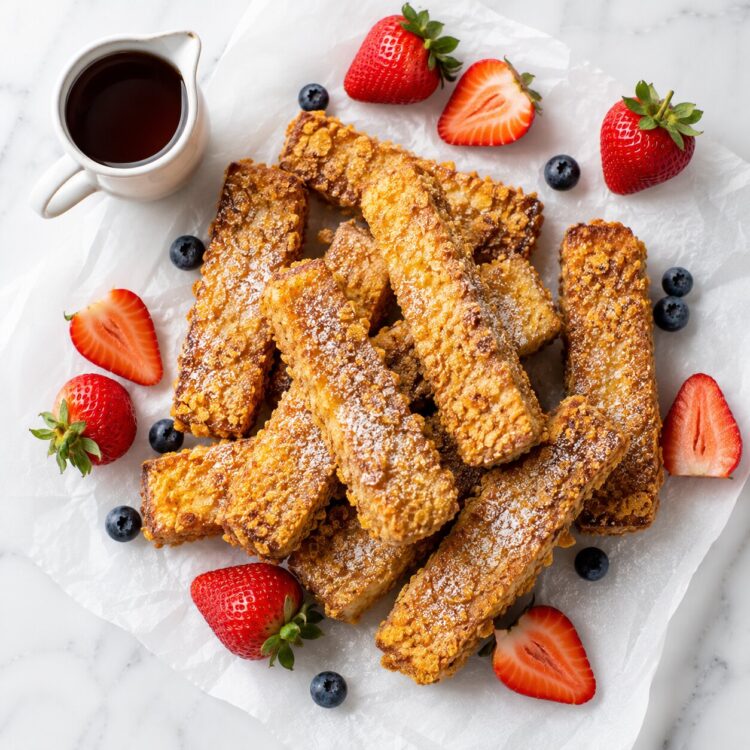
Crushed cornflakes applied to the outside of the custard-soaked sticks before freezing create a thin, crispy coating that sets around the exterior during air frying. The result is French toast sticks with a distinct crunch layer on the outside — a textural contrast that makes each bite significantly more interesting than the uniformly soft texture of plain French toast.
The cornflakes also slightly seal the custard within the bread during the freezing and cooking process, helping the interior stay moist while the exterior crisps.
How to crush cornflakes: Measure 2 cups of cornflakes into a zip-lock bag and roll with a rolling pin until mostly fine crumbs with some larger pieces remaining. The uneven texture of hand-crushed cornflakes (as opposed to completely uniform fine crumbs) produces more textural interest in the finished crust. Do not use a food processor — it produces too-fine crumbs that lose the textural benefit.
Complete Ingredients List (Makes 18 Sticks — Serves 6)
- 6 slices day-old Texas toast (or thick-cut brioche, challah, or country white)
- 4 large eggs, room temperature
- 1 cup 2% milk (whole milk, buttermilk, or oat milk also work)
- 2 tablespoons granulated sugar
- 1 teaspoon pure vanilla extract
- ¼ to ½ teaspoon ground cinnamon
- 2 cups crushed cornflakes (optional but highly recommended)
- Cooking spray (for the pan and air fryer basket)
- Confectioners’ (powdered) sugar — for serving, optional
- Real maple syrup — for dipping; use 100% pure maple syrup
Step-by-Step: How to Make Air Fryer French Toast Sticks
Step 1 — Prepare the Bread
Using a sharp serrated bread knife, cut each slice of Texas toast into thirds lengthwise. This produces three sticks approximately 1.25 inches wide from each slice — 18 sticks total. Cut cleanly without pressing down on the bread, which would compress the structure and reduce the custard capacity.
Arrange all the cut sticks in a single layer in an ungreased 13×9-inch baking dish. It is fine if they are snug — you will be soaking them all in the same custard.
Step 2 — Make the Custard
In a large mixing bowl, whisk together the eggs until completely uniform with no streaks of egg white remaining. Add the milk, sugar, vanilla extract, and cinnamon. Whisk until the mixture is smooth and all the sugar has dissolved. Under-whisked custard leaves egg white streaks that cook unevenly on the bread surface.
Step 3 — Soak the Bread (2 Minutes)
Pour the custard evenly over the bread sticks in the dish. Press gently on any sticks that are not immediately submerged to ensure all surfaces contact the custard.
Set a timer for 2 minutes. At the 1-minute mark, carefully turn each stick using tongs or your hands. The sticks should feel noticeably heavier after soaking — they have absorbed a significant amount of custard.
The 2-minute rule is calibrated. Less than 2 minutes and the sticks do not absorb enough custard — the interior will be underdone and slightly dry in the centre after cooking. More than 2-3 minutes and the bread begins to over-soften and may break apart when handled. The turn halfway through ensures even absorption on both sides.
After 2 minutes, allow the sticks to rest for 30 seconds to let excess custard drip back into the dish. Do not pour the excess custard away — if any sticks look dry, give them another 30 seconds of soaking.
Step 4 — Apply the Cornflake Coating (Optional)
If using the cornflake coating, place the crushed cornflakes in a shallow bowl or plate. Pick up each soaked stick and press it gently into the cornflakes, turning to coat all four sides. Press gently rather than firmly — you want the crumbs to adhere without crushing the soaked bread.
Place each coated stick on a greased 15×10×1-inch rimmed baking pan, spacing them apart so they do not touch.
Step 5 — Freeze Until Solid
Place the baking pan with the arranged sticks in the freezer uncovered. Freeze for approximately 45 minutes — until the sticks are completely solid and firm to the touch.
This initial freeze-on-the-pan step is critical. If you skip it and go directly to bagging, the soft, custard-soaked sticks will stick together in the bag, lose their shape, and be impossible to separate for individual cooking later. The individual freeze ensures each stick remains a distinct, separate piece that can be pulled out of the bag in any quantity.
How to tell they are ready: Press a finger gently on the surface of one stick. It should feel completely firm and solid — no give at all. If there is any softness, leave them for another 10-15 minutes.
Step 6 — Transfer to Freezer Storage
Once completely frozen solid, remove the sticks from the baking pan and transfer to an airtight freezer container or a large zip-lock freezer bag. Press out as much air as possible before sealing. Label with the date.
Storage time: The French toast sticks keep in the freezer for up to 6 weeks at optimal quality; they are food-safe for up to 3 months but may develop slight freezer burn on the cornflake coating after this point.
Step 7 — Cook When Ready (From Frozen)
This is the step that makes the entire recipe so practical. No thawing required.
Preheat your air fryer to 350°F (175°C) for 3 minutes. Spray the air fryer basket or tray lightly with cooking spray. Remove the desired number of sticks from the freezer bag — typically 3 per person as a full serving — and arrange in a single layer in the basket with space between each stick.
Do not overlap the sticks. A single layer is essential for the air fryer’s circulating hot air to reach all surfaces and produce even crisping. Stacked or touching sticks will steam against each other at the contact points rather than crisping.
Cook at 350°F for 3 minutes. Open the air fryer and carefully flip each stick using tongs. Continue cooking for another 2-3 minutes until the sticks are deeply golden brown on both sides and the cornflake coating (if using) has developed a visible, crunchy crust.
Total cooking time from frozen: 5-6 minutes. Extraordinary for a genuinely satisfying hot breakfast.
Step 8 — Serve
Remove from the air fryer and arrange on a plate. If using, dust generously with confectioners’ sugar immediately — it melts slightly on the warm surface and creates a beautiful, slightly sweet glaze. Pour maple syrup into a small dipping bowl alongside.
Serve immediately. These are at their best in the first 2-3 minutes after cooking.
Flavour Variations: Upgrade the Classic
Brown Sugar and Cardamom
Replace the granulated sugar with an equal amount of brown sugar in the custard, and substitute the cinnamon with ¼ teaspoon of ground cardamom plus ¼ teaspoon of cinnamon. The brown sugar adds a molasses depth, and the cardamom brings a floral, warmly aromatic character that makes these sticks feel distinctly more sophisticated. Particularly beautiful with a drizzle of honey rather than maple syrup.
Peanut Butter and Jelly Version
After air frying, spread a thin layer of peanut butter on one side of three sticks and a thin smear of strawberry jam on three more. Press each peanut butter stick face-to-face with a jelly stick. This PB&J French toast stick sandwich is an inspired option for children’s lunches and snacks.
Nutella and Banana
After cooking, spread a thin layer of Nutella on the warm sticks and top with thinly sliced banana before serving. The warmth of the just-cooked stick slightly melts the Nutella. For a weekend brunch presentation, this version is hard to surpass.
Savoury Ham and Cheese
Skip the cinnamon, vanilla, and sugar in the custard. Add ¼ teaspoon of garlic powder, a pinch of cayenne, salt, and black pepper instead. After the custard soak, press a thin strip of thinly sliced ham and a small piece of cheese onto one side of each stick before coating in the cornflakes. Air fry as normal. This savoury version is excellent for adults and children who prefer a less sweet morning meal.
Orange Zest and Vanilla
Add the finely grated zest of one orange to the custard alongside the vanilla and cinnamon. The citrus oil in the zest permeates the custard with a bright, floral orange note that makes these sticks taste more complex and more interesting than the standard version. Serve with orange marmalade alongside the maple syrup.
What to Serve With French Toast Sticks
Classic:
- Pure maple syrup — the essential accompaniment; never corn syrup
- Powdered sugar dusted directly on the warm sticks
- Fresh berries — strawberries, blueberries, or raspberries alongside provide acidity and freshness
More substantial breakfasts:
- Scrambled eggs — the sweet sticks and savoury eggs complement each other
- Crispy bacon — the salty contrast against sweet French toast is a classic American pairing
- Breakfast sausage links or patties
Fun dipping options:
- Warm fruit compote (blueberry, peach, or mixed berry)
- Cream cheese dip (cream cheese beaten with a little powdered sugar and vanilla)
- Chocolate sauce — for a more indulgent, dessert-leaning version
- Greek yogurt with honey — for a protein-balanced option
Reheating Options (For Leftover Cooked Sticks)
If you have cooked more than needed and have leftover sticks (fully cooked, cooled):
Air fryer (best): 350°F for 2-3 minutes — restores most of the crispness. Oven: 375°F for 5-7 minutes on a wire rack — good crispness restoration. Microwave: 45-60 seconds — convenient but produces soft exterior rather than crispy.
Store leftover cooked sticks in an airtight container in the refrigerator for up to 3 days.
Nutrition Information (Per Serving — 3 Sticks)
| Nutrient | Amount |
|---|---|
| Calories | 184 kcal |
| Fat | 6g |
| Saturated Fat | 2g |
| Cholesterol | 128mg |
| Sodium | 253mg |
| Carbohydrates | 24g |
| Fiber | 1g |
| Sugar | 8g |
| Protein | 8g |
At 184 calories per 3-stick serving with 8 grams of protein, these are a nutritionally balanced breakfast option — particularly compared to store-bought frozen versions which often run 220-280 calories for a similar serving size with less protein and more sodium from preservatives.
Expert Tips for the Best Results Every Time
Day-old bread is genuinely important. If your Texas toast is fresh, leave the slices uncovered on a wire rack for 30-60 minutes before cutting and soaking. The drier the bread, the more custard it can absorb, and the more flavourful the interior.
Whisk the custard completely smooth. Egg white streaks in the custard cook unevenly, creating pale, slightly rubbery patches on the bread surface. Whisk until the mixture is completely uniform before pouring.
Turn the sticks at the 1-minute mark during soaking. Both sides need full custard contact. The bottom surface soaking against the dish has full contact immediately; the top surface needs the turn to achieve the same level of absorption.
Do not skip the individual freeze before bagging. This single step determines whether you have individually accessible sticks from the freezer or a single solid frozen mass that cannot be separated without breaking.
Single layer in the air fryer, always. This is more important for French toast sticks than for most air fryer foods — because the sticks are wet and soft when they come out of the freezer, they need maximum airflow to crisp rather than simply steaming in a pile.
Flip at the 3-minute mark. Do not cook continuously for the full 5-6 minutes without flipping. The flip ensures both sides achieve the same golden colour and crunchy texture.
Frequently Asked Questions
Q1. Can I cook these French toast sticks without freezing them first?
The recipe is specifically designed to be frozen before cooking — the freezing step sets the structure and allows the custard inside to gradually reheat during air frying for the best interior texture. However, if you want to skip freezing and cook immediately, air fry the fresh, uncooked sticks at 325°F (a slightly lower temperature to avoid overcooking the exterior before the interior sets) for 4-5 minutes per side. The result will be excellent but the custard interior will be softer than the frozen-to-fryer version.
Q2. Can I use a regular oven if I do not have an air fryer?
Yes — the original version of this recipe is an oven-baked method. Preheat to 425°F (220°C). Place the frozen sticks in a single layer on a greased rimmed baking sheet. Bake for 8 minutes, flip, then bake for another 6-8 minutes until golden. The oven produces excellent results — slightly less crispy on the cornflake exterior than the air fryer, but beautifully golden and equally delicious. The oven method has the advantage of larger batch size.
Q3. How long do these French toast sticks last in the freezer?
At best quality, they keep for 6 weeks. They are food-safe for up to 3 months in a properly sealed freezer bag with the air pressed out, but the cornflake coating may develop slight freezer burn after 6 weeks. For most practical purposes, a batch made on Sunday produces enough for 2-3 weeks of weekday breakfasts for a household of four, which falls well within the optimal quality window.
Q4. What bread works best if I cannot find Texas toast?
In order of preference: (1) Brioche — slightly sweeter, tender, excellent custard absorption; (2) Challah — eggy, rich, produces the most flavourful interior; (3) Thick-cut country white bread from an artisan bakery; (4) French bread cut into thick diagonal slices. Standard sandwich bread is the last resort — cut it into broader strips to compensate for the thinner slices, and reduce the soak time to 90 seconds to prevent over-softening.
Q5. Can I make these French toast sticks without eggs for an egg-free version?
Yes, with a substitution. Replace the 4 eggs with a combination of ½ cup of full-fat coconut milk (for richness), 3 tablespoons of cornstarch (for binding), and an extra tablespoon of sugar (to compensate for the richness eggs add). The result will not be quite as custardy as the egg version, but it is very good — and genuinely egg-free. The cornflake coating becomes even more important in this version to add textural interest that the less-eggy interior does not fully provide on its own.
Make It This Weekend, Eat It All Week
The most valuable thing a breakfast recipe can offer is not just great flavour on the day you make it — it is the ability to extend that effort across an entire week of mornings that would otherwise be chaotic or unsatisfying.
Air Fryer French Toast Sticks do exactly that. One batch, made on a weekend afternoon in less than an hour of active time, produces eighteen individual sticks that can be cooked from frozen in six minutes on any morning that needs them. That is a week of genuinely good breakfasts from a single cooking session.
Make a double batch while you are at it. Eighteen sticks disappear faster than expected.
Try this recipe and tell us how it went in the comments below! Which bread did you use, whether you went with the cornflake coating, and what your household’s preferred dipping sauce turned out to be. And if you found a flavour variation that deserves a permanent place in your freezer rotation — we want to hear that too.
Pairs perfectly with: Pure Maple Syrup | Fresh Berries | Scrambled Eggs | Crispy Bacon | Fruit Compote | Greek Yogurt with Honey
Also explore: Air Fryer Breakfast Egg Rolls | Air Fryer Chicken Strips | Cheesy Breakfast Casserole | Air Fryer Banana Bread