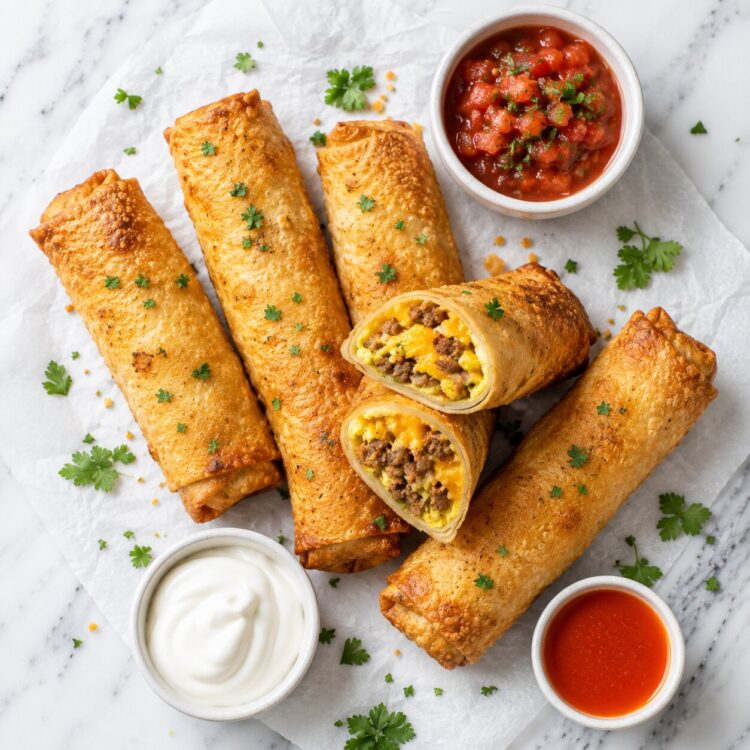
There is a version of breakfast that does not require sitting down, does not need a fork, and can be grabbed from the freezer at 6 AM and eaten on the way out the door — and it is still genuinely, properly good.
Cheesy Breakfast Egg Rolls are that version.
Inside every crispy, golden wrapper: scrambled eggs, crumbled breakfast sausage, sautéed bell peppers and onions, and a generous amount of melted cheddar cheese. The egg roll wrapper crisps in the oven or air fryer into something that crackles when you bite through it, giving way to a warm, savoury, fully satisfying breakfast filling that tastes like the best parts of a diner breakfast plate — all wrapped into a portable, handheld format that works just as well for a leisurely weekend brunch as it does for a Wednesday morning when everyone needs to leave in fifteen minutes.
These are also one of the most effective meal prep breakfasts available. Make a full batch, freeze them individually, and reheat in the toaster oven or air fryer as needed. Eight perfectly crispy, genuinely satisfying breakfast egg rolls from the freezer — done in ten minutes — is a category of weekday morning that most households need and almost nobody has figured out until they make this recipe.
This guide gives you the complete recipe, a detailed rolling technique with troubleshooting for every common problem, full instructions for both baking and air frying methods, the complete make-ahead and freezing strategy, and five variations worth trying.
Why Breakfast Egg Rolls Work So Well as a Concept
Before the recipe, it is worth understanding why this particular combination of format and filling produces such a consistently good result — because it is not immediately obvious why an Asian wrapper format works so well with American breakfast ingredients.
The Egg Roll Wrapper Is the Perfect Breakfast Vessel
Traditional breakfast sandwiches use bread: English muffins, biscuits, bagels, croissants. All of them share the same inherent problem: bread absorbs moisture from the filling and becomes soggy, particularly when reheated after freezing.
Egg roll wrappers are made from wheat flour with a higher gluten structure and thinner profile than bread. When baked or air fried, they crisp into a brittle, crackling shell that does not absorb moisture — it seals the filling inside. Even reheated from frozen, they retain significantly more crispness than any bread-based breakfast sandwich.
This is why frozen egg rolls from a restaurant taste better reheated than a frozen English muffin sandwich: the wrapper maintains its structure in ways that bread simply cannot.
The Filling Is Complete and Balanced
The filling in this recipe is a complete breakfast in miniaturised form: protein (eggs and sausage), vegetables (bell pepper and onion), fat and calcium (cheddar cheese). Everything is fully cooked before wrapping, which means the only thing the oven or air fryer needs to do is crisp the exterior — there is no risk of raw filling, and the texture of each component is controlled entirely before it ever goes near the heat.
The Portability Factor
The closed, sealed format of an egg roll means the filling cannot fall out — a significant practical advantage over every open-faced breakfast option. This makes them genuinely portable in a way that most breakfast foods are not: they can be eaten with one hand, wrapped in a napkin, standing over the kitchen counter, or in a car without consequences.
Ingredients: Everything You Need for 8 Egg Rolls
The Filling
1 pound pork breakfast sausage — the classic choice; the fat content of breakfast sausage seasons the filling and lubricates the scrambled eggs as they cook together. Turkey sausage works as a lower-fat alternative; vegetarian crumbles work for a meat-free version. Whatever protein you choose, it must be fully cooked and crumbled before going into the filling.
6 large eggs — scrambled into soft, large curds that hold their shape within the filling. The key word is soft — the eggs continue cooking slightly when the egg rolls go into the oven, so leaving them slightly underdone at the scrambling stage is intentional and important.
½ cup diced bell pepper — any colour works. Red bell pepper is slightly sweeter and produces more visual appeal in the finished cross-section; green is more assertive and slightly bitter. The dice should be small — 1cm or less — so the pieces distribute evenly through the filling and do not create large gaps in the rolled wrapper.
¼ cup diced white onion — white onion is more pungent than yellow onion when raw and slightly sharper when cooked; it adds a savoury note that yellow onion does not quite replicate. Green onions (scallions) are an excellent alternative that cook in seconds and add a fresher, lighter note.
1 cup shredded sharp cheddar cheese — sharp cheddar has more pronounced flavour than mild and holds up better in a filling that has been seasoned with sausage and pepper. Freshly shredded from a block melts more smoothly than pre-shredded (which contains anti-caking agents that inhibit melting). See cheese variation options below.
Salt and black pepper — to taste; since breakfast sausage is usually pre-seasoned, taste before adding salt.
The Wrapper
8 egg roll wrappers — found in the refrigerated produce section or Asian foods aisle of most supermarkets, and at any Asian grocery store. Wonton wrappers are smaller but can be used in a pinch (you will get smaller egg rolls or need to overlap two). Rice paper spring roll wrappers are a gluten-free alternative but produce a different texture — they do not crisp the same way.
For Assembly and Cooking
1 tablespoon water — mixed with a teaspoon to create a sealing paste for the wrapper edges Cooking spray or light oil brush — for the exterior of the finished rolls before baking or air frying
Optional Additions (Highly Recommended)
- Hot sauce — a few drops mixed into the egg scramble adds warmth that complements the sausage
- Diced jalapeños — for heat; add to the skillet with the bell pepper
- Sun-dried tomatoes — finely chopped; adds a concentrated umami sweetness
- Baby spinach — a handful stirred into the warm scramble wilts in 30 seconds and adds iron and colour
The Rolling Technique: Step-by-Step With Visual Cues
Rolling egg rolls is the step that most first-time makers find intimidating. It should not be — once you have done two or three, the process becomes mechanical and fast. Here is every detail you need.
Stage 1 — Cook the Filling
Brown the sausage first. Heat a large non-stick skillet over medium-high heat. Add the sausage and cook, breaking into small crumbles with a spatula, for 6-8 minutes until fully cooked and no pink remains. Remove the sausage to a plate, leaving the rendered fat in the pan.
Sauté the vegetables in the sausage fat. Add the diced bell pepper and onion to the same skillet over medium heat. Cook for 3-4 minutes until softened and the onion is translucent. The sausage fat seasons the vegetables as they cook — do not discard it.
Why use the sausage fat? This is the simple technique that makes the vegetable component of the filling taste deeply savoury rather than simply cooked. The fat carries the flavour compounds from the browned sausage directly into the vegetables.
Scramble the eggs softly. Crack the eggs into a bowl, season with salt and pepper, and whisk until completely uniform. Pour into the skillet with the cooked vegetables. Cook over medium-low heat, stirring slowly with a spatula, pulling the eggs from the edges into the centre. Remove from heat when the eggs are about 80% set — still visibly soft and slightly wet in places. They will finish cooking in the oven or air fryer.
Combine and cool. Return the cooked sausage crumbles to the skillet and fold everything together. Spread the filling on a plate or baking sheet and allow to cool for 10-15 minutes before assembling. Hot filling makes the wrappers soggy and difficult to roll cleanly. This cooling step is not optional if you want properly crisp egg rolls.
Stage 2 — Assemble the Egg Rolls
Set up your workspace: egg roll wrappers, the cooled filling, shredded cheddar cheese, a small bowl of water, and a clean lined baking sheet for the finished rolls.
Orientation is important. Place one wrapper on the work surface with one corner pointing toward you — like a diamond, not a square. This orientation allows the rolling to proceed from the corner closest to you, which produces the most secure seal.
Fill with restraint. Place approximately 3 tablespoons of the egg-sausage filling horizontally across the centre of the wrapper, leaving at least 1.5 inches clear on the left and right sides. Top with 2 tablespoons of shredded cheddar. Do not overfill — this is the number one cause of egg rolls that split during cooking.
Fold the sides first. Take the left edge of the wrapper and fold it over the filling, pressing gently to squeeze out any air pockets. Repeat with the right edge. The wrapper should now look like an open envelope, with the filling contained and the top corner still pointing away from you.
Roll firmly upward. Take the bottom corner (the one closest to you) and fold it up and over the filling, tucking it firmly underneath the filling as you roll. Continue rolling upward toward the far corner, keeping tension in the roll. The roll should feel tight — not so tight it tears, but not loosely packed.
Seal the final corner. Dab a small amount of water on the top corner of the wrapper with your finger. Press the dampened corner firmly against the roll to seal. The water-activated starch in the wrapper creates a strong bond when pressed. Hold for 3-4 seconds.
Place the sealed roll seam-side down on the prepared baking sheet. This downward placement of the seam means gravity and the weight of the roll press the seal closed during cooking rather than pulling it open.
Stage 3 — Brush with Oil and Cook
Lightly spray or brush all surfaces of each assembled egg roll with cooking oil. This step is what produces the golden, uniformly crisp exterior — without it, the wrapper will dry out and become papery rather than properly crisping.
Oven Method (Baking):
Preheat oven to 425°F (220°C). Arrange egg rolls seam-side down on a parchment-lined baking sheet with space between each. Bake for 10-15 minutes until deeply golden brown and crispy on all visible surfaces.
For extra even browning: flip the egg rolls at the 7-minute mark and brush the newly exposed surfaces with additional oil.
Air Fryer Method:
Preheat air fryer to 390°F (200°C) for 3 minutes. Arrange egg rolls seam-side down in a single layer in the basket with space between each — do not stack. Air fry for 8-10 minutes until golden and crispy. No need to flip, though turning at the 5-minute mark can produce more even browning on all sides.
Air fryer advantage: The air fryer produces slightly more uniform crispness on all surfaces (because the circulating air reaches the underside as well as the top) and takes 3-5 minutes less time than the oven. The oven advantage is batch size — a sheet pan can hold 8 egg rolls simultaneously; most air fryer baskets hold 4 maximum.
Make-Ahead and Freezing: The Real Power of This Recipe
This is the section that transforms this from a weekend recipe into a weekday life-changer.
Freezing Assembled, Uncooked Egg Rolls
- Assemble all 8 egg rolls through the oiling step
- Place on a parchment-lined baking sheet without touching
- Freeze uncovered for 2 hours until completely solid
- Transfer to a zip-lock freezer bag and press out excess air
- Label with the date — keeps up to 3 months
Cooking from frozen: No thawing required.
- Oven: 425°F for 18-20 minutes from frozen
- Air fryer: 390°F for 12-15 minutes from frozen
The frozen-to-oven method actually produces outstanding results — because the filling is cold when it enters the oven, the wrapper has extra time to crisp before the interior begins steaming, producing a slightly crisper shell than a fresh egg roll.
Freezing Cooked Egg Rolls
- Bake or air fry all 8 egg rolls until fully cooked
- Cool completely on a wire rack — at least 30 minutes
- Wrap each individually in cling film or foil
- Transfer to a freezer bag, press out air, and freeze up to 3 months
Reheating cooked frozen egg rolls:
- Air fryer (best method): 390°F for 6-8 minutes from frozen — the crispness comes back almost completely
- Oven: 375°F for 12-15 minutes from frozen, uncovered
- Microwave (quick but soft): 60-90 seconds, which is acceptable for a Monday morning when time is the priority
The Weekly Meal Prep Strategy
Make a double batch on Sunday: 16 egg rolls. Keep 4 in the refrigerator for Mon-Wed (they reheat beautifully in the air fryer for 3-4 minutes at 350°F). Freeze 12 for the rest of the week and the following week. This single cooking session produces approximately two full weeks of grab-and-go breakfasts.
6 Filling Variations Worth Making
Variation 1 — Bacon and Cheese
Replace the pork sausage with 6 strips of crispy cooked bacon, crumbled. The sharper, smokier flavour of bacon versus sausage changes the character significantly — this variation is popular with people who find breakfast sausage too rich.
Variation 2 — Vegetarian Spinach and Mushroom
Replace sausage with 1 cup of diced mushrooms sautéed until golden, and add a large handful of baby spinach to the egg mixture. Use a combination of mozzarella and parmesan in place of cheddar. The umami depth of the mushrooms compensates for the absence of meat.
Variation 3 — Southwest Style
Add 2 tablespoons of drained, rinsed black beans, ¼ cup of corn, and 1 tablespoon of diced jalapeño to the filling. Use pepper jack cheese instead of cheddar. Serve with salsa and sour cream for dipping.
Variation 4 — Smoked Salmon and Cream Cheese
This elevated, no-cook filling requires no skillet time: spread a thin layer of cream cheese on each wrapper, top with 2 tablespoons of flaked smoked salmon, capers, diced red onion, and fresh dill. Roll and air fry at 350°F for 6-8 minutes. Serve with a squeeze of lemon. This is the brunch-party version.
Variation 5 — Buffalo Chicken Breakfast
Replace sausage with shredded rotisserie chicken tossed in 1 tablespoon of buffalo sauce. Use blue cheese or ranch crumbled over the filling instead of cheddar. Air fry to a deep golden brown. For anyone who already loves buffalo chicken for dinner — this version confirms you can have it for breakfast.
Variation 6 — Indian-Spiced Egg and Potato
Replace sausage and bell pepper with a spiced potato filling: diced boiled potato sautéed with cumin seeds, turmeric, green chili, ginger, and coriander. Swap cheddar for crumbled paneer. Serve with mint chutney. This version is genuinely extraordinary and appeals to anyone who loves masala dosa or samosa flavours in a portable format.
Dipping Sauce Guide
The right dipping sauce elevates breakfast egg rolls from convenient to genuinely special:
- Salsa — the default and the right choice for the Southwest filling; also works beautifully with the classic recipe
- Sour cream — cooling, rich, balances the sausage’s fat; a small dollop on the plate works better than dipping
- Hot sauce — Tabasco, sriracha, or Frank’s RedHot alongside the classic filling for those who want heat
- Ranch dressing — quintessentially American; the herby, creamy character works with every variation
- Honey mustard — the sweetness plays against the savoury sausage and cheese in a genuinely pleasurable way
- Sriracha mayo — 2 tablespoons mayo + 1 tablespoon sriracha; the fastest, most versatile sauce in the arsenal
Expert Tips for Consistently Perfect Results
Let the filling cool before rolling. Hot, steaming filling condenses inside the wrapper and creates moisture that prevents the outer shell from crisping. Even 10 minutes of cooling makes a meaningful difference. Spread the filling on a plate to cool faster.
Do not overfill. Three tablespoons of filling per wrapper is the maximum. Overfilled egg rolls split at the seam during cooking, releasing the filling and losing the structural integrity that makes these worth making.
Diamond orientation, not square. Always place the wrapper with a corner toward you, not an edge. This is how proper egg roll rolling works — the corner-forward start allows a complete, secure tuck before rolling.
Seal with water, press for 3-4 seconds. A quick dab and press is not enough. Water-activated starch bonds require sustained pressure to set. Hold for a full three count.
Always place seam-side down. This is a small detail that makes a real difference — gravity plus the weight of the roll presses the seal closed during cooking rather than allowing it to open.
Brush oil generously and evenly. Every surface of the wrapper needs oil for proper crisping. Dry spots produce pale, tough, slightly papery patches rather than golden crust.
Nutrition Information (Per Egg Roll, Approximate)
| Nutrient | Amount |
|---|---|
| Calories | ~245 kcal |
| Protein | 14g |
| Fat | 14g |
| Saturated Fat | 6g |
| Carbohydrates | 15g |
| Fiber | 1g |
| Sugar | 1g |
| Sodium | ~520mg |
| Calcium | ~150mg |
For a lighter version: Use turkey breakfast sausage (reduces fat by approximately 4-5g per egg roll), reduced-fat cheddar, and 3 whole eggs + 3 egg whites in place of 6 whole eggs. Total calorie reduction: approximately 60-70 kcal per egg roll.
Frequently Asked Questions
Q1. Can I prepare breakfast egg rolls the night before?
Yes — in two ways. First, you can make the filling completely the night before, refrigerate it covered, and assemble and cook fresh in the morning. Second, you can assemble the complete egg rolls the night before, refrigerate them uncovered on a baking sheet (this dries the wrapper surface slightly and actually improves crispness), and bake or air fry directly from the refrigerator in the morning — add 2-3 minutes to the cook time to compensate for the cold start. Both approaches work very well.
Q2. Why do my egg rolls keep splitting open during cooking?
Three causes: overfilling (the most common — more than 3 tablespoons of filling puts too much pressure on the wrapper); insufficient water seal (press the dampened corner firmly for at least 3-4 seconds rather than a quick press); or placing seam-side up rather than seam-side down (gravity works against you). Address all three and splitting becomes very rare.
Q3. Can I deep fry breakfast egg rolls instead of baking them?
Yes. Heat 2-3 cups of neutral oil to 350°F (175°C) in a heavy-bottomed pot. Fry 2-3 egg rolls at a time, turning occasionally, for 3-4 minutes until golden brown on all sides. Drain on paper towels. Deep frying produces the crispiest possible shell — crispier than either oven or air fryer — but adds approximately 80-100 calories per egg roll and requires oil management and disposal.
Q4. Where do I find egg roll wrappers in the grocery store?
Egg roll wrappers are almost always in the refrigerated section of the produce aisle, sometimes near the tofu or fresh pasta. Alternatively, check the Asian foods aisle if your store has one. Any Asian grocery store carries them year-round. If completely unavailable, large flour tortillas can be used as a substitute — the texture will be softer and less crispy, but the overall concept works.
Q5. How long do breakfast egg rolls keep in the freezer?
Both cooked and uncooked (assembled) breakfast egg rolls keep in the freezer for up to 3 months when properly wrapped and sealed. After 3 months, they are still food-safe but may develop slight freezer burn on the wrapper surface. For the best quality, aim to consume within 6 weeks of freezing, though the 3-month window works well for batch-cooking purposes.
The Breakfast You Make Once and Eat All Week
The highest compliment a recipe can receive is that it genuinely changes how a household eats — not because it is the most ambitious or the most impressive thing you have ever made, but because it solves a real, recurring daily problem in a way that actually tastes good.
Breakfast Egg Rolls solve the morning meal problem. They are quick enough to make fresh, smart enough to freeze in bulk, portable enough to eat on the way anywhere, and satisfying enough that they actually carry people through the morning rather than leaving them hungry by 10 AM.
Make a double batch this Sunday. Freeze ten of them. Eat the other six through the week. See how different Monday morning feels when breakfast is done in eight minutes and tastes like something you actually wanted.
Try this recipe and share your results in the comments below! Tell us which filling variation you tried, which dipping sauce won, and whether the freezer-to-air-fryer method made your weekday mornings noticeably easier. Your experience helps other home cooks figure out what works — and we read every comment.
Pairs perfectly with: Salsa | Sour Cream | Hot Sauce | Ranch Dressing | Fresh Fruit | Coffee or Orange Juice
Also explore: Air Fryer Chicken Strips | Cheesy Breakfast Casserole | Make-Ahead Breakfast Burritos | Air Fryer Breakfast Potatoes