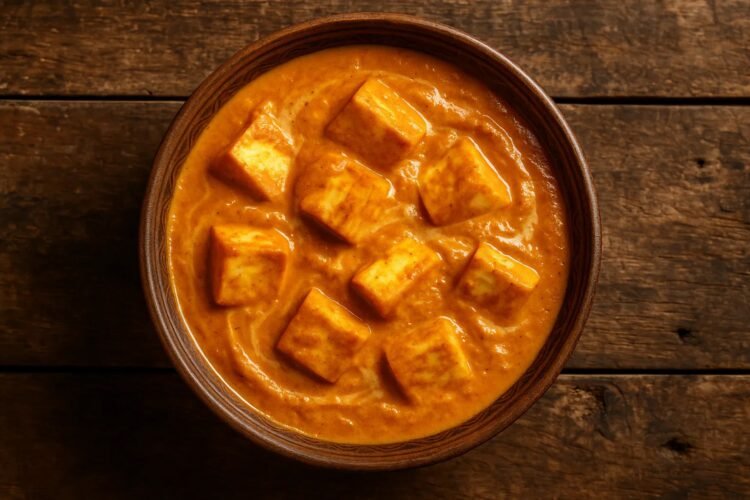
Most people who love Indian restaurant food know paneer butter masala, palak paneer, and paneer tikka masala by heart. What far fewer people have made at home — despite ordering it regularly — is paneer lababdar.
The name itself is evocative. Lababdar comes from an Urdu root that broadly translates to intense desire or deeply craved. It is a name that fits: this is an indulgent, unapologetically rich dish with layered spice character and a gravy that clings to every piece of paneer in a way that makes it genuinely hard to stop eating.
What makes it distinct from every other paneer curry you have made? Two things: the whole Kashmiri dried chillies simmered directly into the tomato base (not a powder added later), and the technique of using grated paneer in addition to cubed pieces — the grated paneer dissolves into the sauce, enriching its body and creating a creamy thickness that no amount of added cream can replicate on its own.
This recipe replicates the restaurant method faithfully and explains every technical step so the result is consistent from the first attempt.
What Is Paneer Lababdar?
Paneer lababdar is a Punjabi restaurant curry — richer and more spiced than paneer makhani, slightly coarser in texture than paneer butter masala, and more complex in spice architecture than either. It is a staple of North Indian restaurant menus but less commonly made at home, which makes it one of the more rewarding dishes to master.
Three elements define its character:
- Whole spices simmered into the tomato base — cardamom, cloves, cinnamon, and dried red chillies are cooked directly with the tomatoes and cashews, infusing the puree with flavour compounds that ground spices added later cannot achieve
- Grated paneer in the gravy — in addition to cubed paneer pieces, grated paneer is stirred in and partially dissolves, adding a natural, protein-rich creaminess to the sauce
- Slightly textured gravy — unlike paneer butter masala (fully blended, strained smooth), lababdar keeps finely chopped onions in the base, giving the sauce a subtly coarser character that feels more robust
Paneer Lababdar vs Paneer Butter Masala vs Paneer Makhani
Understanding the differences makes choosing between them — and making each correctly — far more intentional.
| Feature | Paneer Lababdar | Paneer Butter Masala | Paneer Makhani |
|---|---|---|---|
| Onion in gravy | Yes (finely chopped) | Yes (pureed/strained) | No onion traditionally |
| Gravy texture | Slightly textured | Silky smooth (strained) | Silky smooth |
| Paneer form | Cubed + grated | Cubed only | Cubed only |
| Spice character | Bold — whole chillies, garam masala | Mild — Kashmiri powder | Mildest — minimal ground spice |
| Chilli form | Whole dried Kashmiri chillies in base | Kashmiri chilli powder | Minimal chilli |
| Richness | High (cashews + cream) | High (cashews + cream) | Highest (butter dominant) |
| Cooking time | 30 minutes | 45 minutes | 45-50 minutes |
| Complexity | Intermediate | Intermediate | Intermediate |
If you enjoy a curry with more spice depth and body than butter masala but without the intensity of a tikka masala, lababdar is exactly the right dish.
Ingredients (Serves 4)
For the Tomato-Cashew Base (Blended)
| Ingredient | Amount | Notes |
|---|---|---|
| Tomatoes, chopped | 350g / 2 cups | About 3 large ripe tomatoes |
| Cashews | 15 whole | Or skinned almonds for a nuttier flavour |
| Dried Kashmiri red chillies | 4 | Byadgi chillies also work; both are mild with deep colour |
| Green cardamom pods | 4 | |
| Cloves | 4 | |
| Cinnamon stick | 2-inch piece | Use 1-inch if using stronger cassia bark |
| Water | ½ cup | For simmering the base |
For the Gravy
| Ingredient | Amount | Notes |
|---|---|---|
| Oil | 2 tbsp | Or ghee for richer flavour |
| Bay leaf | 1 | |
| Onion, very finely chopped | ½ cup / 1 medium | Fine chop is essential — coarse pieces ruin the texture |
| Ginger-garlic paste | 1 tbsp | Or ½-inch ginger + 3 garlic cloves ground together |
| Kashmiri red chilli powder | ½ tsp | For additional colour |
| Coriander powder | 1¼ tsp | Earthy base note |
| Garam masala | ½ tsp | Added during cooking, not just at finish |
| Salt | ¾ tsp | Adjust to taste |
| Water | ¾ to 1 cup | For consistency adjustment |
| Sugar | ¾ tsp | Balances tomato acidity |
| Green chilli | 1, slit | Adds fresh heat alongside the dried chilli depth |
For Finishing
| Ingredient | Amount | Notes |
|---|---|---|
| Paneer, cubed | 200g | ¾-inch cubes; raw, not fried |
| Paneer, grated | 3-4 tbsp | The defining technique of lababdar — do not skip |
| Kasuri methi | ½ to ¾ tsp | Crush between palms before adding |
| Heavy cream | 2-3 tbsp | Stir in off heat |
| Fresh coriander | 2 tbsp, chopped | Garnish |
The Key Techniques Explained
Why Whole Dried Chillies in the Tomato Base?
Adding whole Kashmiri dried chillies directly to the simmering tomato base extracts their colour and flavour compounds into the liquid over a sustained, gentle heat. This is fundamentally different from stirring Kashmiri chilli powder into cooked onions: the simmering process extracts fat-soluble pigments (carotenoids) and water-soluble flavour compounds simultaneously, producing a depth and complexity that powder added late cannot match.
The result is a gravy that tastes as though it was cooked for much longer than it was.
Why Grated Paneer Changes the Dish
This is the single technique that most distinguishes paneer lababdar from every other paneer curry. When grated paneer is stirred into a hot sauce, it partially dissolves at the edges — the fine strands of protein melt into the liquid and act as a natural thickener and enricher. The effect is a creaminess from within the sauce itself rather than from added dairy.
Restaurants use this technique to build a gravy body that is richer than the quantity of cream alone would suggest. At home, it is as simple as running a block of paneer over a box grater. Use 3-4 tablespoons and stir in with the cubed pieces.
Why the Onion Must Be Very Finely Chopped
Paneer lababdar keeps its onion in the gravy rather than blending it out, which means the size of the onion pieces defines the final texture. Coarsely chopped onion produces a chunky, unrefined sauce. Very finely chopped onion — almost a fine mince — softens and nearly disappears into the sauce during cooking while still providing the flavour base and slight texture that distinguishes lababdar from the blended-and-strained smoothness of butter masala. Take 2-3 extra minutes at the chopping stage; it makes a visible difference in the finished dish.
How to Make Paneer Lababdar: Step-by-Step
Prep time: 15 minutes
Cook time: 25 minutes
Total time: 40 minutes
Serves: 4
Stage 1 — Build and Simmer the Tomato Base (10 minutes)
Combine the chopped tomatoes, cashews, dried Kashmiri chillies, cardamom, cloves, cinnamon, and ½ cup water in a saucepan. Cover and simmer on medium heat for 8-10 minutes, until the tomatoes have fully collapsed and the cashews are soft.
Remove from heat and allow to cool for 10 minutes. Transfer to a blender and blend on high for 90 seconds until completely smooth. If you have a standard blender rather than a high-powered one, strain the puree through a fine-mesh sieve, pressing to extract all liquid — this removes any remaining cashew or chilli skin fragments and produces a smoother gravy.
Stage 2 — Build the Gravy Base (8 minutes)
Heat 2 tbsp oil in a heavy-bottomed pan over medium heat. Add the bay leaf and allow it to sizzle for 20 seconds.
Add the very finely chopped onion. Cook over medium heat for 6-8 minutes, stirring regularly, until the onion is evenly golden brown. This is a critical step — pale onion produces a sharp, raw note in the finished sauce; properly golden onion provides sweetness and depth.
Add the ginger-garlic paste. Stir continuously and cook for 1-2 minutes until the raw, pungent aroma fully fades. Watch carefully — ginger-garlic paste burns quickly, particularly once the onion is golden and the pan is already hot.
Stage 3 — Cook the Spiced Puree (8 minutes)
Pour the tomato-cashew puree into the pan. Add the Kashmiri chilli powder, coriander powder, garam masala, and salt. Stir everything together.
Cook uncovered on medium heat for 2-3 minutes, stirring frequently, until the puree begins to visibly thicken and darken. Then cover and cook for 4-5 minutes more, stirring once or twice. When the oil begins to pool visibly at the edges and surface of the sauce — the bhunno signal — the tomato base is properly cooked through.
Add ¾ cup water and the sugar. Stir and bring to a gentle simmer. Cover and cook on medium-low for 5-6 minutes until the gravy reaches a thick, glossy, spoonable consistency. Taste and adjust salt.
Stage 4 — Finish with Paneer (3 minutes)
Add the slit green chilli. Crush the kasuri methi between your palms and add it — the crushing releases the aromatic oils that give kasuri methi its distinctive herbal character.
Add the cubed paneer and grated paneer together. Stir gently to coat every piece. Cook on very low heat for 1-2 minutes — just enough to warm the paneer through. Do not cook longer; extended heat toughens paneer significantly and the grated paneer will clump rather than dissolve smoothly.
Turn off the heat. Stir in the cream. Cover and allow to rest for 5 minutes — this resting period is not optional. The residual heat finishes integrating the cream and allows the grated paneer to fully dissolve into the sauce, producing the characteristic rich, slightly thick gravy body of a well-made lababdar.
Garnish with fresh coriander and serve immediately.
Instant Pot Paneer Lababdar
- Blend the tomato-cashew base without pre-simmering — simply blend tomatoes, cashews, dried chillies, and whole spices with 2-3 tbsp water until smooth.
- Set Instant Pot to Sauté (Normal). Heat oil, add bay leaf, cook onion to golden, add ginger-garlic paste.
- Add the blended tomato puree, spices, salt, and 1¼ cups water. Stir.
- Cancel Sauté. Seal lid. Set to Pressure Cook High for 3 minutes.
- Allow natural pressure release for 5 minutes, then carefully release remaining pressure.
- Open, set to Sauté (Less), add kasuri methi, cubed paneer, and grated paneer. Cook 1-2 minutes on low.
- Cancel Sauté, stir in cream, cover and rest 5 minutes before serving.
Paneer Lababdar Troubleshooting
| Problem | Cause | Fix |
|---|---|---|
| Gravy too thin/watery | Insufficient simmering; too much water | Simmer uncovered 5 minutes more; remove lid for final stage |
| Gritty or grainy texture | Puree not fully blended or strained | Use high-speed blender; strain through fine-mesh sieve |
| Paneer is tough/rubbery | Cooked too long in sauce | Add off high heat; maximum 2 min on very low only |
| Sauce tastes too sour | Acidic tomatoes; insufficient sugar | Add extra ¼ tsp sugar and a pinch of jaggery |
| Cream splits or grainy | Added on high heat | Always add cream off heat or on very low |
| Bland, flat flavour | Ginger-garlic not cooked through; kasuri methi skipped | Cook paste until raw smell fully gone; always crush and add kasuri methi |
| Grated paneer clumped | Heat too high when added | Turn heat to lowest before adding grated paneer |
Vegan and Dairy-Free Adaptations
For a fully vegan lababdar:
- Replace paneer with extra-firm tofu (press and cube) or chickpeas (1 cup cooked)
- Replace cream with cashew cream (blend soaked cashews with water until completely smooth) — use the same quantity
- Use oil rather than ghee throughout
For a nut-free version:
- Replace cashews with soaked white poppy seeds (khus khus) or soaked white sesame seeds — soak in hot water 30 minutes, drain, blend with the tomato base
Serving Suggestions
| Pairing | Notes |
|---|---|
| Butter naan | The restaurant classic — richness with richness |
| Tandoori roti | Slightly lighter; the char notes complement the spice |
| Laccha paratha | Layered flatbread; ideal for scooping thick gravy |
| Jeera rice | The cumin notes echo the whole spice base of the dish |
| Plain basmati | Works beautifully with a slightly thinner gravy |
| Phulka / chapati | The everyday option; good for a balanced meal |
Make-Ahead and Storage
The tomato-cashew base freezes exceptionally well. Make a double batch, cool completely, and freeze in portions for up to 2 months. When ready to cook, thaw overnight in the refrigerator and proceed from Stage 2. This reduces weeknight cooking time to under 20 minutes.
Refrigerator storage: Store the cooked gravy (without paneer) for up to 2 days. Add fresh paneer when reheating. Paneer stored in gravy overnight can become slightly dense — soak refrigerated paneer cubes in hot water for 10 minutes before serving to restore softness.
Reheating: Warm on medium-low with 2-3 tablespoons of water added. Do not boil — this toughens the paneer and can split the cream.
Nutrition Profile (Per Serving)
| Nutrient | Amount |
|---|---|
| Calories | 367 kcal |
| Carbohydrates | 18g |
| Protein | 12g |
| Fat | 28g (Saturated: 12g) |
| Fibre | 4g |
| Sugar | 8g |
| Calcium | 341mg |
| Iron | 2mg |
| Vitamin A | 1,657 IU |
| Vitamin C | 90mg |
| Potassium | 559mg |
| Sodium | 524mg |
Paneer lababdar is a calorie-dense dish from the combination of cashews, cream, and paneer. The paneer itself provides meaningful calcium (341mg per serving — roughly a third of the daily requirement) and all essential amino acids, making it one of the more protein-complete vegetarian curries. For a lighter version, reduce cream to 1 tablespoon and increase grated paneer to 5 tablespoons — the grated paneer provides creaminess from protein rather than fat, and the nutritional profile shifts meaningfully.
Frequently Asked Questions
Q1. What does “lababdar” mean and where does the dish come from?
Lababdar comes from the Urdu word labab, broadly meaning intense longing or strong desire. The name signals the dish’s character: deeply craved, intensely flavoured, and unapologetically indulgent. It is a North Indian restaurant creation — Punjabi in its spice vocabulary and technique — that developed in the same tradition as paneer butter masala and dal makhani. Unlike those dishes, lababdar has remained primarily a restaurant offering rather than a widely cooked home dish, which is exactly what makes mastering the home version so rewarding.
Q2. What is the main difference between paneer lababdar and paneer butter masala?
Three differences define the distinction. First, texture: paneer lababdar keeps finely chopped onions in the gravy rather than pureeing and straining them out, giving the sauce a slightly more textured, robust character. Second, spice architecture: lababdar uses whole dried Kashmiri chillies simmered into the tomato base, producing a deeper, more complex spice note than the chilli powder added to butter masala. Third, paneer form: lababdar uses both cubed and grated paneer — the grated paneer dissolves into the sauce and creates a natural creaminess that butter masala achieves through greater quantities of cream and butter. The result is that lababdar has more body, more spice depth, and a richer gravy despite comparable or less added fat.
Q3. Can I make paneer lababdar without cashews?
Yes. Cashews provide creaminess and body to the tomato base, but they can be replaced. The closest substitute in terms of texture and richness is soaked almonds (skinned) — use the same quantity. For a nut-free version, soaked white poppy seeds (khus khus) produce a very similar silky body when blended with the tomatoes. For a simpler adaptation, increase the cream to 4-5 tablespoons at the finish to compensate for the creaminess the cashews would have contributed within the sauce. The flavour will be slightly lighter without cashews but still very good.
Q4. Why does my paneer lababdar taste different from the restaurant version?
Restaurant paneer lababdar typically differs from home versions in three ways: more fat (restaurants often use 3-4 tablespoons of butter or ghee versus the 2 tablespoons in a home recipe), more seasoning (restaurants salt more aggressively and often add a pinch of MSG or extra sugar for balance), and resting time (restaurant curries often rest in a bain-marie or warm pot for extended periods, which deepens flavour integration). To close the gap at home: use cultured butter instead of regular butter or oil for the richest flavour, add an extra ¼ teaspoon of sugar if the sauce tastes sharp, and always rest the finished curry covered for a full 5-10 minutes before serving.
Q5. How do I keep the paneer soft in the gravy?
Three techniques work together. First, do not fry the paneer before adding it — raw paneer absorbs the gravy flavour better and stays softer than a fried outer crust allows. Second, add paneer only after the heat is reduced to its lowest setting, and cook for a maximum of 2 minutes — longer cooking at any heat level toughens paneer. Third, if your store-bought paneer is very firm, soak the cubed pieces in hot salted water for 15-20 minutes before adding them to the dish. This pre-softening step is the single most effective trick for bringing commercial paneer to the texture of fresh homemade paneer.
The Restaurant Dish Worth Bringing Home
Paneer lababdar does not demand an exceptional skill level or an unusual ingredient list. It demands attention to a few specific techniques — the whole chillies in the base, the golden onions, the grated paneer, the final rest — and in return it delivers a curry that is genuinely richer, more complex, and more memorable than the standard paneer dishes most home kitchens produce.
Make the tomato-cashew base ahead on a weekend and the weeknight version becomes a 20-minute exercise in building a gravy and adding paneer. That is a very good trade for a dish this satisfying.
Made this paneer lababdar? Leave a comment below — tell us whether you used the grated paneer technique for the first time and what difference it made. Your experience helps other home cooks make this restaurant classic with confidence.
More restaurant-style paneer and North Indian recipes on KitchenWhisper.in:
- Paneer Butter Masala – The Silky Gravy Guide
- Palak Paneer Recipe – Restaurant Style
- Dal Makhani – Creamy Restaurant Style
- Dal Tadka – Smoky Punjabi Style
- Paneer Bhurji – High Protein Breakfast
- Low Calorie Paneer Tikka – Air Fryer Method