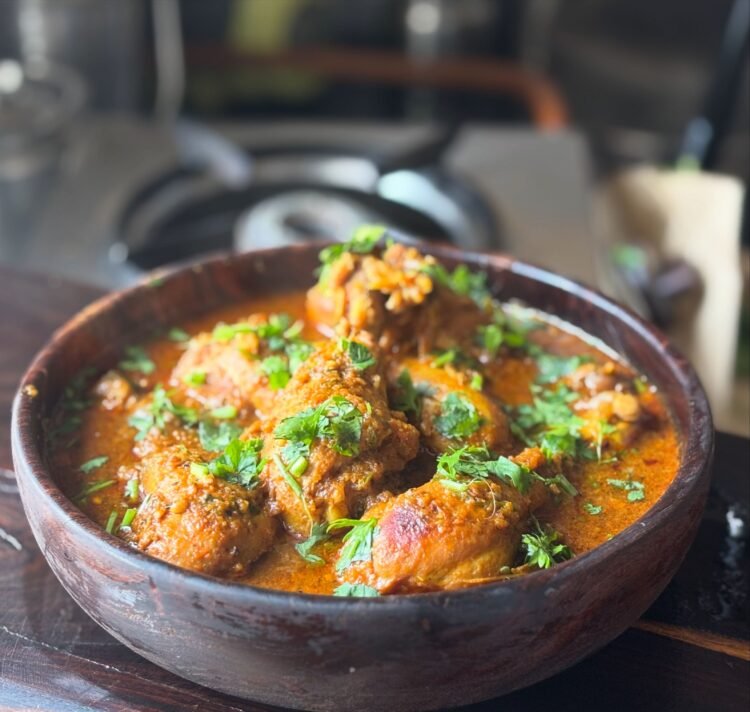
There are Indian restaurant curries you order because they are reliable. They are good, they are familiar, they do what you expect.
And then there are dishes that make you understand why Indian food is considered one of the great cuisine traditions in the world.
Chicken Rogan Josh is in that second category.
It is not the most well-known Indian curry — that belongs to Butter Chicken or Tikka Masala. It is not the most fiery — that belongs to dishes from Andhra or Rajasthan. But Rogan Josh has something that many of those better-known curries do not: genuine complexity. The warmth of Kashmiri red chili that builds slowly rather than hitting immediately. The fragrance of whole spices — cardamom, cloves, bay, cinnamon — that perfume the oil at the very start and remain as a background note throughout. The depth of properly caramelised onion masala. The slight tang of yogurt. The characteristic oil-rising-to-the-surface that signals a properly cooked curry.
This is a curry that earns its flavour — and it rewards the home cook who understands each step rather than simply following it mechanically.
The chicken version of Rogan Josh has become enormously popular as an accessible, faster-cooking alternative to the traditional lamb version — and it genuinely delivers. Bone-in chicken pieces absorb the rich, spiced masala during cooking in a way that boneless chicken simply cannot replicate, and the dish comes together in about 45 minutes rather than the 90+ minutes required for properly cooked lamb.
This guide gives you everything: the marinade and why it matters, the whole spice blooming technique, the colour science behind Kashmiri red chili, the oil-separation milestone that tells you the curry is ready, three variations worth knowing, and the complete answers to every question first-time Rogan Josh makers ask.
The History and Identity of Rogan Josh
Rogan Josh has two origin stories, and both are true — because they describe two different versions of the same dish.
The Kashmiri Pandit Version uses no onion, no garlic, and no ginger — all vegetables considered unsuitable in this Hindu Brahmin cooking tradition. The characteristic deep red colour comes from Kashmiri dried red chilies and a small amount of Ratan Jot (alkanet root), a natural colouring plant. The spicing centres on fennel and dried ginger powder, with the warming whole spices that are now associated globally with the dish.
The Kashmiri Muslim (Wazwan) Version uses onion, garlic, and ginger alongside the spices, creating a more robust, deeply savoury masala base while keeping the essential Kashmiri chili colouring and fennel-forward spice character.
The British-Indian Restaurant Version — which is the style this recipe follows — draws from the Muslim version’s aromatic masala tradition, adapts the spice levels for a broader audience, and achieves the iconic deep red colour entirely from Kashmiri red chili powder rather than Ratan Jot (which is difficult to source outside Kashmir). The result is a dish that is unmistakably Indian in character while being more accessible and faster to prepare than either traditional Kashmiri version.
Why the Marinade Is the Most Important Step
The chicken in this recipe is marinated before cooking — and this is not decorative or traditional formality. The marinade does specific, identifiable work that the finished curry depends on.
What the Yogurt Does
Yogurt contains lactic acid, which is mildly acidic and begins gently denaturing the surface proteins of the chicken over the marination period. This protein breakdown produces three effects: it tenderises the outer layer of the meat (allowing it to absorb the cooking masala more readily), it creates a slightly more porous surface texture that grips the masala better during simmering, and it adds a barely detectable tanginess to the finished dish that rounds out the richness of the spiced sauce.
What the Spices in the Marinade Do
The spices added to the yogurt marinade — Kashmiri red chili, turmeric, coriander, cumin — are not the same spices that go into the curry during cooking. They serve a different purpose: they flavour the chicken from the outside in during the marination period, ensuring the interior of each piece is seasoned, not just the surface. When these pre-seasoned pieces enter the hot masala, the spices from the marinade and the spices from the masala meet and create a more layered, integrated flavour than either would achieve alone.
Minimum marination time: 30 minutes at room temperature. Better: 2-4 hours in the refrigerator. Best: Overnight in the refrigerator.
The longer the marinade, the more pronounced the tenderness and the more deeply integrated the spice flavour in the finished curry.
The Kashmiri Red Chili Colour Secret
The first thing most people notice about a good Rogan Josh is its colour — that distinctive, deep, almost lacquered red that signals something significantly different from a regular curry’s orange-brown.
That colour comes from Kashmiri red chili powder, and understanding it helps you use it correctly.
Kashmiri red chili is not a heat ingredient. It is a colour ingredient. The chili variety grown in Kashmir (and similarly, the Spanish Nora pepper or the Byadagi chili from Karnataka) is prized specifically for its capacity to produce a rich, deep red colour at modest heat levels. Regular red chili powder at the same quantity would produce a dish that is aggressively hot rather than beautifully red.
The practical upshot: use Kashmiri red chili generously for colour without fear of making the curry unacceptably spicy. If you want more heat, add a small amount of regular red chili alongside — but keep the Kashmiri chili for the colour.
Substitution if Kashmiri chili is unavailable: Mix sweet paprika and a small amount of cayenne (4:1 ratio) to approximate the colour-to-heat balance. Pure paprika gives colour without heat; the cayenne adds the measured warmth.
Ingredients for Chicken Rogan Josh (Serves 4)
For the Chicken Marinade
- 800g (1.75 lb) bone-in, skin-on chicken pieces — thighs and drumsticks preferred; bone-in provides significantly more flavour depth than boneless during the long simmering stage
- ½ cup plain full-fat yogurt — not low-fat; the fat in full-fat yogurt prevents the yogurt from separating when it enters the hot pan
- 1 teaspoon Kashmiri red chili powder — for the characteristic deep red colour
- ½ teaspoon turmeric powder
- ½ teaspoon ground coriander
- ¼ teaspoon ground cumin
- 1 teaspoon salt
Whole Spices (The Aromatic Foundation)
- 2 tablespoons neutral oil or ghee — ghee produces a richer, more traditionally authentic flavour
- 2 bay leaves (Indian tej patta, not European bay — slightly different in character)
- 4 green cardamom pods, lightly crushed
- 2 black cardamom pods, lightly crushed — black cardamom has a smoky, camphor-like quality that green does not; do not substitute
- 4 cloves
- 1 cinnamon stick (2-inch piece)
- 6-8 black peppercorns
The Masala Base
- 2 large onions (about 2 cups), very finely sliced or processed to a paste
- 1½ tablespoons fresh ginger, grated or pounded
- 1½ tablespoons fresh garlic (6-7 cloves), minced
- 2 medium tomatoes, finely chopped
- 1½ teaspoons Kashmiri red chili powder — additional to what goes in the marinade
- 1 teaspoon ground coriander
- ½ teaspoon ground fennel (saunf) — one of the most characteristic spices in Rogan Josh; do not omit
- ¼ teaspoon ground ginger powder (dry ginger / sonth) — different from fresh ginger; adds a warmth that fresh cannot replicate
- ½ teaspoon garam masala
- ½ teaspoon turmeric
- Salt to taste
Finishing
- ¼ cup water — for adjusting consistency
- 1 tablespoon kasuri methi (dried fenugreek leaves), crushed between palms
- 2 tablespoons fresh coriander, chopped
- 1 teaspoon lemon juice
Why Fennel and Dry Ginger Powder Are Non-Negotiable
These two ingredients — fennel seeds (ground) and dry ginger powder — are the ingredients that most distinguish Rogan Josh from other Indian curries and should not be omitted or substituted.
Ground fennel provides the characteristic sweet, anise-like warmth that is the defining aromatic note of authentic Rogan Josh. Fresh fennel does not produce the same effect when cooked into a masala — the volatile compounds behave differently in heat. Ground fennel is the correct form.
Dry ginger powder (sonth) is made from dried, fully mature ginger root and has a significantly more intense, more pungent, and more warming character than fresh ginger. In Rogan Josh, it adds a background heat that is quite different from both fresh ginger’s brightness and chili’s frontline sting — it is a slow-building, penetrating warmth. Many Kashmiri recipes use dry ginger in combination with fresh precisely because they perform different aromatic roles.
Step-by-Step: How to Make Chicken Rogan Josh
Step 1 — Marinate the Chicken
Combine all marinade ingredients in a large bowl — yogurt, Kashmiri chili, turmeric, coriander, cumin, and salt. Mix to a smooth, uniform paste. Add the chicken pieces and toss thoroughly to coat all surfaces, including getting marinade under the skin if possible.
Cover and refrigerate for a minimum of 30 minutes. If you have 2-4 hours, use it. Overnight is ideal.
Before cooking: Remove the chicken from the refrigerator 20-30 minutes before it goes into the pan. Cold chicken entering a hot masala cooks unevenly.
Step 2 — Bloom the Whole Spices (The Foundation Step)
Heat the oil or ghee in a heavy-bottomed, wide pan or Dutch oven over medium heat. Once the fat is hot and shimmering, add all the whole spices simultaneously: bay leaves, green and black cardamoms, cloves, cinnamon, and black peppercorns.
Stir continuously for 45-60 seconds until the spices sizzle actively and the oil is intensely aromatic — the kitchen should smell warm, clove-forward, and complex. This blooming step extracts the fat-soluble essential oils from the whole spices directly into the cooking fat, which then carries them through every subsequent element of the curry.
The spice blooming test: Hold your hand 20cm above the pan and you should feel the fragrance rising. If the spices smell burned rather than toasted and fragrant, they have gone too far — reduce heat and continue with caution.
Step 3 — Cook the Onions to Deep Golden (12-15 Minutes)
Add the finely sliced or processed onions to the spiced oil. Stir to coat with the oil and spices.
Cook over medium-high heat for 12-15 minutes, stirring regularly, until the onions are deep golden — the colour of raw honey approaching caramel. Pale or lightly golden onions produce a flat-tasting masala without the natural sweetness and body that properly caramelised onions contribute.
This is the longest single step in the recipe. Do not rush it. The quality of the Rogan Josh is determined here more than anywhere else.
Step 4 — Add Ginger, Garlic, and Tomatoes
Add the grated ginger and minced garlic to the golden onions. Stir constantly for 2 minutes until the raw, sharp aroma of the garlic gives way to a sweeter, cooked fragrance.
Add the chopped tomatoes. Cook for 5-7 minutes, stirring regularly, until the tomatoes have completely broken down and the oil begins to separate visibly at the edges of the masala — this is the critical oil separation milestone indicating the masala is fully cooked.
Add the Kashmiri red chili powder (1½ teaspoons), ground coriander, ground fennel, ground ginger powder, turmeric, and salt. Stir immediately to incorporate into the wet tomato masala and cook for 1-2 minutes to bloom the ground spices into the base.
Step 5 — Sear the Marinated Chicken
Increase heat to medium-high. Add the marinated chicken pieces to the masala. Sear for 4-5 minutes, turning occasionally, until the outside of each piece shows a change in colour from the raw marinated exterior to a slightly browned, set surface.
This searing stage locks the marinade to the chicken surface and begins developing the Maillard browning that adds flavour depth.
Step 6 — Add Water and Simmer
Add ¼ cup of water (or more for a thinner sauce) and stir to deglaze any browned bits from the pan bottom — these bits are intensely flavourful and should be incorporated into the sauce.
Bring to a gentle boil, then reduce heat to low. Cover the pan and simmer for 25-30 minutes, turning the chicken pieces once halfway through, until the chicken is completely cooked through (internal temperature 74°C/165°F at the bone) and the sauce has thickened considerably.
The final oil-rise: By the end of simmering, you should see the flavoured cooking oil separating and rising to the top of the curry. This oil-rise is the traditional signal of a properly cooked Rogan Josh — it indicates that the sauce water has reduced to the right level and the flavour is fully concentrated.
Step 7 — Finish and Serve
Stir in the garam masala, crushed kasuri methi, and lemon juice. Cook uncovered for 3-4 more minutes to allow these finishing aromatics to bloom.
Taste and adjust salt. Garnish generously with fresh coriander.
The Colour Guide: Building That Signature Rogan Josh Red
The visual signature of Rogan Josh — that specific deep, warm red — comes from the combination of:
- Kashmiri red chili powder — the primary colour source; rich, red-orange with minimal heat
- Tomatoes — contribute body and acidity; a secondary red note
- Turmeric — a small amount; shifts the overall colour slightly toward orange-red
- Proper masala cooking — fully reduced, caramelised masala concentrates and deepens colour
If your curry looks orange rather than deep red: Increase the Kashmiri red chili powder (it is safe to use generously — the colour comes before the heat at this quantity). If the colour is still not deep enough, a small amount of sweet paprika can be added for additional depth.
If your curry looks brown: The masala was not simmered long enough after adding the chili, or too much oil was used relative to the masala ingredients.
4 Variations and Serving Adaptations
Variation 1 — Traditional Lamb Rogan Josh
Replace chicken with 800g of bone-in lamb shoulder or leg pieces, cut into 5cm chunks. Increase simmering time to 60-75 minutes (or 30-35 minutes in a pressure cooker). Everything else remains the same. The lamb version is the original and is extraordinary — richer, deeper, and more complex than the chicken adaptation.
Variation 2 — Slow Cooker Rogan Josh
Complete Steps 1-5 on the stovetop. Transfer everything to a slow cooker. Add ¼ cup water. Cook on LOW for 6-7 hours or HIGH for 3-4 hours. The long, gentle cooking produces a remarkably tender result and makes this ideal for a dinner party (prepare in the morning, serve in the evening).
Variation 3 — Pressure Cooker / Instant Pot Rogan Josh
Complete the onion-masala steps (1-5) using the Sauté function of the Instant Pot or in a separate pan. Add the seared marinated chicken, ¼ cup water, and seal. Cook on High Pressure for 12 minutes with a 10-minute natural pressure release. The result is fall-off-the-bone tender chicken in a deeply developed sauce.
Variation 4 — Vegetarian Paneer Rogan Josh
Replace chicken with 400g of firm paneer, cut into 3cm cubes. Skip the marinade (paneer does not need tenderising) — simply season the paneer cubes with a pinch of Kashmiri chili and salt. Add to the masala after Step 4 and cook for just 10 minutes. For extra protein, add a tin of drained chickpeas alongside the paneer.
What to Serve With Chicken Rogan Josh
Classic accompaniments:
- Steamed basmati rice — the clean, separate grains absorb the rich sauce beautifully
- Kashmiri pulao — fragrant rice cooked with whole spices and dried fruits; the traditional pairing that celebrates the Kashmiri origin of the dish
- Plain roti or chapati — for everyday serving
- Naan — for a restaurant-style experience; peshwari naan (sweet, nut-stuffed) contrasts particularly well with the savoury curry
For a complete spread:
- Cucumber raita — the cooling yogurt dip is essential contrast to the warmth of the chili
- Kashmiri shami (lamb kebabs) as an additional starter
- Sliced raw onion with mint and lime
- Mango chutney or mixed pickle
Nutrition Information (Per Serving — 1 of 4)
| Nutrient | Amount |
|---|---|
| Calories | 340-380 kcal |
| Protein | 35-40g |
| Fat | 18-22g |
| Saturated Fat | 5-7g |
| Carbohydrates | 10-14g |
| Fiber | 2-3g |
| Sodium | ~520mg |
| Iron | 3mg |
| Vitamin C | 22mg |
| Calcium | 95mg |
The protein content of 35-40g per serving (from bone-in chicken — higher than boneless due to collagen and connective tissue protein contribution) makes this one of the highest-protein Indian curry options available. The carbohydrate content is modest (primarily from onion and tomato), making it suitable for low-carb and diabetic-friendly eating patterns.
Expert Tips for Restaurant-Quality Results
Use bone-in chicken, always for this recipe. The flavour from the bone during simmering is significant and irreplaceable. The marrow and connective tissue around the bone contribute to the sauce’s body and depth in a way that boneless chicken simply cannot.
Do not skip the whole spice blooming. The first minute of this recipe, when the whole spices hit the hot oil, produces the most important flavour compounds in the entire dish. Rush it, skip it, or use a cold pan and the result is noticeably flatter.
Cook the onions properly. Deep golden is not negotiable. Pale golden onions in a curry this complex are a waste of the masala’s potential.
Watch for the oil separation at two stages. First, in the masala after the tomatoes are added. Second, at the end of simmering. Both separations signal a properly cooked stage. Neither should be rushed.
Add garam masala at the end. Added early, the volatile aromatics of garam masala cook off during the long simmering and you lose the fragrance. Added in the final 3-4 minutes, the warmth stays vibrant.
Rest 5 minutes before serving. Like any braised dish, Rogan Josh’s sauce redistributes and deepens in flavour in the 5 minutes after you turn off the heat. The oil-rise is most beautiful at this point.
Frequently Asked Questions
Q1. What is the difference between Rogan Josh and Chicken Tikka Masala?
Both are popular restaurant Indian curries but they are fundamentally different in character. Rogan Josh is a Kashmiri curry with warming whole spices, fennel, dry ginger, and Kashmiri red chili — earthy, complex, moderately spiced, with a deep red sauce and visible cooking oil on the surface. Chicken Tikka Masala is a British-Indian creation with grilled tikka chicken in a creamy, sweet-tangy tomato-cream sauce with a milder, more approachable spice profile. Rogan Josh is bolder and more complex; Tikka Masala is more universally mild and creamy.
Q2. Can I make Rogan Josh without Kashmiri red chili powder?
Yes, but you need to replicate both its colour and its mild heat profile. The closest substitute is a mixture of sweet paprika (for colour, no heat) and a very small amount of cayenne (for heat), approximately 4:1 ratio. Use this mixture at the same quantities as Kashmiri chili called for in the recipe. The flavour will be slightly different (paprika has a sweeter character than Kashmiri chili) but the visual result will be very similar.
Q3. Why does my Rogan Josh not look as red as in restaurant photos?
Restaurant Rogan Josh gets its intense red from Kashmiri red chili used generously — sometimes 2-3 tablespoons per serving — alongside food colouring in some establishments. At home, ensure you are using genuine Kashmiri red chili (not regular red chili, which will be too hot at high quantities), and be generous with the quantity. The oil rising to the top of the finished curry also carries the fat-soluble red pigment, which pools visually and intensifies the colour impression.
Q4. Is Rogan Josh very spicy?
Traditional Kashmiri Rogan Josh is considered a medium-heat curry — warming and flavourful rather than incendiary. The heat comes primarily from Kashmiri red chili, which provides colour with relatively mild heat, and black peppercorns in the whole spice blend. The recipe as written is suitable for most adult palates. To reduce heat further: use only 1 teaspoon of Kashmiri chili total (not 2.5 tsp across the recipe) and skip the black peppercorns. To increase heat: add ¼ to ½ teaspoon of regular red chili alongside the Kashmiri quantity.
Q5. Can I use boneless chicken thighs instead of bone-in pieces?
Yes, with two adjustments: reduce the simmering time to 18-20 minutes (boneless cooks faster and overcooks more easily), and accept that the sauce will be slightly less complex in body and depth (the bone contributes gelatin and marrow compounds to the sauce during long simmering that boneless chicken does not). Boneless thighs are significantly more convenient and produce a very good curry — just a slightly different result from the bone-in version.
The Kashmiri Curry That Rewards Every Minute You Give It
Chicken Rogan Josh asks more of you than a simple weeknight curry — the whole spice blooming, the long onion caramelisation, the two oil-separation milestones — but none of those steps are difficult. They are simply intentional. Attentive. The kind of cooking where you are actually watching what happens and understanding why.
That attentiveness produces something genuinely exceptional. A curry with the warmth of cardamom and clove in the background. The distinctive fennel note that tells you this is Kashmiri, not just any Indian dish. The deep red that makes the bowl look like something from a professional kitchen. The oil rising to the surface with its concentrated colour and aroma.
Make it on a weekend when you have time to enjoy the process. Make it for guests and watch the reaction when the bowl arrives at the table. Make it once from scratch and understand why this dish has been part of Kashmir’s culinary identity for centuries.
Share your Rogan Josh results in the comments below! Tell us whether you used ghee or oil, which variation you tried, how long you marinated the chicken, and what your household said when they tasted it for the first time. This is a recipe people come back to again and again — we want to know your version of that story.
Pairs perfectly with: Steamed Basmati Rice | Kashmiri Pulao | Plain Naan | Peshwari Naan | Cucumber Raita | Fresh Coriander
Also explore: Butter Chicken | Chicken Biryani | Chicken Keema Curry | Lamb Rogan Josh | Kashmiri Dum Aloo