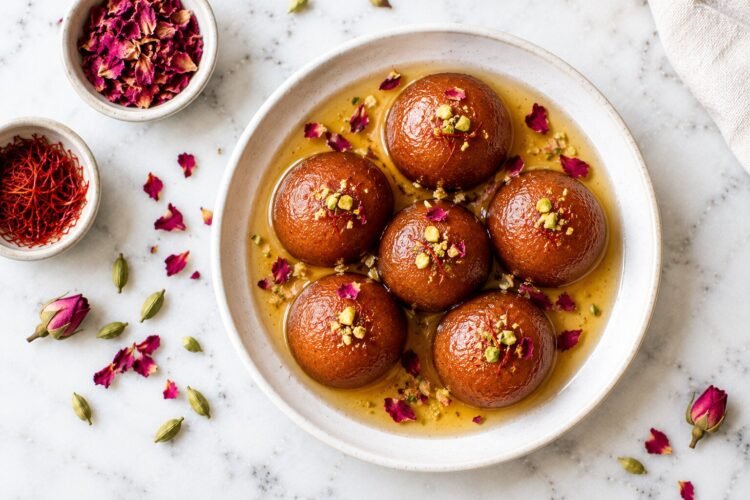
Close your eyes and picture this: a warm, round ball of golden-brown sweetness, glistening in a fragrant syrup of rose water and cardamom, soft enough to dissolve the moment your spoon breaks through its surface. The aroma reaches you before the bowl does. And when it does arrive — steaming, syrup-soaked, impossibly tender — you understand, in a very immediate way, why this single dessert has been India’s emotional and celebratory currency for hundreds of years.
Gulab Jamun is not simply a sweet. It is the dessert that appears at every Indian wedding, every Diwali celebration, every Eid feast, every birthday gathering, every moment when a family wants to say something words cannot adequately express. Offering gulab jamun to a guest is an act of warmth and welcome. Serving it at a celebration is a statement about the importance of the occasion.
But how did this extraordinary dessert come to be? The journey of gulab jamun — from Persian royal kitchens to Indian wedding mandaps, from Mughal court tables to the modest earthenware bowls of street halwais across the subcontinent — is one of the most fascinating stories in Indian culinary history.
The Etymology: What Does “Gulab Jamun” Actually Mean?
Before tracing the history, the name itself deserves attention. Every word in “gulab jamun” contains a story.
Gulab is a Persian compound word — derived from gul (flower) and āb (water), together meaning “rose water.” This is not a decorative name: rose water is the defining aromatic ingredient in the syrup that gives gulab jamun its characteristic fragrance. The word gulab also appears in the Urdu and Hindi word for the rose flower itself — the same flower whose distilled essence perfumes the syrup these sweets are bathed in.
Jamun carries an Indian origin — it is the Hindustani name for Syzygium jambolanum, commonly known as Java plum or black plum. This is the dark purple, oblong Indian summer fruit that the golden-brown spheres of fried khoya are said to resemble in size and shape. The visual comparison was evocative enough to stick permanently.
The word “gulab” is derived from the Persian words gul (flower) and āb (water), referring to the rose water-scented syrup, while “jamun” is Hindustani for Syzygium jambolanum, an Indian fruit with a similar size and shape.
Together, the name describes both what the dessert is dipped in and what it looks like — a remarkably complete description that has survived centuries without alteration.
The Ancient Ancestors: Persian Fritters and the World of Luqmat al-Qadi
To understand where gulab jamun came from, you have to travel back further than Mughal India — back to the medieval Middle East and the Persian-speaking world that exerted enormous influence over South Asian culture.
In the Middle East, a similar fritter called luqmat al qadi, or “judge’s morsels,” are made of leavened and deep-fried dough balls, soaked in syrup or honey. This dish — combining simple fried dough with sweet syrup — appears in medieval Arab culinary manuscripts dating back to the 13th century and was a staple of courtly dining across the Persian and Arab world.
The Persian bamieh and the Turkish tulumba represent parallel traditions: fried, syrup-soaked confections that share the same essential architecture as gulab jamun. Greek loukoumades — golden puffs of fried dough glazed in sweet syrup and dusted with cinnamon — belong to the same ancient family. The Persian bamieh and the Turkish tulumba are both similar to the gulab jamun: fluffy lumps of unleavened dough fried and soaked in sugar syrup.
What distinguished these from what would eventually become gulab jamun was the Indian adaptation that was still centuries away — the transformation of simple wheat or leavened dough into a dough built from reduced milk solids, which would give the Indian version its distinctive creaminess and extraordinary tenderness.
The Mughal Connection: How Gulab Jamun Came to India
The arrival of gulab jamun in India is inseparable from the story of the Mughal Empire and, specifically, one of its most significant emperors.
Humayun’s Persian Exile — The Sweet Consequence of Defeat
According to food anthropologist Kurush F. Dalal, the dessert came to India courtesy the Mughals, more specifically Humayun, the second Mughal emperor who fled to Persia after he was defeated by Sher Shah Suri in 1540. He is said to have brought back the treat when he returned to India in 1555.
Humayun spent approximately 15 years in Persian exile at the court of Shah Tahmasp I of the Safavid dynasty — one of the most sophisticated and culturally rich courts in the world at that time. Persian cuisine, already extraordinarily developed in its use of aromatics, rose water, saffron, dried fruits, and delicate frying techniques, made an indelible impression on the Mughal emperor and his court.
When Humayun returned to India in 1555 to reclaim the Mughal throne, he brought back not just military support and political alliances — he brought back the tastes, the aromas, and the culinary sensibilities of Persian court culture. Dalal notes: “His return from Persia led to important changes in Mughal court culture and cuisine. In India, the dough balls that were dipped in sugar syrup scented with rose water — something the Persians were very big on — were replaced with balls made with milk solids to make a richer, creamier dessert.”
This substitution — wheat or leavened dough replaced by khoya (milk solids reduced to a semi-solid form by long, slow cooking) — was the single most significant transformation in the sweet’s evolution. It was the moment a Middle Eastern concept became genuinely Indian.
Shah Jahan’s Royal Kitchen: The Accidental Creation Legend
A competing folk origin story attributes the first gulab jamun to the personal chef of Shah Jahan — the fifth Mughal emperor, builder of the Taj Mahal, and one of history’s great patrons of luxury. Food folklore has it that the gulab jamun was accidentally concocted by Shah Jahan’s royal chef who took inspiration from Persian/Turkish traditions and local halwais.
The legend holds that the chef, working in the imperial kitchen and drawing from both Persian dessert traditions and local Indian techniques with khoya, created the first gulab jamun — possibly as a happy accident when an existing preparation was adapted or when a new combination of ingredients was tried.
Whether the credit belongs to Humayun’s return from Persia, to Shah Jahan’s kitchen, or to some gradual evolution across multiple Mughal reigns, what is clear is that <cite index=”2-1″>gulab jamun emerged in medieval India during the Mughal Empire, blending Persianate influence with local influences.</cite>
The Great Indian Transformation: Khoya and the Making of a Classic
The substitution of khoya for simple wheat dough was not merely a swap of one ingredient for another. It was a fundamental reimagining of what the dessert could be — and it reflected something uniquely Indian about the culinary culture that absorbed and transformed the Persian tradition.
What Is Khoya and Why Does It Matter?
Khoya (also spelled mawa) is made by slowly simmering whole milk over low heat for several hours until nearly all the moisture evaporates, leaving behind a dense, slightly granular solid of concentrated milk protein and fat. This laborious reduction process — which requires patience and constant stirring — produces an ingredient with extraordinary richness, a faint caramel note from the milk sugars that cook during the reduction, and a fat content that produces, when formed into balls and fried, a texture that is simultaneously dense and impossibly tender.
When khoya balls are gently fried in ghee or oil until golden and then submerged in the rose water, cardamom, and saffron-infused sugar syrup, the still-slightly-porous fried exterior absorbs the syrup completely — expanding slightly, becoming saturated with sweetness and fragrance, producing a final texture that is unlike any other food in the world.
<cite index=”4-1″>The introduction of khoya, a dairy product made from evaporated milk, added a distinct richness to Gulab Jamun, making it a favourite among royalty.</cite>
The Journey from Royal Kitchens to the Streets of India
For much of its early history, gulab jamun was a dessert of privilege — prepared in the royal kitchens of the Mughal court and available only to those within or closely connected to the imperial household.
The democratisation of gulab jamun — its gradual spread from court to common table — is one of the most important chapters in the sweet’s evolution. As the Mughal Empire declined across the 17th and 18th centuries and its courtly culture dispersed across the subcontinent, the cooks and halwais (confectioners) who had learned these techniques in royal kitchens took their knowledge with them to the cities and towns of India.
Sweet shops — mithai ki dukaans — became the vehicle through which gulab jamun reached the masses. Neighbourhood halwais who had learned the art of making khoya and working with sugar syrups established shops that brought court-level confectionery to ordinary people for the first time.
Over time, the dessert gained popularity beyond the palace walls, finding its place in local sweet shops and homes across the subcontinent.
By the 19th century, gulab jamun had become a fixture of Indian celebration food — present at weddings, festivals, and religious occasions across communities, castes, and regions. This crossover — from Muslim Mughal court food to Hindu festival essential to beloved sweet of every Indian community — represents one of the great culinary syncretisms of Indian history.
The Cultural Significance of Gulab Jamun: More Than Just a Sweet
To understand gulab jamun’s place in Indian life, you have to understand that Indian sweets operate within a specific cultural logic where sweetness is synonymous with auspiciousness, celebration, and goodwill.
The Language of Sweets in Indian Culture
In Hindu tradition, mithai (sweets) are offered to gods, distributed as prasad after prayers, and exchanged between families at every significant life event. Sweets mark births, thread ceremonies, weddings, festival days, and even the departure of a loved one. The act of giving sweets is an expression of joy, gratitude, and blessing.
Gulab jamun occupies the highest position within this culture of sweetness because it is simultaneously:
- Appropriate for every major religion observed in India — Hindu, Muslim, Sikh, Jain
- Appropriate for every region — it is loved equally in Kashmir, Kerala, Bengal, and Maharashtra
- Appropriate for every economic class — both the five-star hotel version and the earthenware katori from a street halwai are celebrated
- Scalable from a household of four to a wedding of four thousand
Found in every Indian wedding, festival, and joyful occasion, Gulab Jamun transcends regional boundaries, becoming a symbol of indulgence, festivity, and comfort.
The Festival Calendar of Gulab Jamun
Gulab Jamun’s appearance tracks India’s festival calendar with remarkable faithfulness:
- Diwali: Gifted in ornate boxes, served at pooja gatherings
- Eid: A standard part of the festive mithai spread in Muslim households
- Holi: Served at the festive meal that follows the colour celebrations
- Raksha Bandhan: Often the sweet a sister feeds her brother after tying the rakhi
- Weddings: Present at virtually every Indian wedding reception across communities and regions
- Navratri and Janmashtami: Offered as prasad in temples and home shrines
Regional Variations: How India Made Gulab Jamun Its Own
As gulab jamun spread across the subcontinent, it adapted to local ingredients, techniques, and preferences — producing a remarkable variety of regional versions that share the same soul but express it differently.
Kala Jamun (Black Gulab Jamun)
The deepest, most intensely flavoured variation — fried longer than standard gulab jamun until the exterior turns very dark brown, almost black. The extended frying caramelises the milk solids deeply, producing a bittersweet, complex flavour in the crust that contrasts powerfully with the sweet syrup interior. Popular in North India.
Dry Gulab Jamun
A version where the syrup is reduced to a glaze rather than a soaking medium — the jamuns are coated in the thick, concentrated syrup rather than submerged in it. The result is a less syrup-saturated, slightly drier exterior with an intensely sweet, sticky coating. Served at room temperature rather than warm.
Pantua (Bengal)
Bengal’s version uses a batter of chhena (fresh paneer/cottage cheese) instead of khoya — or a combination of both. The texture is more spongy and the flavour slightly tangier than the standard khoya version. Deeply associated with Bengali festive cooking and considered a regional delicacy.
Laal Mohan (Bangladesh and Eastern India)
A slightly smaller, perfectly round variation popular in Bangladesh and eastern India, named for its distinctively red-orange syrup (coloured with a small amount of red food colouring or the natural colour of the syrup reduction). The texture is similar to Bengali pantua.
Gulab Jamun with Khoya vs Milk Powder
The traditional khoya version requires hours of milk reduction. Modern versions — particularly in home kitchens — use milk powder as a shortcut, producing results that range from excellent to very close to the original depending on the recipe. Most commercially produced gulab jamun in India today uses a combination of milk powder, flour, and a small amount of ghee.
The Modern Era: Gulab Jamun in Tins, Restaurants, and Global Tables
The 20th century brought industrial food production to Indian confectionery, and gulab jamun was among the first traditional sweets to be packaged and sold commercially. Canned gulab jamun — made from milk powder and sold in syrup — became widely available across India and in Indian diaspora communities globally, making the dessert accessible to anyone, anywhere, without the need for either a halwai’s skill or hours in the kitchen.
Today, gulab jamun occupies every stratum of Indian food culture simultaneously:
- In five-star hotel restaurants, it appears deconstructed with ice cream, reduction sauces, and contemporary plating
- In neighbourhood sweet shops, it is served piping hot in small earthenware katori at ₹10-30 per piece
- In millions of Indian homes, it is made from scratch on festive occasions using khoya or milk powder
- In Indian restaurants globally, from London to Toronto to Sydney, it is the default dessert offering on virtually every menu
<cite index=”6-1″>Celebrity chef Vicky Ratnani calls gulab jamun one of the most likable desserts of India.</cite>
The famous Mashoor Gulab Jamun ki Purani Dukaan in the sweet streets of old Indian cities serves gulab jamun fresh and hot in earthenware dishes — the same format, the same product, the same experience that ordinary Indians have been having for centuries.
Frequently Asked Questions
Q1. Where did gulab jamun originally come from?
Gulab jamun originated in the Persian-speaking world — most likely from the Middle Eastern tradition of luqmat al-qadi, fried dough balls soaked in syrup. It was brought to the Indian subcontinent through the Mughal Empire, most specifically credited to Emperor Humayun who encountered similar desserts during his Persian exile (1540-1555) and brought the culinary influence back to India. Indian cooks then transformed the simple dough with khoya (reduced milk solids), creating the distinctly Indian version that exists today.
Q2. What does “gulab jamun” mean in English?
“Gulab” is a Persian compound word combining gul (flower) and āb (water), together meaning rose water — the fragrant ingredient that defines the syrup. “Jamun” is the Hindustani name for the black plum (Syzygium jambolanum), an Indian fruit whose size and dark oval shape the dessert is said to resemble. Together, “gulab jamun” can be loosely translated as “rose water plum” — describing both what the dessert is dipped in and what it looks like.
Q3. What is the difference between gulab jamun made with khoya vs milk powder?
Traditional gulab jamun uses khoya (milk solids produced by reducing whole milk over hours of slow cooking), which produces a richer, creamier, slightly denser texture with a complex flavour from the long milk-reduction process. Milk powder versions (increasingly common in both commercial production and home cooking) are faster and more accessible, producing a lighter, more uniform texture. Most home cooks and halwais today use a combination of both. Connoisseurs generally consider the khoya version superior in flavour depth.
Q4. Why is gulab jamun important in Indian culture?
Gulab jamun occupies a unique position in Indian culture as a dessert that transcends religious, regional, and economic boundaries. It is served at Hindu, Muslim, and Sikh celebrations alike; it is equally present at a street halwai stall and a five-star hotel banquet; and it appears across every Indian state from Kashmir to Kerala. In the cultural language of Indian sweets — where sweetness signals auspiciousness, celebration, and warmth — gulab jamun is the most universally understood symbol of festivity and joy.
Q5. Is gulab jamun the same as pantua or kala jamun?
They belong to the same family but are distinct preparations. Kala jamun (black gulab jamun) uses the same khoya base but is fried much longer until the exterior turns very dark — almost black — with a deeply caramelised, bittersweet crust. Pantua is the Bengali version made primarily with chhena (fresh cheese/paneer) instead of khoya, producing a more spongy, slightly tangy texture. All three share the essential format of fried milk-based balls in sugar syrup, but each has a distinct flavour profile and regional identity.
A Sweet That Carries Centuries in Every Bite
The story of gulab jamun is, in many ways, the story of Indian civilisation itself — a civilisation that absorbed, adapted, and perfected. A Persian fritter arrived through the Mughal court. Indian cooks replaced simple dough with the richness of khoya. Rose water and cardamom joined saffron in the syrup. The halwais of a declining empire carried the recipe to the streets. And a court dessert became the dessert of the people — present at the births and weddings and festivals that mark every Indian life, in every state, in every community, across centuries.
That is what you taste in a gulab jamun. Not just sugar and milk and rose water. The accumulated labour of generations of Indian cooks who received something from the world and gave it back as something better.
Explore more stories about the food that defines Indian culture on KitchenWhisper.in — from the history of iconic Indian sweets to the science of Indian spices, we are dedicated to bringing you content that is as nourishing for the curious mind as the recipes on your table are for the hungry body.
How to Make Soft and Juicy Gulab Jamuns at Home: A Complete Guide