You have probably tried eating less. You have tried skipping meals, cutting carbs, and counting calories. And somewhere around day four or five, the hunger got loud enough that the whole plan collapsed.
Here is what most short-term diet approaches miss: the problem is not willpower. The problem is satiety. When you reduce calories without increasing protein, your body responds by increasing hunger hormones and decreasing fullness hormones. You are not failing the diet — the diet is failing you.
A high protein diet changes this equation entirely. Protein is the most satiating macronutrient — meaning it keeps you fuller for longer than the same number of calories from carbohydrates or fat. It also burns more calories during digestion, preserves the muscle mass you need for a healthy metabolism, and stabilises blood sugar in ways that dramatically reduce afternoon cravings and late-night snacking.
This guide gives you everything you need to implement a high protein diet for weight loss with Indian food — the actual science, the right amounts, the best Indian protein sources, a practical meal plan, and the common mistakes that slow results.
Why Protein Is the Most Powerful Tool for Weight Loss
The Science of Satiety: Why Protein Keeps You Full
When you eat protein, your body releases two important hormones: GLP-1 and PYY (both fullness hormones) and suppresses ghrelin (the primary hunger hormone). This hormonal shift is measurable and significant. Research published in the American Journal of Clinical Nutrition found that increasing protein intake from 15% to 30% of total calories caused participants to consume an average of 441 fewer calories per day — without any deliberate calorie restriction.
441 fewer calories per day, without trying to eat less. That is the satiety effect of protein in action.
For the Indian context, this matters enormously. Many traditional Indian meals are built around rice, roti, and dal — a carbohydrate-heavy structure that, while nutritious, can leave you hungry again within 2-3 hours. Adding more protein to these meals — more dal, a source of paneer or eggs, or a protein-rich side — fundamentally changes how long you stay satisfied after eating.
The Thermic Effect: Protein Burns Calories Just by Being Digested
Every food you eat costs your body some energy to digest. This is called the thermic effect of food (TEF). But the energy cost varies enormously by macronutrient:
| Macronutrient | Thermic Effect (% of calories burned in digestion) |
|---|---|
| Protein | 20–35% |
| Carbohydrates | 5–10% |
| Fat | 0–3% |
This means that if you eat 100 calories worth of protein, your body uses 20-35 of those calories just to digest and process it. The same 100 calories from white rice costs only 5-10 calories to process. This thermic advantage adds up significantly over the course of a day — studies estimate that a high-protein diet can increase total daily calorie expenditure by 80-100 calories compared to a lower-protein diet with the same total calorie intake.
Muscle Preservation: The Key to Sustainable Fat Loss
This is the most underappreciated benefit of high protein for weight loss, and it is critical to understand.
When you reduce your calorie intake to lose weight, your body does not exclusively burn fat. It also breaks down muscle tissue for energy — particularly if your protein intake is too low. This muscle loss is problematic for two reasons:
- Muscle burns more calories than fat at rest. Every kilogram of muscle tissue burns approximately 13 calories per day at rest, compared to approximately 4.5 calories for fat. When you lose muscle during weight loss, your resting metabolic rate drops — meaning you burn fewer calories every day, making it progressively harder to continue losing weight.
- Lost muscle is hard to rebuild. Once you have lost muscle mass through crash dieting, rebuilding it requires consistent resistance training and adequate protein over months. This is why many people who lose weight by severe calorie restriction end up regaining it quickly — their slower metabolism cannot support the same eating patterns that maintained their weight before.
High protein intake during weight loss preserves muscle mass, keeps metabolic rate from dropping, and produces a body composition that is leaner (less fat, more muscle) rather than simply lighter on the scale.
How Much Protein Do You Actually Need for Weight Loss?
This is the most common question, and the answer is more specific than “eat more protein.”
The Research-Based Recommendation
For weight loss, the evidence-based target is 1.2–1.6 grams of protein per kilogram of body weight per day. This range is higher than the basic RDA (Recommended Dietary Allowance) of 0.8g/kg, which is the minimum needed to prevent deficiency — not the optimal amount for weight loss or body composition.
How to calculate your personal target:
- Find your weight in kilograms (divide your weight in pounds by 2.2)
- Multiply by 1.2 for the lower end of the range
- Multiply by 1.6 for the upper end
Example:
- Weight: 70 kg
- Lower target: 70 × 1.2 = 84g protein per day
- Upper target: 70 × 1.6 = 112g protein per day
- Practical daily target: 90–100g protein per day
| Body Weight | Minimum Daily Protein | Optimal for Weight Loss |
|---|---|---|
| 50 kg | 60g | 65–80g |
| 60 kg | 72g | 75–95g |
| 70 kg | 84g | 85–110g |
| 80 kg | 96g | 100–130g |
| 90 kg | 108g | 110–145g |
Spread Protein Across All Meals
Research consistently shows that protein synthesis — the process of building and preserving muscle — is maximised when protein is spread evenly across meals rather than concentrated in one or two. Aim for at least 20-30 grams of protein per meal, three times a day, plus protein-containing snacks.
A common Indian eating pattern of a small breakfast, light lunch, and large dinner concentrates too much protein in the evening, when the body’s ability to use it for muscle protein synthesis is not necessarily higher. Redistributing protein earlier in the day — particularly at breakfast — produces better body composition results.
Best Indian Protein Foods for Weight Loss
One of the most common concerns about high protein eating in the Indian context is that protein-rich foods are expensive, non-vegetarian, or incompatible with traditional Indian cooking. None of these concerns hold up — India has an extraordinary range of affordable, vegetarian, high-protein foods that fit naturally into everyday Indian meals.
Animal Protein Sources
| Food | Serving | Protein | Calories |
|---|---|---|---|
| Eggs (whole) | 2 eggs | 12g | 140 kcal |
| Chicken breast (cooked) | 100g | 31g | 165 kcal |
| Fish (rohu, pomfret, tuna) | 100g | 22–26g | 130–180 kcal |
| Paneer (full fat) | 100g | 18g | 265 kcal |
| Greek yogurt | 150g | 12–15g | 100–130 kcal |
| Curd (homemade dahi) | 200g | 7g | 120 kcal |
| Egg whites | 3 whites | 11g | 48 kcal |
Plant Protein Sources
| Food | Serving | Protein | Calories |
|---|---|---|---|
| Toor dal (cooked) | 1 cup | 17g | 200 kcal |
| Moong dal (cooked) | 1 cup | 14g | 180 kcal |
| Rajma (cooked) | 1 cup | 15g | 225 kcal |
| Chana dal (cooked) | 1 cup | 16g | 220 kcal |
| Kala chana (cooked) | 1 cup | 15g | 210 kcal |
| Tofu (firm) | 100g | 8–10g | 76 kcal |
| Soy milk | 240ml | 7g | 80 kcal |
| Roasted chana (sattu) | 30g | 8g | 110 kcal |
| Peanuts | 30g | 7g | 170 kcal |
Practical Insight: Combining Plant Proteins
Individual plant proteins are often incomplete — they lack one or more essential amino acids. However, combining two plant proteins within a meal creates a complete protein profile. The classic Indian dal-roti or dal-chawal combination does exactly this — the amino acids missing from dal are present in wheat or rice, and together they form a complete protein.
This means traditional Indian vegetarian cooking is already well-designed for protein quality. The gap in most Indian diets is protein quantity, not quality — most people simply don’t eat enough dal, legumes, or dairy to hit their daily protein targets.
High Protein Indian Meal Plan: One Full Week
Understanding the Plan
This 7-day plan targets approximately 90-100g of protein per day for a 70kg person — appropriate for active weight loss. Adjust portions up or down based on your personal calculation. Each day is built around traditional Indian food with protein-focused modifications.
Day 1
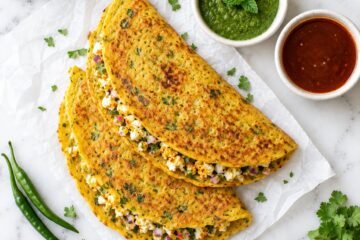
- Breakfast: Moong dal chilla (3 pieces) + mint chutney + 1 boiled egg = ~22g protein
- Mid-morning: Roasted chana (30g) + 1 small apple = ~8g protein
- Lunch: Grilled chicken (100g) or paneer tikka (100g) + 1 cup mixed dal + 1 multigrain roti + sautéed sabzi = ~35g protein
- Evening snack: Greek yogurt (150g) + chia seeds (1 tsp) = ~14g protein
- Dinner: Palak tofu curry (150g tofu) + 1 phulka + cucumber salad = ~18g protein
- Daily total: ~97g protein
Day 2
- Breakfast: 2 scrambled eggs + 2 egg whites + 1 slice whole wheat toast = ~22g protein
- Mid-morning: Sattu sharbat (30g sattu in water with lemon) = ~8g protein
- Lunch: Rajma (1 cup) + brown rice (½ cup) + raita = ~28g protein
- Evening snack: Handful of peanuts (30g) + black tea = ~7g protein
- Dinner: Grilled fish (150g) + steamed broccoli + 1 roti = ~38g protein
- Daily total: ~103g protein
Day 3
- Breakfast: Paneer bhurji (100g paneer) + 1 multigrain roti = ~22g protein
- Mid-morning: 1 cup warm soy milk = ~7g protein
- Lunch: Chicken keema curry (100g) + 1 cup dal + 1 roti + salad = ~38g protein
- Evening snack: 2 boiled eggs + black pepper = ~12g protein
- Dinner: Kala chana curry (1 cup) + 1 roti + raita = ~20g protein
- Daily total: ~99g protein
Day 4–7 (Rotation Principle)
Rotate the above combinations across the remaining four days using these swaps:
- Breakfast swaps: Oats with milk and nuts / Besan chilla with curd / Tofu scramble / Egg omelette with vegetables
- Lunch protein swaps: Toor dal tadka / Chana masala / Grilled paneer salad / Chicken curry
- Dinner protein swaps: Moong dal soup / Tofu palak / Fish curry / Dal with extra protein powder stirred in
7 Practical Tips for a High Protein Indian Diet
1. Start breakfast with protein, not carbs. Most Indian breakfasts are carbohydrate-heavy (poha, upma, plain paratha). Adding eggs, curd, or besan (gram flour) to your breakfast immediately shifts the protein content and sets up a more satiated morning. Even adding a glass of milk or soy milk alongside a standard breakfast makes a measurable difference.
2. Use dal as the protein foundation of every meal. One cup of cooked toor dal or moong dal provides 14-17 grams of protein. If you eat dal at lunch and dinner, that is 28-34 grams of protein from dal alone — roughly a third of your daily target from one of the cheapest, most readily available foods in Indian cooking.
3. Greek yogurt is the highest-protein dairy option. Regular homemade dahi contains approximately 3-4g protein per 100g. Greek yogurt contains 8-10g per 100g — more than double. Used as a snack, a marinade base, or a raita, it is one of the easiest single swaps you can make to increase daily protein without changing your meals significantly.
4. Replace refined snacks with protein snacks. Biscuits, namkeen, and chips are calorie-dense, low-protein snack foods that drive hunger rather than satisfying it. Replace afternoon snacks with roasted chana, peanuts, a boiled egg, or a small bowl of Greek yogurt. The protein content of these snacks reduces the hunger that typically leads to overeating at dinner.
5. Prep protein foods in advance. Boiling eggs, cooking dal, marinating and grilling paneer or chicken — these tasks feel effortful in the moment but require very little active cooking time. Prepping these protein staples once or twice a week means that assembling a high-protein meal on a busy day takes minutes, not an hour.
6. Add protein to your rotis and breads. Mixing besan (gram flour) or soy flour into your whole wheat flour when making roti increases the protein content of each roti by 3-5 grams. This is an invisible change to flavour and texture that significantly boosts the protein content of a staple meal.
7. Track protein for two weeks. Most people who think they eat a “good amount of protein” are actually eating significantly less than they think. Tracking your protein intake using a food diary app (Healthify Me, MyFitnessPal, or Cronometer all have Indian food databases) for two weeks provides an accurate picture of your actual intake and shows you exactly where the gaps are.
High Protein Diet: Common Mistakes That Stall Weight Loss
Eating protein but not reducing total calories. Protein supports weight loss by improving satiety and muscle preservation — but calories still matter. If you add protein to your existing meals without replacing some of the high-calorie, low-nutrient foods, you may increase total calorie intake. The goal is to shift the composition of your diet toward protein while maintaining or slightly reducing total calories.
Relying too heavily on processed “protein products.” Protein bars, protein biscuits, and packaged protein supplements are often high in sugar, artificial sweeteners, and refined ingredients. Whole food protein sources (eggs, dal, paneer, fish, legumes) are superior in nutritional value, more satiating, and significantly cheaper.
Neglecting fibre alongside protein. Protein and fibre work together for satiety. A high-protein meal with no fibre (a plate of chicken breast with white rice, for example) is significantly less satisfying than the same protein paired with vegetables, dal, or whole grains. Always pair protein sources with fibre-rich foods.
Expecting results without consistency. The benefits of a high-protein diet — particularly muscle preservation and improved body composition — develop over weeks, not days. Many people try a high-protein approach for one week, see only modest scale movement (partly because building or preserving muscle adds weight even as fat is lost), and abandon the approach too early. Body composition changes are best measured with measurements and photos over 4-8 weeks, not by the scale alone.
High Protein vs Low Carb: Do You Need to Cut Carbs?
A common misconception is that a high-protein diet requires cutting carbohydrates. It does not.
The most effective weight loss diet is the one you can sustain long-term. For many Indian people, a diet with no rice or roti is not sustainable — these foods are cultural, social, and practical staples. The good news is that the evidence for high-protein eating does not require carbohydrate restriction.
| Approach | Works for Weight Loss? | Sustainability for Indian diet |
|---|---|---|
| High protein only (no carb restriction) | Yes | High |
| High protein + low carb | Yes (faster initially) | Moderate |
| Low carb only (standard protein) | Yes (initially) | Low for most Indians |
| Low fat only | Moderate | High |
The practical recommendation: Increase protein at every meal. Reduce refined carbohydrates (white bread, maida products, processed snacks, sugary drinks) if possible, but do not eliminate complex carbohydrates (brown rice, whole wheat roti, oats, sweet potato). The protein increase alone produces significant fat loss without requiring you to give up the foods that make Indian meals satisfying.
Who Should Be Cautious with High Protein Diets
A high protein diet is safe and beneficial for most healthy adults. However, some people should consult a doctor or registered dietitian before significantly increasing protein intake:
- People with kidney disease or reduced kidney function — High protein intake increases the kidneys’ filtration workload, which can be problematic in those with existing kidney disease (not healthy kidneys)
- People with gout — Some high-protein foods (particularly organ meats and shellfish) are high in purines, which can trigger gout flares
- Pregnant or breastfeeding women — Protein needs are higher during pregnancy and lactation; a qualified nutritionist should guide targets
- People with diabetes — Protein sources and portions should be discussed with a healthcare provider alongside any dietary changes
For the vast majority of healthy adults, a high-protein diet in the ranges described in this article is safe, evidence-based, and effective for weight loss.
Frequently Asked Questions
Q1. How much protein should I eat per day for weight loss?
For weight loss, aim for 1.2–1.6 grams of protein per kilogram of body weight daily. For a 65kg person, this means approximately 78–104 grams of protein per day. Spread this across three meals and 1-2 snacks, aiming for 20-30g at each main meal. This range is well above the basic RDA but is backed by substantial research for fat loss, muscle preservation, and long-term weight management.
Q2. What are the best vegetarian high-protein foods for an Indian diet?
The best vegetarian high-protein foods for an Indian diet are: paneer (18g per 100g), Greek yogurt (8-10g per 100g), all varieties of dal (moong, toor, chana, masoor — 14-17g per cooked cup), rajma and kala chana (15g per cooked cup), tofu (8-10g per 100g), roasted chana and sattu (8g per 30g), and soy milk (7g per cup). Using dal twice daily and including paneer or Greek yogurt makes hitting protein targets straightforward on a vegetarian diet.
Q3. Will eating more protein make me gain weight?
Protein itself does not cause weight gain. Excess calories from any macronutrient — including protein — can contribute to weight gain if total intake significantly exceeds expenditure. However, protein is the most difficult macronutrient to overeat because it is so satiating. Research consistently shows that people who increase their protein intake spontaneously reduce their total calorie intake because they feel fuller at each meal. The concern about protein causing weight gain comes from high-calorie, high-protein processed foods (like high-fat cheeses or fried meats), not from lean protein sources like dal, eggs, fish, or grilled chicken.
Q4. Can I follow a high protein diet for weight loss if I don’t eat meat?
Absolutely. A well-planned vegetarian high-protein diet is completely achievable with Indian foods. The key is combining multiple plant protein sources throughout the day and including dairy (paneer, Greek yogurt, milk, curd) or eggs if you consume them. A vegetarian diet built around dal, legumes, paneer, tofu, Greek yogurt, and whole grains can easily provide 80-100g of quality protein per day — sufficient for effective weight loss and muscle preservation.
Q5. How quickly will I see results on a high protein diet?
Most people notice reduced hunger and fewer cravings within the first week of increasing protein intake — this is the satiety effect becoming apparent. Visible body composition changes (reduced body fat, improved muscle tone) typically take 4-8 weeks of consistent eating. Scale weight changes vary; some people lose 1-2kg in the first two weeks, while others see the scale move slowly as fat loss is offset by improved muscle retention. Measurements (waist, hips, upper arms) and progress photos are more reliable indicators of progress than the scale alone.
Start Eating Smarter, Not Less
The goal of a high protein diet for weight loss is not to eat less — it is to eat better. When protein makes up a meaningful part of every meal, you stay fuller for longer, eat fewer calories without trying, preserve the muscle that keeps your metabolism running, and build a sustainable relationship with food that does not depend on willpower or hunger management.
For Indian eaters, this is not a foreign or restrictive way of eating. The protein-rich foods of Indian cuisine — dal, paneer, eggs, curd, legumes, fish, chicken — are already on most tables. The shift is simply to make them more prominent, more consistent, and more intentional.
Where to start: Calculate your daily protein target using the formula above. Track your intake for three days using a food app to see where you currently stand. Then make one or two changes — add an egg to breakfast, increase the dal at lunch, replace your afternoon biscuits with roasted chana. Small, consistent changes stack into significant results.
Explore more high-protein recipes on KitchenWhisper.in to build your weekly meal plan:
High-protein recipes to get you started on KitchenWhisper.in:
- Moong Dal Chilla – High Protein Breakfast Pancakes
- Paneer Bhurji – Quick High Protein Breakfast
- Cottage Cheese Toast – 27g Protein in 12 Minutes
- High Protein Cottage Cheese Breakfast Bowl
- Tofu Scramble – Indian Spicy Bhurji (Vegan)
- Kala Chana Curry – Black Chickpea Protein Bowl
- Palak Tofu – Spinach Tofu Curry
- Mushroom Omelette – 14g Protein, 10 Minutes