Some recipes do not come from cookbooks. They come from grandmothers.
Easy Blueberry Cake is that kind of recipe — the kind that gets passed from one kitchen to the next not because it appeared in a magazine or won a competition, but because the person who made it handed it to someone who loved it, who made it for someone else who loved it, until it quietly became a permanent fixture in a family’s baking year.
The recipe was passed from a grandmother to a grandchild, and from that grandchild to the world. It uses nothing unusual — flour, sugar, eggs, milk, vegetable oil, vanilla, and two cups of fresh blueberries. It bakes in a 9×13-inch pan. It takes 45 minutes from start to finish. And it has the specific quality that makes a cake worth making again and again: it is reliably, unpretentiously, deeply good.
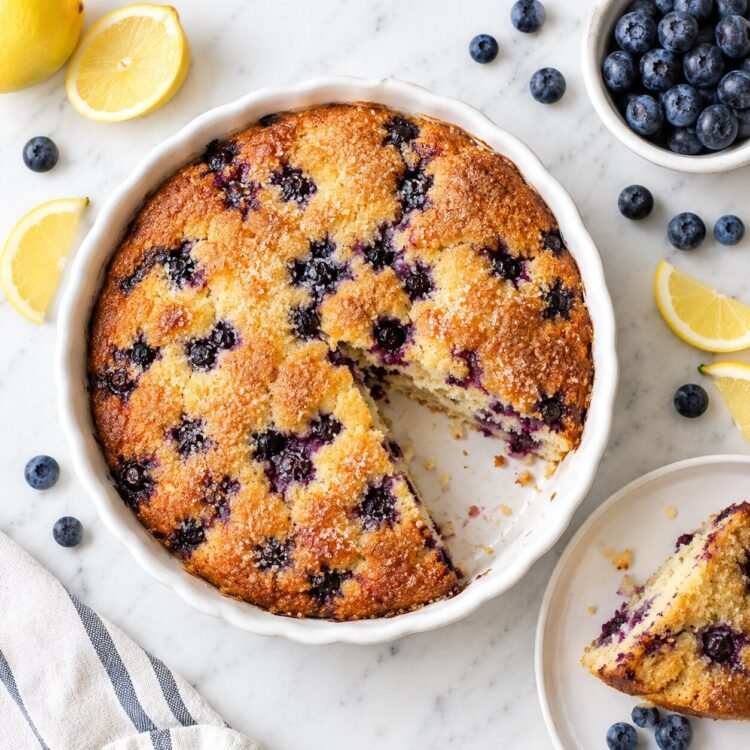
The finishing touch is what makes it special. While the cake is still hot from the oven, you brush the entire surface with melted butter and sprinkle it with sugar. That hot butter and sugar caramelise against the warm cake top, creating a delicate, lightly golden crust that makes the first bite different from any unfrosted sheet cake you have had. It is not a glaze. It is not a frosting. It is something simpler and better — a hot buttered sugar surface that sets into the cake as it cools and makes every piece taste like it was made with deliberate, loving care.
This guide covers every detail of the recipe, the baking science behind the blueberry-flour trick, all the variations worth knowing, and the complete answers to every question that comes up when making this for the first time.
Why This Particular Recipe Has Lasted Generations
Simplicity That Does Not Compromise Flavour
The recipe uses vegetable oil rather than butter in the batter — and this is a choice that contributes significantly to the cake’s staying power (both in terms of recipe longevity and actual shelf life). Oil-based cakes stay moister for longer than butter-based cakes because oil remains liquid at room temperature, while butter solidifies as the cake cools, causing the crumb to firm and dry more quickly.
The result is a cake that is as good on Day 2 as it is on Day 1 — which matters for a family recipe that gets cut and served across multiple meals rather than finished at a single sitting.
The 9×13-Inch Pan: The Great Equaliser
The 9×13 sheet cake format is one of the most practical in American home baking. It:
- Requires no special equipment beyond the pan itself
- Needs no layering, stacking, or frosting skill
- Travels beautifully to potlucks, gatherings, and school events
- Serves 12-15 people from a single bake
- Stores and covers easily
For a recipe that was designed to be shared — made for family gatherings, brought to neighbours, served at church potlucks — this format is the obvious choice, and it is part of why the recipe has remained so practical and so beloved.
The Blueberry Season Connection
This cake is at its most extraordinary during peak fresh blueberry season — roughly June through August in most of North America. Freshly picked, ripe blueberries at peak season have a natural sweetness and flavour intensity that dramatically outperforms off-season or frozen berries. The berries burst during baking, releasing juice that creates vivid purple-blue pockets of concentrated flavour throughout the cake.
That specific experience — cutting a slice of this cake during blueberry season and finding those brilliant, jammy pockets of burst berry running through the pale golden crumb — is the quality that makes people want to make this recipe every single year when blueberries come back in.
The Blueberry-Flour Trick: Small Step, Big Payoff
The recipe calls for tossing the blueberries in approximately 2 teaspoons of all-purpose flour before folding them into the batter. This step appears in virtually every good blueberry baking recipe — and it is worth understanding why.
Why Berries Sink
Blueberries are heavier than the batter they are suspended in. Without any intervention, gravity acts on them during the first 10-15 minutes of baking — before the batter has set enough to hold them in place — causing them to migrate downward and accumulate on the bottom of the pan. The result is a cake with a dense, wet-bottomed layer of berries at the base rather than a beautiful distribution throughout.
What the Flour Coating Does
A light coating of flour on each berry:
- Increases surface friction between the berry and the batter, creating temporary drag that slows the sinking process
- Absorbs some of the surface moisture on the berries (wet berries release that moisture into the batter immediately, making the batter around them locally thinner — making it even easier for the berries to sink)
- Creates a very slight starch-thickening effect at the berry-batter interface as the heat hits it, helping lock each berry in place within the first few minutes of baking
The result is blueberries distributed throughout the cake’s full depth — top, middle, and bottom — rather than a soggy, berry-heavy base layer.
The technique in practice: Put the blueberries in a separate small bowl. Sprinkle 2 teaspoons of flour over them. Toss gently until all the berries have a light, even white dusting. Fold into the batter last, after all other ingredients are combined, using 8-10 gentle strokes of a spatula rather than aggressive stirring. The goal is distribution, not complete integration.
Ingredients: Easy Blueberry Cake (Serves 12-15)
The Batter
- 2½ cups all-purpose flour — measured using the spoon-and-level method (spoon flour into the cup, level with a straight edge — never scoop directly with the cup, which compresses the flour and produces 20-30% more than intended)
- 1½ cups white granulated sugar
- 1 tablespoon baking powder — this larger-than-usual amount is correct and necessary for the rise in an oil-based batter
- 1 teaspoon salt — balances sweetness and enhances the vanilla and blueberry flavour
- 1 cup whole milk — whole milk produces a richer, more tender crumb than low-fat
- ½ cup vegetable oil — neutral-flavoured oils (canola, sunflower, or refined coconut all work)
- 2 large eggs, beaten — room temperature eggs incorporate more evenly into the batter
- 2 teaspoons pure vanilla extract — pure vanilla, not imitation; the vanilla note is prominent and worth the difference in quality
The Berries
- 2 cups fresh blueberries — fresh are preferred for maximum flavour; see the frozen blueberry section below if fresh are unavailable
- 2 teaspoons all-purpose flour — for dusting the berries
The Finishing Topping
- 2 tablespoons butter, melted — for brushing over the hot cake surface
- 2 tablespoons white sugar — for sprinkling over the buttered surface; adjust to taste
Step-by-Step: How to Make Easy Blueberry Cake
Step 1 — Prepare the Pan and Preheat
Preheat the oven to 375°F (190°C). Grease a 9×13-inch baking dish or pan thoroughly — either with butter and a dusting of flour (the traditional method that produces clean release), or with a good cooking spray that includes flour.
A properly prepared pan ensures the cake releases cleanly after cooling and that the bottom develops a uniformly golden colour rather than pale, soft patches where inadequate greasing allowed the batter to steam against the pan.
Step 2 — Combine Dry Ingredients
In a large mixing bowl, sift together the flour, sugar, baking powder, and salt. Sifting is specifically mentioned in the original recipe and serves two purposes: it breaks up any lumps in the flour and sugar, and it aerates the mixture so it distributes evenly when the wet ingredients are added.
Whisk the sifted dry ingredients once after sifting to ensure the baking powder and salt are thoroughly distributed. Uneven distribution of baking powder produces uneven rise — some parts of the cake puff dramatically while others stay flat.
Step 3 — Add Wet Ingredients and Mix to Batter
Add the milk, vegetable oil, beaten eggs, and vanilla extract to the dry ingredient bowl. Using a wooden spoon, rubber spatula, or electric hand mixer on low, mix until you have a semi-thick, smooth batter — all dry flour is incorporated, no lumps remain, and the batter pours slowly and consistently.
The semi-thick batter test: The batter should flow off a spoon in a slow, thick ribbon rather than dripping freely. If it flows too freely (like milk), the batter is too thin and the cake may be dense. If it barely moves, it is too thick and the cake may not rise properly. The balance comes from the 2½ cups flour : 1 cup milk : ½ cup oil ratio, which is calibrated correctly — if you measured the flour properly, the consistency will be right.
Do not overmix. Mix until just combined — a few gentle strokes after everything is incorporated is sufficient. Overmixing develops gluten, which makes cakes tough and dense.
Step 4 — Fold in the Blueberries
In a separate small bowl, toss the blueberries with the 2 teaspoons of flour until all are lightly coated. Using a large spatula, fold the floured blueberries into the batter in 8-10 gentle, sweeping strokes. The batter will streak blue-purple where berries make contact — this is completely normal and becomes the beautiful swirled appearance of the baked cake.
Pour the batter into the prepared pan and spread to an even layer using the spatula.
Step 5 — Bake at 375°F for 25-30 Minutes (First Phase)
Place the pan in the centre of the preheated oven. Bake for 25-30 minutes, until the cake is lightly browned — a pale golden colour across the surface, with the edges beginning to pull slightly from the pan sides.
Do not insert a toothpick at this stage — the cake is not finished yet.
Step 6 — The Finishing Touch: Butter and Sugar Topping
Remove the pan from the oven. While the cake is still hot, brush the entire top surface with the 2 tablespoons of melted butter. Use a pastry brush or the back of a spoon for even coverage — every inch of the surface should receive some butter.
Immediately sprinkle the 2 tablespoons of sugar evenly over the buttered surface. The hot butter causes the sugar to begin dissolving and caramelising almost immediately — you will see the surface begin to glisten and the sugar crystals start to transform.
Return the pan to the oven and continue baking for 5-10 more minutes, until the cake is golden brown — deeper in colour than before the topping was applied — and a toothpick inserted in the very centre comes out clean (no wet batter clinging, though moist crumbs are fine).
Total bake time: 30-40 minutes from start to finish.
Step 7 — Cool Before Serving
Allow the cake to cool in the pan for at least 15-20 minutes before cutting. The caramelised butter-sugar topping continues to set as the cake cools — cutting too early collapses the still-soft crumb and pulls the crust before it has fully firmed.
The caramelised topping will look crisp and golden when fully set. Cut into rectangles directly in the pan (a 9×13 pan cuts into 12 generous pieces or 15 standard ones) and serve from the pan.
Fresh vs Frozen vs Dried Blueberries
Fresh Blueberries (Best Choice)
Fresh blueberries at peak ripeness produce the most vivid flavour, the most beautiful colour distribution in the crumb, and the most satisfying burst-berry texture when the cake is cut. During June-August blueberry season, use fresh without question.
Frozen Blueberries (Excellent Year-Round Option)
Frozen blueberries work very well in this recipe with one important modification: do not thaw them before use. Add frozen berries directly from the freezer to the flour-dusting bowl, toss lightly, and fold directly into the batter. Thawed frozen blueberries release significant moisture and bleed intensely purple into the batter, turning the entire cake blue-purple rather than producing distinct berry pockets.
From frozen, the berries also sink more slowly (they are colder and therefore denser within the colder portion of batter around them), which can actually improve distribution. Add 5-7 minutes to the total bake time for frozen berries.
Dried Blueberries (Emergency Substitute)
Dried blueberries soaked in warm water for 15 minutes, then drained and patted dry, can substitute in a pinch. The flavour is more concentrated and sweeter, and the texture is chewy rather than bursting. The cake will be noticeably different but still excellent.
5 Variations Worth Exploring
Variation 1 — Lemon Blueberry Cake
Add the zest of 2 lemons to the batter at the same time as the vanilla extract. Replace 2 tablespoons of the milk with fresh lemon juice. The lemon brightens the blueberry flavour dramatically. For the topping, use lemon-sugar (mix the 2 tablespoons of sugar with ½ teaspoon of additional lemon zest before sprinkling).
Variation 2 — Blueberry Sour Cream Cake
Replace the milk with an equal amount of full-fat sour cream. The sour cream’s acidity tenderises the crumb significantly, producing a finer, more cake-like texture rather than the slightly bread-like quality of the milk version. Also reduce the baking powder to 2 teaspoons (sour cream is acidic and provides leavening support). The result is denser, richer, and more luxurious.
Variation 3 — Cream Cheese Frosted Version
Skip the butter-sugar topping and instead frost the completely cooled cake with cream cheese frosting: beat 4 oz softened cream cheese with 2 tablespoons softened butter, 1 cup powdered sugar, 1 teaspoon vanilla, and enough milk (1-2 tablespoons) for spreading consistency. This transforms the humble sheet cake into something appropriate for birthdays and celebrations.
Variation 4 — Mixed Berry Cake
Replace 1 cup of the blueberries with 1 cup of fresh raspberries or blackberries. Both berries have higher moisture content than blueberries — ensure they are well-dried and toss with an extra ½ teaspoon of flour before adding. The colour distribution in the finished cake is extraordinary.
Variation 5 — Mini Muffin Version
Pour the batter into a greased 12-cup muffin tin, filling each cup approximately two-thirds full. Bake at 375°F for 18-22 minutes. Apply the butter-sugar topping to each muffin immediately after removing from the oven. This produces 12 individual servings that are perfect for lunchboxes, bake sales, and gatherings where individual portions are more practical than a shared pan.
Glazing and Topping Options
Beyond the classic butter-sugar finish, these additions transform the presentation:
Simple vanilla glaze: Mix 1 cup powdered sugar with 2-3 tablespoons milk and ½ teaspoon vanilla until smooth. Drizzle over the completely cooled cake. Adds a visible sweetness and visual appeal.
Blueberry compote topping: Simmer ½ cup fresh blueberries with 2 tablespoons sugar and 1 tablespoon lemon juice for 5 minutes until thickened. Spoon over individual slices just before serving.
Whipped cream: Serve each slice with a generous spoonful of whipped cream alongside. The cool, light cream against the warm, dense cake is the perfect pairing.
Powdered sugar dust: For the simplest presentation upgrade, dust the cooled cake with powdered sugar through a fine sieve. The white-on-golden-blueberry visual is beautiful.
Storage and Make-Ahead Tips
Room temperature: Cover the pan tightly with cling film or foil. The cake keeps at room temperature for 2-3 days — the oil-based batter ensures it stays moist throughout this period.
Refrigerator: Refrigerate covered for up to 1 week. Bring individual slices to room temperature for 15-20 minutes before serving, or microwave briefly (20-30 seconds) to restore the warmth and soften the butter-sugar topping.
Freezer: Cool completely, cut into individual portions, wrap each in cling film, and place in a sealed freezer bag for up to 3 months. Thaw at room temperature for 30-45 minutes or warm in the microwave for 30-45 seconds.
Bake ahead: This cake is excellent made the day before serving — the flavours deepen overnight and the blueberries develop a more cohesive relationship with the crumb. Many home bakers who make this for gatherings bake it the evening before and serve the next day.
Nutrition Information (Per Serving — 1 of 12)
| Nutrient | Amount |
|---|---|
| Calories | ~253 kcal |
| Carbohydrates | 39g |
| Fat | 10g |
| Protein | 4g |
| Sugar | 22g |
| Fiber | 1g |
| Sodium | ~210mg |
| Cholesterol | ~32mg |
| Vitamin C | 4mg |
Expert Tips for the Perfect Blueberry Cake
Measure the flour correctly. This is the single most common baking mistake. Scoop with a spoon, level with a straight edge. Direct-scooping with the measuring cup packs in 20-30% more flour, producing a dense, dry cake.
Use room temperature eggs. Cold eggs do not beat into the batter as evenly, potentially leaving small pockets of unincorporated egg that set into rubbery patches during baking. Take them out 20 minutes before starting.
Do not skip the flour on the blueberries. The 2 teaspoons is a small amount but the result — evenly distributed berries throughout the cake rather than a berry-dense bottom — is significant.
Fold, don’t stir. The blueberries go in last, with gentle folding strokes. Over-stirring bleeds the berry juice through the entire batter.
The butter-sugar topping goes on while the cake is hot. Applying it to a cooled cake prevents the sugar from caramelising and the butter from absorbing — you lose the entire textural benefit. Hot cake, immediate topping application, back into the oven.
Frequently Asked Questions
Q1. Can I use frozen blueberries instead of fresh?
Yes — frozen blueberries work very well in this recipe. The critical rule: do not thaw them before using. Add directly from the freezer, toss in the flour coating, and fold into the batter frozen. Thawed berries release too much moisture and bleed intensely purple through the entire batter. From frozen, add 5-7 minutes to the total baking time and check for doneness with a toothpick.
Q2. What makes the butter-sugar topping special? Can I skip it?
The butter-sugar topping is the defining finishing touch of this recipe — while you can skip it, the cake will be noticeably different. The topping caramelises as it heats in the second phase of baking, creating a delicate, golden crust on the cake surface that adds both sweetness and texture. The warm butter also prevents the top of the cake from drying out during the final minutes of baking. If you want to make a plain, unfrosted cake, the topping is technically skippable — but if you want Easy Blueberry Cake, keep it.
Q3. Why does my cake have all the blueberries on the bottom?
This is the sinking berry problem — and it is entirely preventable. Tossing the blueberries in flour before folding them into the batter creates surface friction and slight starch thickening that slows their migration downward during the early baking phase. Also ensure the batter has reached its proper “semi-thick” consistency — a too-thin batter provides very little resistance to berry sinking. If the problem persists, try refrigerating the assembled batter in the pan for 15 minutes before baking — the cold slows the sink further.
Q4. Can I make this cake in a different pan size?
Yes, with timing adjustments. In a round 9-inch cake pan: reduce the quantity by approximately 25% and reduce bake time to 25-30 minutes total. In a 12-cup muffin tin: same batter, fill cups two-thirds full, bake 18-22 minutes total. In a 8×8 square pan: the recipe may overflow — reduce batter by 25% or use a 9×9 pan. Always test with a toothpick rather than relying solely on time.
Q5. How do I know when the cake is done?
Two reliable tests: the toothpick test (inserted in the very centre, it should come out clean or with a few moist crumbs but no wet batter) and the visual test (the surface should be golden brown — deeper than the pale gold of the first baking phase — and the edges should be beginning to pull slightly away from the pan sides). The toothpick test is more reliable since all ovens run slightly differently and the butter-sugar topping makes the surface colour difficult to judge accurately after the second phase.
The Cake That Earns Its Place at Every Table
Easy Blueberry Cake does not try to be anything it is not. It is not a showstopper layered cake for a landmark birthday. It is not a technically demanding pastry project for an experienced baker. It is a family recipe — honest, reliable, made from pantry staples, handed down for the specific reason that the people who made it wanted the people who received it to experience exactly the same pleasure they had.
The pleasure is real. A warm slice with that caramelised butter-sugar crust, the jammy pockets of burst blueberry visible in the crumb, the vanilla warmth in every bite.
Make it at the height of blueberry season for the most extraordinary version. Make it in January with frozen berries for a reminder that summer still exists. Make it in a 9×13 pan, bring it to wherever you are going, and watch it be the thing people go back for a second piece of.
Try this recipe and share your results in the comments below! Tell us whether you used fresh or frozen berries, which variation you tried, and whether anyone asked for the recipe before the pan was half empty. First-time blueberry cake bakers — we especially want to hear from you.
Pairs perfectly with: Whipped Cream | Vanilla Ice Cream | Blueberry Compote | Hot Tea | Fresh Coffee
Also explore: Blueberry Muffins | Blueberry Pancakes | Lemon Blueberry Bread | Blueberry Crumble | Air Fryer Banana Muffins