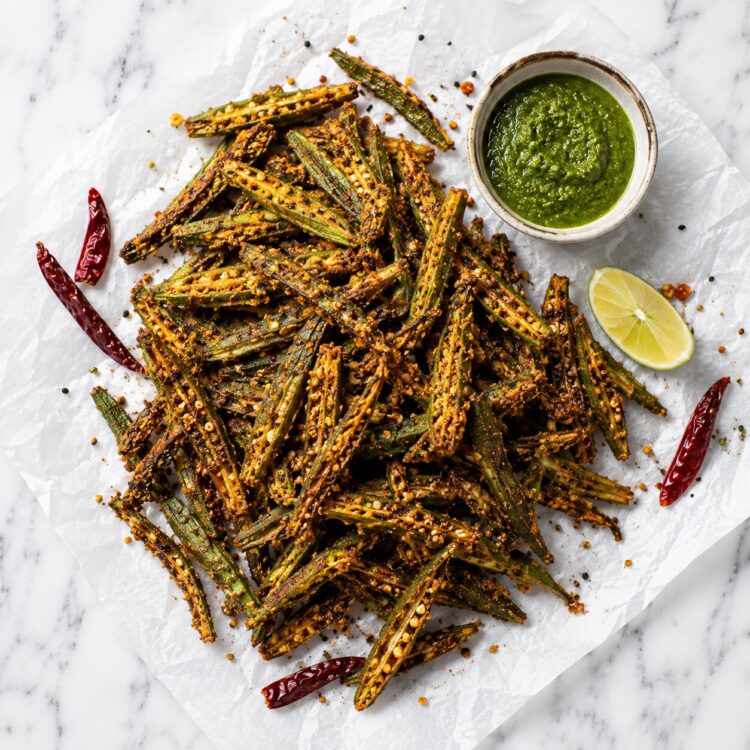
Ask anyone who grew up in an Indian household about their complicated relationship with okra and you will hear a version of the same story: there were two kinds. The soft, slightly sticky kind that appeared in dal or masala. And then — on special days, cooked by a skilled pair of hands who knew exactly what they were doing — the other kind. The crispy kind.
The kind that crackled. The kind that was gone from the plate before you finished reaching for a second piece.
Kurkuri Bhindi is that second kind. Kurkuri means crunchy or crispy in Hindi — and this recipe delivers exactly that, with a precision that makes it impossible to stop eating. Thinly sliced okra coated in a spiced batter of rice flour and semolina, fried until each piece becomes a brittle, golden, intensely flavoured crisp. Not soft bhindi masala. Not sautéed bhindi do pyaza. Kurkuri bhindi — where the okra is completely transformed by the batter and the heat into something that feels more like an extraordinary snack than a vegetable side dish.
The recipe has its roots in Bengali cuisine, where it is known as Kurmure Bhendi Bhaja — traditionally served as the first course of a meal alongside a light lentil stew. The combination works brilliantly: the lightness of the dal and the shattering crunch of the bhindi together form a complete, balanced beginning to a Bengali meal.
This guide gives you both methods — the classic deep-fry and the air fryer version — along with the Bengali original and the Punjabi besan variation, the expert tips that prevent stickiness and ensure maximum crunch, and the complete answers to every question that comes up when making this for the first time.
Why This Recipe Works: The Rice Flour and Semolina Secret
Most Indian bhindi recipes that aim for crispness use a single coating — besan (chickpea flour) being the most common. Besan works well and the Punjabi variation of this recipe uses it effectively. But the Bengali original combines rice flour and semolina, and this particular combination is why the crunch of Kurkuri Bhindi is distinctly different from any other fried okra you may have made.
What Rice Flour Does
Rice flour is gluten-free and has a fine, starchy quality that creates a very thin, very light coating on the okra surface. When this thin coating hits hot oil, the rice starch gelatinises and crisps instantly — almost the moment it enters the oil. The result is a coating that is shatteringly thin rather than thick and doughy: you taste the okra through it rather than through a layer of batter.
Compare this to a wheat flour batter, which tends to produce a softer, more bread-like coating that absorbs oil more readily. Rice flour stays crisp and dry.
What Fine Semolina Adds
The semolina (rava/sooji) takes the texture one step further. Semolina’s slightly coarser grain than rice flour creates micro-texture on the surface of the coating — tiny ridges and irregular surfaces that increase the area of the coating exposed to direct heat. These surfaces brown faster, create more Maillard reaction flavour compounds, and add a pleasantly gritty crunch that is unmistakably different from a smooth batter. It is semolina that gives Kurkuri Bhindi its characteristic crackling texture rather than just a crispy one.
For a gluten-free version: simply skip the semolina and increase the rice flour by the same amount. Several home cooks have made this substitution with excellent results, as confirmed by recipe feedback.
Why the 15-Minute Rest Is Not Optional
This step surprises most first-time makers — why rest battered okra before frying? The answer is both chemical and structural.
Okra contains a natural moisture that migrates to the surface once the vegetable is cut. When you add the coated okra to the batter and let it rest for 15 minutes, this moisture releases gradually into the batter — thickening it slightly and creating a more cohesive, stronger adhesive bond between the coating and the okra surface. Okra fried immediately after coating has a looser, more fragile crust that falls off more readily. Rested okra has a coating that fuses to the surface and holds through the entire frying process.
Understanding the Spice Mix: Every Ingredient’s Purpose
Nigella Seeds (Kalonji)
Nigella seeds are a distinctive Bengali flavour element — their slightly bitter, onion-like character with a faint herbal note is immediately recognisable and adds something that no other spice quite replicates. They are what signals “this is the Bengali version” to anyone familiar with Eastern Indian cooking.
Fennel Seeds (Saunf)
Fennel seeds add a gentle, sweet anise warmth that balances the earthiness of the turmeric and the heat of the chili powder. Their slight sweetness also complements okra’s own mild vegetable sweetness.
Kashmiri Red Chili Powder
The recipe specifies Kashmiri red chili specifically — not regular red chili powder. Kashmiri chili is selected for its deep, vivid colour rather than intense heat. It gives the coated okra its characteristic orange-red appearance and adds mild warmth without making the dish too spicy. For a hotter version, add a pinch of regular red chili or cayenne alongside the Kashmiri chili. For a milder version, reduce or replace with sweet paprika.
Turmeric (Haldi)
Half a teaspoon of turmeric serves two purposes: it adds the characteristic golden warmth to the batter colour, and its curcumin content provides anti-inflammatory properties that have made turmeric a cornerstone of Indian cooking for both flavour and traditional wellness reasons.
Ingredients for Kurkuri Bhindi (Serves 4)
- 300g (10.5 oz) fresh okra (bhindi/lady finger) — choose small to medium pods; very large okra have large seeds that are best removed
- ½ cup rice flour — fine rice flour gives the crispiest coating
- ¼ cup fine semolina (sooji/rava) — fine-ground semolina, not coarse; skip for gluten-free
- 1 tablespoon nigella seeds (kalonji) — the distinctive Bengali flavour element
- ½ teaspoon fennel seeds (saunf)
- 1 teaspoon salt — adjust to taste
- ½ teaspoon ground turmeric (haldi)
- ½ teaspoon Kashmiri red chili powder — for colour and mild heat; adjust to preference
- 1 cup water — for making the batter
- Oil — for deep frying; or 1 tablespoon oil spray for air fryer version
- Lime wedges — for serving; do not skip this — the lime juice brightens the entire dish
For the Punjabi Variation (see full section below)
Replace semolina with ¼ cup besan (chickpea flour) + reduce rice flour to 2 tablespoons. Replace nigella seeds with ajwain (carom seeds).
Choosing the Right Okra: What to Look For
The okra you choose determines the texture of the finished dish. Here is the complete selection guide:
Ideal okra: Small to medium pods (7-10 cm), firm when squeezed with no soft spots, vibrant green colour, tip that snaps cleanly rather than bending — this snap test indicates freshness. The interior should have small, underdeveloped seeds.
Avoid: Large, overgrown pods with fully developed large seeds (these need the seeds removed before cooking or they create a dense, chewy interior within the crispy coating); soft or browning pods (stale okra releases excessive moisture that ruins the batter adhesion); pods that bend rather than snap at the tip.
The seed issue: If your okra has seeds that are noticeably large, slice the pods open and scrape the seeds out with a small spoon before adding to the batter. Large seeds create an unpleasant dense bite at the centre of otherwise crispy pieces. Small seeds in young okra are not a concern.
Drying is critical: Wash the okra and then dry thoroughly with a clean kitchen towel. Wet okra releases additional moisture into the batter that loosens the coating and prevents crisping. Pat vigorously — the drier the okra going into the batter, the crispier the finished result.
Step-by-Step: How to Make Kurkuri Bhindi
Step 1 — Prepare the Okra
Wash all the okra under cold running water and then spread on a clean kitchen towel. Pat completely dry — pressing and rolling each pod to remove surface moisture. Once dry, trim the stem end (just the very tip) but leave most of the cap intact. Using a sharp knife, slice each okra pod lengthwise in half, or into quarters if the pods are larger. Thin slices produce the crispiest result; thicker pieces retain more of the soft interior character.
Pro tip: If you want extra-crispy pieces, after slicing, spread the cut okra on a clean cloth and leave in sunlight or a warm spot for 10-15 minutes before battering. The air-drying draws additional surface moisture away.
Step 2 — Make the Batter
In a medium-sized mixing bowl, combine the rice flour, semolina, nigella seeds, fennel seeds, salt, turmeric, and Kashmiri red chili powder. Whisk all the dry ingredients together until evenly combined.
Pour in 1 cup of water gradually, whisking continuously, until you have a smooth, thick batter — similar in consistency to a thick pancake batter. It should coat the back of a spoon heavily and fall in slow, thick drops rather than freely flowing. If the batter seems too thin (water flows off the spoon), add 1-2 tablespoons of extra rice flour. Too thin a batter produces a thin, fragile coating that falls off during frying.
Step 3 — Coat and Rest
Add all the sliced okra to the batter bowl. Using a large spoon or your hands (gently), toss and turn the okra until every slice is completely coated on all sides. Make sure the coating gets into the cut interior surfaces, not just the exterior skin side.
Cover the bowl loosely and set aside for 15 minutes. Do not skip this rest period — see the science explanation above.
During the rest, you will notice the batter thickening slightly as the okra releases its natural moisture. This is exactly what should happen.
Step 4 — Deep Fry Method
Place a heavy-bottomed pan or kadai over medium-high heat. Pour oil to a depth of approximately 1 inch. Heat until the oil reaches approximately 175-180°C (350-360°F). Test readiness: drop a small piece of batter into the oil — it should surface within 3-4 seconds and begin frying actively. If it sinks and stays at the bottom, the oil is not hot enough.
Using a fork or your hands, lift the battered okra pieces and gently lower them into the hot oil in a single layer without overcrowding. Overcrowding drops the oil temperature and causes the coating to absorb oil rather than crisping. Fry in batches of comfortable size.
Fry for approximately 5 minutes, turning every 60-90 seconds using tongs or a slotted spoon. The okra should turn golden to deep golden brown on all sides, the coating should look dry and set, and the colour should be uniform.
Remove with a slotted spoon and drain on a plate lined with kitchen paper. Serve immediately — Kurkuri Bhindi loses its crunch within 10-15 minutes.
The double-fry technique for entertaining: Fry the okra to 80% done (about 3 minutes), drain, and set aside at room temperature. When ready to serve, refry in hot oil on high heat for 60-90 seconds until deeply golden and shatteringly crisp. This allows you to prepare the okra ahead without losing crunch at serving time.
Step 5 — Air Fryer Method
This method is the healthier alternative — and it works remarkably well. The coating crisps in the circulating hot air rather than in oil, producing a result that is genuinely crispy (slightly less dramatically so than deep fried, but excellent) with a fraction of the fat.
Preheat the air fryer basket. Spread the battered okra slices in a single layer in the basket — do not stack or they will steam against each other rather than crisping. Spray generously with oil spray: this top-coat of oil is what enables the batter to crisp in hot air.
Cook at 330°F (165°C) for 10 minutes. Open and shake the basket vigorously to redistribute the pieces. Spray with oil again if they look dry.
Increase to 350°F (175°C) and cook for a further 2-5 minutes until golden brown and crispy. The two-temperature approach (lower first, higher to finish) allows the batter to set gently before the high-heat crisping phase — the same principle as the parboiling step in oven-roasted potatoes.
Serve immediately from the air fryer.
The Two Versions: Bengali Original vs Punjabi Variation
This recipe exists in two very different but equally excellent forms:
Bengali Original (This Recipe)
- Coating: Rice flour + fine semolina
- Seeds: Nigella seeds (kalonji) + fennel seeds (saunf)
- Character: Lighter, more delicate crunch; a faint anise and herbal note; the classic Eastern Indian character
- Best served: As a starter or first course alongside a light lentil soup; in the Bengali tradition of pairing fried starters with simple dal
- Occasion: Elegant, refined; excellent as an appetiser at a multi-course Indian meal
Punjabi Variation
- Coating: Besan (chickpea flour — ¼ cup) + reduced rice flour (2 tablespoons)
- Seeds: Ajwain (carom seeds) instead of nigella and fennel
- Additional spice: Often includes red chili powder and a pinch of chaat masala at the end
- Character: Bolder, more robustly flavoured; the besan adds an earthiness; the ajwain provides a distinctive thyme-like warmth that aids digestion
- Best served: As a snack or side dish with chai; or alongside a complete North Indian meal
- Occasion: More casual, everyday; the version most commonly found in Punjabi households and North Indian street food stalls
Both are made by the same method — only the coating ingredients change. Trying both in the same session to compare the textures and flavour profiles is genuinely interesting and recommended.
What to Serve With Kurkuri Bhindi
As a Bengali starter (traditional):
- Masoor dal or moong dal soup — the classic Bengali first-course pairing
- Lime wedges — squeeze generously over the hot bhindi immediately before eating
- No chutney needed in the Bengali tradition — the flavour of the bhindi stands alone
As an Indian snack:
- Mint-coriander chutney — the bright, herbal freshness is a perfect contrast (this is the green dip seen in the original recipe photos; recipe: blend mint, coriander, garlic, green chili, lemon juice, and salt)
- Tamarind-date chutney — sweet-sour contrast works beautifully
- Masala chai — the perfect pairing for a monsoon afternoon snack
As a side dish:
- Dal and rice — Kurkuri Bhindi makes an extraordinary textural contrast alongside soft dal and plain rice
- Roti or paratha — serve alongside any simple dal or curry
- Raita — the cooling yogurt is an excellent counterpoint to the crispy, spiced bhindi
Health Benefits of Okra (And Why Kurkuri Bhindi Is Nutritious)
Beyond its extraordinary taste, okra is a genuinely nutritious vegetable that earns its place in a balanced diet:
Per 100g raw okra:
- Fiber: 3.2g — supports gut health and slows glucose absorption
- Vitamin C: 23mg — approximately 25% daily value; strong antioxidant
- Vitamin K: 31.3mcg — approximately 26-39% daily value; important for bone health and blood clotting
- Folate: 88mcg — approximately 22% daily value; essential for cell health
- Magnesium: 57mg — supports muscle and nerve function
- Antioxidants: Including flavonoids and polyphenols associated with anti-inflammatory benefits
The coating in Kurkuri Bhindi adds primarily carbohydrate (from rice flour and semolina) with minimal fat in the air fryer version. The full recipe per serving provides approximately 151 calories with 4g protein, 30g carbohydrates, and 3g fiber — a light, nutritious snack or side dish.
Nutrition Per Serving (Approximate, 1 of 4)
| Nutrient | Amount |
|---|---|
| Calories | 151 kcal |
| Carbohydrates | 30g |
| Protein | 4g |
| Fat | 1g (air fryer) / 6-8g (deep fried) |
| Fiber | 3g |
| Vitamin C | 17mg |
| Vitamin A | 635 IU |
| Iron | 1.5mg |
| Calcium | 86mg |
Expert Tips for Maximum Crunch Every Time
Pat the okra bone-dry before coating. Surface moisture is the primary enemy of crispy fried okra. Even a small amount of water in the coating prevents the batter from crisping properly. Dry each piece individually if needed.
Remove large seeds. Check your okra when slicing — pods with very large seeds will have a dense, chewy centre inside the crispy coating. Scrape these out with a small spoon.
Do not skip the 15-minute rest. The science is explained above. This step takes zero active time and makes a meaningful difference to coating adhesion.
Maintain oil temperature. Oil that is too cool (below 165°C/330°F) produces oil-absorbing, soggy okra rather than crispy bhindi. Test with a batter drop before adding the first batch.
Fry in small batches. Overcrowding drops the oil temperature and causes steaming between pieces rather than frying. Less satisfying batches are significantly better than one disappointing overcrowded batch.
Serve immediately. Kurkuri bhindi is a serve-immediately dish. The crunch lives for 10-15 minutes at most before the coating begins to soften from the okra’s internal moisture. Plan to eat the moment it comes out.
The lime juice is not decoration. A generous squeeze of fresh lime over the hot bhindi immediately before serving adds a brightness and acidity that lifts the entire dish. This is the finishing touch that makes everything taste 15% better.
Frequently Asked Questions
Q1. How do I prevent okra from being slimy when making Kurkuri Bhindi?
The sliminess of okra is caused by mucilaginous compounds released when the okra is cut and exposed to moisture. Three techniques eliminate this problem in this recipe: first, wash and thoroughly dry the okra before slicing — wet cutting significantly increases slime release; second, the 15-minute batter rest allows the slime to release and actually bind with the batter (where it contributes to coating adhesion rather than creating an unpleasant texture); third, the high heat of frying completely eliminates any residual sliminess. The finished Kurkuri Bhindi should have no sliminess whatsoever — only crispy coating and tender vegetable inside.
Q2. Can I make Kurkuri Bhindi without semolina for a gluten-free version?
Yes — simply replace the semolina with an equal amount of additional rice flour. Several cooks have confirmed this substitution works very well. The texture will be slightly less gritty/crunchy than the semolina version (semolina provides a distinctive coarse texture that rice flour alone does not replicate), but the okra will still be genuinely crispy and delicious. Everything else in the recipe remains identical. The Punjabi besan variation is also naturally gluten-free if you use only besan and rice flour.
Q3. How do I keep Kurkuri Bhindi crispy if I am not serving immediately?
Use the double-fry technique: fry the okra to approximately 80% done (about 3 minutes in hot oil — just until the coating is set and beginning to colour), drain, and set aside at room temperature for up to 1 hour. When ready to serve, refry on high heat for 60-90 seconds until the coating is deeply golden and shatteringly crisp. This method works for dinner parties and gatherings where you want to prepare ahead without losing the signature crunch. In the air fryer, partial cook for 8 minutes, then finish at 350°F for 3-5 minutes just before serving.
Q4. What is the difference between Kurkuri Bhindi and Bhindi Masala?
These are fundamentally different dishes despite both using okra. Bhindi Masala is a cooked vegetable curry or semi-dry sabzi — okra cooked with onions, tomatoes, ginger, garlic, and spices until tender. It is typically soft, savoury, and served as a main or side dish with roti. Kurkuri Bhindi is a crispy fried snack — the okra is not cooked before coating; it is raw, sliced, battered, and fried until completely crispy. The texture, preparation method, and eating experience are entirely different. Bhindi Masala is everyday home cooking; Kurkuri Bhindi is a special occasion or snack dish.
Q5. Can I use frozen okra for this recipe?
Fresh okra is strongly preferred for this recipe. Frozen okra has been blanched before freezing and contains significantly more internal moisture than fresh — this moisture migrates into the batter during the rest period and the frying process, making it very difficult to achieve the crunchy coating that defines Kurkuri Bhindi. If fresh okra is unavailable, thaw frozen okra completely, drain thoroughly on kitchen paper, and then spread in a single layer to air-dry for 20-30 minutes before battering. The result will not be quite as crispy as fresh okra but will still be enjoyable.
The Crispiest Vegetable Snack Your Kitchen Will Ever Produce
There is a reason Kurkuri Bhindi reliably converts okra sceptics into okra enthusiasts. The vegetable itself — mild, slightly grassy, with a pleasant bite — is completely transformed by the rice flour-semolina coating and the heat into something that delivers on every level: flavour, texture, aroma, satisfaction.
Make the Bengali original for a dinner party starter. Make the Punjabi variation for a chai-time snack. Make the air fryer version on a weeknight when you want something genuinely crunchy without the oil or the effort. Every version is worth making. Every version disappears from the plate before you finish describing what it is.
Try this recipe and share your results in the comments below! Tell us whether you went Bengali or Punjabi, deep fried or air fryer, and whether the lime juice at the end made as much difference as we believe it does. And if someone who claimed to hate okra ate three pieces — we especially want to hear that story.
Pairs perfectly with: Mint-Coriander Chutney | Masoor Dal | Tamarind Chutney | Masala Chai | Lime Wedges | Plain Curd
Also explore: Bhindi Masala | Air Fryer Paneer Tikka | Air Fryer Samosa Pinwheels | Air Fryer Bombay Potatoes | Aloo Gobi