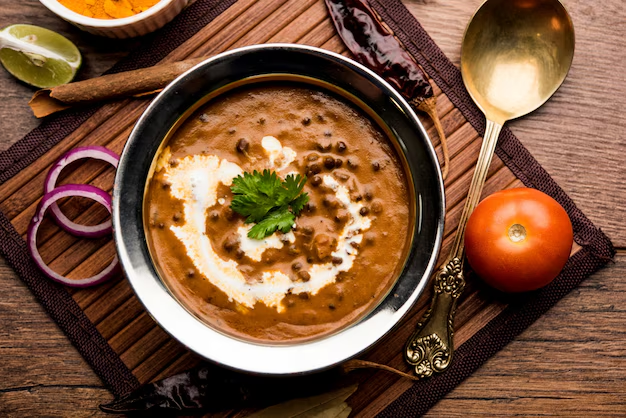
There is a reason dal makhani appears on the menu of nearly every Indian restaurant on the planet — from Delhi dhabas to Michelin-starred Indian restaurants in London and New York. It is the vegetarian dish that needs no apology, no comparison to meat, and no asterisk. It is simply one of the great dishes of Indian cuisine, full stop.
A truly great dal makhani is a study in contrasts. The base is humble — whole black urad dal and kidney beans, two of the most common and inexpensive legumes in Indian cooking. But the process transforms them into something extraordinary: velvety, rich, deeply flavoured from a long, slow simmer, finished with enough butter and cream to make even devoted non-vegetarians pause and reconsider.
The secret is time. Dal makhani cannot be rushed. The long, low simmer — 60 to 90 minutes after pressure cooking, with regular stirring — is what breaks down the dal to that characteristic creamy consistency, what allows the tomato masala to absorb into the lentils, and what creates the deep, complex flavour that separates restaurant dal makhani from a quick weeknight pot of dal.
This recipe gives you the full authentic method, the Instant Pot shortcut, the optional dhungar smoking technique for that tandoor-style depth, and everything you need to know to get the result right on the first attempt.
The Origin Story: From Moti Mahal to Every Table
Dal makhani’s story begins in Delhi in the 1950s, at Moti Mahal — the restaurant founded by Kundan Lal Gujral and later developed by Kundan Lal Jaggi after Partition. Moti Mahal is credited with creating or popularising several of the most iconic dishes in Indian restaurant cuisine: tandoori chicken, butter chicken, and dal makhani.
The dish evolved from maa ki dal — literally “mother’s dal” — a simple, slow-cooked whole urad dal that had been a staple of Punjabi home kitchens for generations. Traditionally, soaked black lentils were placed in a clay pot and left to simmer overnight on the residual heat of a tandoor (clay oven), with nothing more than salt and perhaps a little ghee. By morning, the dal was impossibly soft and creamy from the long, gentle heat.
Moti Mahal’s cooks added the tomato masala, the generous butter and cream enrichment, and the characteristic smoky finish from cooking over coal and wood fires. What had been simple home food became a luxurious restaurant centrepiece — the vegetarian rival to butter chicken, eaten at the same table, from the same menu.
Understanding this history helps explain the recipe: dal makhani is meant to taste like it has been cooking for hours, because it has. No shortcut fully replaces the slow simmer. But knowing the original method helps you get closer to it in a modern home kitchen.
Why These Specific Ingredients Matter
Whole Urad Dal — Non-Negotiable
Whole urad dal (whole black gram, with the skin intact) is the backbone of dal makhani, and there is no substitute. When cooked long and slow, the starch from the urad dal naturally emulsifies with the cooking liquid to create a thick, viscous, almost creamy consistency — without any added thickener. This is the texture that defines dal makhani. Split urad dal, chana dal, or any other legume behaves differently and cannot replicate this. Use whole urad dal, full stop.
Rajma — The Supporting Role
Red kidney beans (rajma) add body, a slightly different texture, and a mild earthiness that balances the rich dal. The standard ratio is 1 cup urad dal to ¼ cup rajma. The rajma should be fully cooked but holding its shape — it provides a textural contrast to the mashed, creamy urad dal base.
The Butter and Ghee Combination
The masala is cooked in a combination of ghee and butter. The reason is practical: butter alone burns easily at the temperatures needed to properly sauté onions to golden. Ghee has a higher smoke point and stabilises the butter, allowing both to work together without scorching. The finishing butter — stirred in after the heat is off — is what creates the final gloss and richness on the surface of the dal.
Kashmiri Red Chilli Powder
Kashmiri chilli powder is essential for two reasons: its vibrant, deep red colour (which gives restaurant dal makhani its characteristic russet hue) and its mild, fruity heat (which adds flavour without overwhelming the dish with spice). Regular red chilli powder can be used in a smaller quantity, but the colour and flavour profile will differ. Paprika is a reasonable substitute for the colour if Kashmiri chilli is unavailable.
Kasuri Methi — The Flavour Bridge
Dried fenugreek leaves, crushed between the palms before adding, provide a slightly bitter, herbaceous note that acts as a flavour bridge between the rich masala and the cream. It is what stops the dal from tasting too heavy or one-dimensional. Always add it crushed — the act of crushing between the palms releases the volatile aromatic compounds.
Cream — The Finishing Touch
Heavy cream, whipping cream, or fresh homemade malai all work. Stir it in near the end of cooking rather than at the beginning — adding cream too early causes it to split at the high temperatures of the initial cooking. The cream needs 6-10 minutes of gentle simmering to properly integrate into the dal.
Ingredients (Serves 4-5)
For Cooking the Lentils
| Ingredient | Amount |
|---|---|
| Whole urad dal (black gram) | 1 cup / 200g |
| Rajma (red kidney beans) | ¼ cup / 55g |
| Water (for pressure cooking) | 4 cups / 960ml |
For the Masala
| Ingredient | Amount | Notes |
|---|---|---|
| Ghee | 2 tbsp | Prevents butter from burning |
| Unsalted butter | 3 tbsp | Cultured butter preferred |
| Onion, finely chopped | ½ cup / 65g | 1 small-medium onion |
| Ginger-garlic paste | 1 tbsp | Or ¾ tbsp each grated fresh |
| Tomato puree | 1 cup / 220g | Passata or 2-3 blended fresh tomatoes |
| Kashmiri red chilli powder | ¾–1½ tsp | Adjust to colour and heat preference |
| Garam masala | 1 tsp + ½ tsp finishing | Punjabi garam masala preferred |
| Salt | 1 tsp | Adjust to taste |
| Hot water | 2 cups / 480ml | Added in stages during simmer |
| Kasuri methi | 1 tbsp | Crush between palms before adding |
| Heavy cream | ¼–⅓ cup / 60–80ml | Added near the end |
Optional whole spices (for tempering): 1 bay leaf, 2 green cardamom, 1 black cardamom
How to Make Dal Makhani: Step-by-Step
Soaking time: 8 hours (or overnight) Cook time: ~2 hours Total time: ~2 hours 15 minutes (after soaking) Serves: 4-5
Stage 1 — Soak (The Night Before)
Rinse the urad dal and rajma 4-5 times under cold water until the water runs clear. Transfer to a large bowl, cover with 4 cups of cold water, and soak for 8 hours or overnight.
Short soak option: Cover with freshly boiled water and soak for 4 hours. This accelerates the process but overnight soaking gives better results.
Why soaking matters: Urad dal and rajma both have thick skins and hard centres. Adequate soaking begins the process of hydrating the starches and softening the skins, which is essential for achieving the smooth, creamy texture of restaurant dal makhani. Under-soaked lentils take longer to pressure cook and may never reach the right creaminess.
Drain and rinse the soaked lentils before cooking.
Stage 2 — Pressure Cook Until Completely Soft
Add the drained lentils to a pressure cooker with 4 cups of fresh water (no salt at this stage — salt can toughen legume skins during cooking). Pressure cook for 10 whistles on medium heat (approximately 35-40 minutes), then allow the pressure to release naturally.
Open and test: press a few urad dal grains between your fingers. They should mash completely with minimal pressure — smooth, with no chalky or hard centre. The rajma should be fully tender but mostly holding its shape. If the dal is still firm, add ½ cup hot water and pressure cook for 3-4 more whistles.
This step is not negotiable: The dal must be completely soft before the masala is added. Tomatoes are acidic, and acid prevents legumes from softening further once added. If you add the masala to under-cooked dal, the dal will remain grainy and dense no matter how long you simmer it.
Stage 3 — Build the Masala (12-15 Minutes)
Heat 2 tbsp ghee and 1 tbsp butter in a heavy-bottomed pot (cast iron or thick aluminium) over medium heat. Add the whole spices if using — bay leaf, green cardamom, black cardamom — and let them sizzle for 20-30 seconds.
Add the finely chopped onion and cook on medium heat for 7-8 minutes, stirring regularly, until golden and beginning to caramelise at the edges. Add the ginger-garlic paste and cook for 1 minute until the raw smell disappears.
Add the tomato puree. Cook on medium heat for 3-4 minutes, stirring frequently, until the tomato darkens and thickens. Add the salt, Kashmiri chilli powder, and 1 tsp garam masala. Stir well and cook for a further 4-5 minutes until the masala is thick, glossy, and fragrant, and the ghee-butter mixture appears at the edges of the masala.
Stage 4 — The Long Slow Simmer (60-90 Minutes)
Mash the cooked dal lightly with the back of a spoon — roughly 20-30% mashed, with the rest left whole for texture. Add the dal and all its cooking liquid to the masala pot. Add 1 cup of hot water. Stir to combine thoroughly.
Bring to a gentle boil, then reduce to the lowest possible flame. This is the most important stage of the recipe. Cook on the lowest heat, stirring every 5-7 minutes to prevent the dal from sticking and burning on the base.
After approximately 45-60 minutes, the dal will have thickened considerably. Add another ½-1 cup of hot water and continue simmering for 30-45 more minutes. The finished dal should be thick, deeply coloured, and visibly glossy — when you stir it, it should move in slow, heavy waves rather than flowing freely like a soup.
The total simmer time from when the dal goes in should be 60-90 minutes. Longer (up to 2-3 hours on the very lowest flame) produces an even deeper, more complex result. This patience is what distinguishes homemade dal makhani from quick versions.
Stage 5 — The Creamy Finish
Taste and adjust salt. Add an extra ½ tsp garam masala if the spice level feels flat. Crush the kasuri methi between your palms and stir it in.
Pour in the cream and stir well. Cook on low heat for 6-10 minutes, stirring regularly, until the cream is fully integrated and the dal has a visibly silky texture. Turn off the heat. Add the remaining 2 tbsp of butter (cut into pieces) and stir through until melted. The finishing butter should not be cooked — it is stirred in off the heat for maximum richness and gloss.
Serve immediately, garnished with a swirl of cream, a small knob of butter, and a pinch of crushed kasuri methi.
Instant Pot Dal Makhani (Faster Method)
For days when the full stovetop method isn’t practical, the Instant Pot produces excellent results in significantly less time.
- Set Instant Pot to Sauté mode. Heat ghee + 1 tbsp butter and sauté onions for 5 minutes until golden. Add ginger-garlic paste for 1 minute, then tomato puree, chilli powder, garam masala, and salt for 3-4 minutes.
- Add the soaked, drained lentils and 3 cups of water. Stir well.
- Cancel Sauté, seal the lid, and set to High Pressure for 30 minutes.
- Allow natural pressure release for 15 minutes, then manually release any remaining pressure.
- Open and mash some of the urad dal (not the rajma). Set to Sauté on Low. Add 1 cup hot water and simmer for 12-15 minutes, stirring frequently.
- Add another cup of hot water if needed and simmer 12-15 more minutes.
- Finish with kasuri methi, cream, extra garam masala if desired, and butter off the heat.
Instant Pot note: The Instant Pot version is quicker but the dal will not develop the same depth as the stovetop slow simmer. If time allows, after pressure cooking, transfer to a heavy stovetop pot and simmer for 30-45 minutes on the lowest flame — the difference in flavour is significant.
The Dhungar Smoking Technique (Optional but Transformative)
The smoky depth you taste in great restaurant dal makhani comes from the coal or wood fire the dal was traditionally cooked over. The dhungar (smoke infusion) technique replicates this at home.
How to do it:
- When the dal is fully cooked and finished, place a small piece of natural hardwood charcoal (not briquettes with additives) directly over a gas flame using tongs. Heat for 3-4 minutes until it is glowing red and covered in a thin layer of grey ash.
- Create a small foil cup (a double layer of heavy-duty foil shaped into a small bowl). Place it in the centre of the dal, ensuring the foil sits above the surface of the dal and not submerged in it.
- Place the hot charcoal in the foil cup using tongs. Pour ¼ teaspoon of ghee directly onto the coal — it will immediately begin to smoke.
- Cover the pot with a tight lid immediately. Leave for 3-4 minutes.
- Remove the foil cup and charcoal and discard. Stir the dal gently — the smoke will have infused through.
A word of caution: Use only natural hardwood charcoal with no additives, lighter fluid, or chemical accelerants. The smoke from treated charcoal is not safe to use with food. This step is entirely optional — the dal is excellent without it — but for a special occasion or when you want to replicate the exact restaurant experience, dhungar makes a remarkable difference.
Dal Makhani vs Maa Ki Dal: What’s the Difference?
| Dal Makhani | Maa Ki Dal | |
|---|---|---|
| Lentil base | Whole urad dal + rajma | Whole urad dal only |
| Cream | Yes (essential) | No, or very little |
| Butter | Generous (2-3 tbsp + finishing) | Minimal |
| Tomato masala | Full masala with onion | Simple, minimal |
| Cook time | 2+ hours | 2-3 hours (overnight traditionally) |
| Character | Rich, restaurant-style | Simple, home-style, more earthy |
| Origin | Restaurant (Moti Mahal, Delhi) | Punjabi home kitchen |
Vegan Dal Makhani
Dal makhani adapts beautifully to a fully vegan version:
- Replace ghee and butter with neutral oil (refined coconut oil works well)
- Replace cream with cashew cream: soak ¼ cup cashews in ½ cup boiling water for 20 minutes, blend until completely smooth, stir into the dal in the last 5 minutes of cooking
- The result is rich, creamy, and very close to the original — the cashew cream provides a similar fat content and silky texture
Do not use coconut milk — the coconut flavour competes with the spices and changes the character of the dish entirely.
Serving Suggestions
Dal makhani is rich enough to anchor a complete meal with minimal accompaniments:
- Jeera rice — The cumin in jeera rice complements the dal’s spice profile beautifully; the classic combination
- Plain basmati rice — Lets the dal’s flavour take centre stage
- Butter naan or garlic naan — The restaurant combination; perfect for scooping
- Tandoori roti — Lighter than naan, good for a less indulgent pairing
- Phulka — The everyday Punjabi pairing that keeps the meal balanced
- Garnish: A swirl of fresh cream, a pat of butter melting on the surface, and a pinch of kasuri methi
Storage, Freezing, and Reheating
| Method | Duration | Notes |
|---|---|---|
| Refrigerator | 2-3 days | Thickens when cold — add water when reheating |
| Freezer | Up to 3 months | Freeze before adding cream/butter; add fresh when reheating |
| Reheating (stovetop) | Warm on low with splash of water | Stir frequently; add cream and butter fresh |
| Reheating (Instant Pot) | High pressure 3-4 min, no extra water | Good for frozen portions |
Pro storage tip: If making a large batch for the week or for freezing, omit the cream, butter, and kasuri methi during the initial cooking. Store the base. When reheating, add the cream, butter, and kasuri methi fresh — this gives you a perfectly fresh-tasting dal every time you reheat.
Nutrition Profile (Per Serving)
| Nutrient | Amount |
|---|---|
| Calories | 410 kcal |
| Protein | 15g |
| Carbohydrates | 37g |
| Fibre | 16g |
| Fat | 22g (Saturated: 13g) |
| Iron | 5mg |
| Calcium | 72mg |
| Potassium | 350mg |
| Vitamin A | 664 IU |
Dal makhani is exceptionally high in dietary fibre (16g per serving — more than half the recommended daily intake) from the urad dal skins and rajma. The urad dal is rich in iron, magnesium, and B vitamins. The protein content (15g per serving) makes it one of the most protein-dense vegetarian dal preparations.
Frequently Asked Questions
Q1. Why is my dal makhani not creamy?
The most common reason is that the urad dal was not cooked soft enough before the masala was added. Tomatoes contain acid, which prevents legumes from softening further once added to the pot. Test the dal thoroughly after pressure cooking — it must mash completely between your fingers with no resistance. The second reason is insufficient simmer time: the creamy, emulsified consistency only develops after 60+ minutes of slow simmering. If your dal is grainy or thin, continue simmering on the lowest possible heat.
Q2. Can I make dal makhani without soaking overnight?
You can use the quick soak method: cover the lentils with just-boiled water and soak for 4 hours. This is significantly better than no soak at all. Completely unsoaked whole urad dal requires a much longer pressure cooking time and may not achieve the right texture. If you are completely out of time, increase the pressure cooking to 15-18 whistles (stovetop) or 40 minutes (Instant Pot) and check doneness carefully before proceeding.
Q3. How do I make dal makhani less rich without losing the flavour?
The richness in dal makhani comes primarily from the butter and cream. The flavour, however, comes primarily from the masala, the long simmer, and the kasuri methi — not from the fat. You can reduce the cream to 2 tablespoons and the finishing butter to 1 tablespoon without significantly compromising the depth of flavour. The texture will be slightly less silky, but the taste will remain. Alternatively, keep the full recipe as written and serve slightly smaller portions — the dal is filling enough that a smaller portion is still satisfying.
Q4. What is the difference between dal makhani and dal tadka?
Dal makhani uses whole urad dal and rajma, with a slow-cooked masala and cream-and-butter enrichment. The defining characteristic is the long simmer and the creamy, velvety finish. Dal tadka uses toor dal (split pigeon pea), is cooked faster, and is finished with a separate crackling hot tempering of ghee, cumin, and garlic poured over the top just before serving. Dal makhani is richer and more time-intensive; dal tadka is quicker and lighter. Both are quintessentially Punjabi, but they serve different occasions — dal makhani for a special meal, dal tadka for a satisfying everyday dinner.
Q5. Can I freeze dal makhani?
Yes, dal makhani freezes exceptionally well for up to 3 months. The key is to freeze the base before adding the cream and butter. Cool the cooked dal quickly (an ice bath around the pot works well), portion into freezer-safe containers, and freeze within 2 hours of cooking. When reheating, warm on the stovetop with a splash of water, then stir in fresh cream and butter just before serving. This method gives you restaurant-quality dal makhani ready in 15 minutes from frozen.
The Dal Worth Every Minute
Dal makhani is not the dish you make on a Tuesday night when you have 30 minutes and nothing planned. It is the dish you make on a Sunday afternoon, when the kitchen fills with the smell of slow-cooking dal and spices, and everyone finds a reason to wander in and ask what’s for dinner.
It rewards patience. The 90-minute simmer. The regular stirring. The patience to not rush the cream in too early, not skip the kasuri methi, not shortcut the masala. These are the choices that separate good dal makhani from extraordinary dal makhani — the kind that earns that “better than the restaurant” response you were hoping for.
Made this dal makhani? Leave a star rating and a comment below — tell us whether you tried the dhungar smoking method, how long you simmered it, and what you served it with. And if this is your first time making it, let us know in the comments — the first dal makhani is always a moment worth marking.
More Punjabi and North Indian recipes on KitchenWhisper.in:
- Punjabi Dal Tadka – Dhaba Style at Home
- Chicken Rogan Josh – Kashmiri Slow-Cooked Curry
- Hyderabadi Biryani – Authentic Kacchi Dum Method
- Kala Chana Curry – Black Chickpeas Recipe
- Chicken Keema Curry – Quick Weeknight Dinner