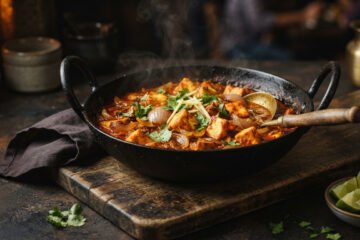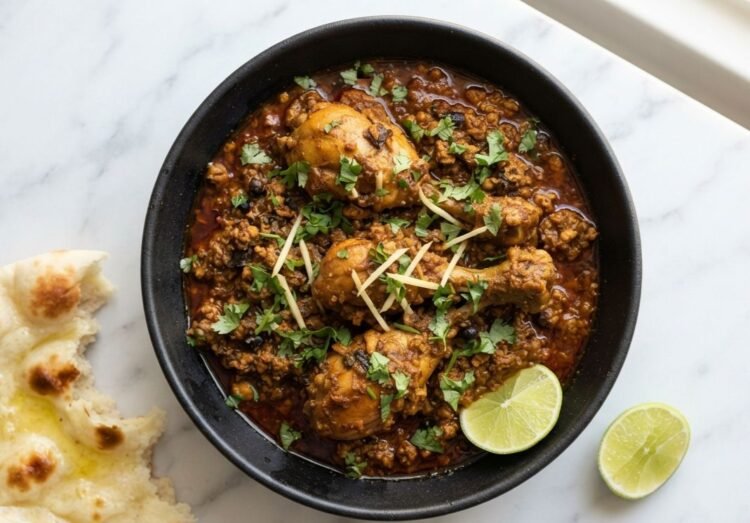
Most chicken curries work with a single form of the protein — pieces on the bone, or boneless cubes, or occasionally shredded meat. Rara chicken does something different. It uses both bone-in chicken pieces and minced chicken (kheema) cooked simultaneously in the same thick, deeply spiced gravy. The mince dissolves almost entirely into the sauce as it cooks, binding with the masala and creating a gravy that is richer, denser, and more intensely flavoured than any single-form chicken curry can produce. The bone-in pieces then cook in this gravy, absorbing every layer of flavour.
The result is a dish that looks like a chicken curry and eats like something between a curry and a kheema — with a thick, almost dry-gravied texture that clings to bread and coats rice in a way that thinner curries simply cannot.
Rara chicken is not especially well-known outside the North Indian restaurant circuit and the highway dhaba culture of Punjab and Himachal Pradesh, but among the people who know it, it occupies a position of quiet authority. This guide gives you the complete recipe — the rara masala blend made from scratch, the full method, the technique notes, the troubleshooting table, and all the useful variations including a vegan tofu version for plant-based households.
The Origin of Rara Chicken: Punjab, Himachal, or Lucknow?
The precise origin of rara chicken is genuinely disputed among food historians and culinary writers. Three regions claim it:
- Punjab — where dhaba culture produced some of the most robust, unapologetically spiced chicken preparations in Indian cooking, and where the combination of kheema and whole pieces in one dish would be entirely at home
- Himachal Pradesh — where mountain-region cooking tends toward richer, more concentrated gravies given the cold climate and the need for warming, substantial food
- Lucknowi Awadhi cuisine — where the practice of combining different textures of the same protein in one dish has deep roots, and where the word “rara” may have its earliest documented culinary use
What is not disputed is the technique itself — the double-protein method is what defines this dish in every regional interpretation, and the name has become synonymous with that approach across North Indian restaurant menus.
What Makes Rara Chicken Different: The Double-Protein Technique
The defining characteristic of rara chicken is the two forms of chicken cooked in the same gravy:
Form 1 — Minced chicken (kheema): Added to the masala base early in the cooking process. As it cooks, the mince releases its fat, proteins, and juices directly into the sauce. It essentially becomes the gravy — binding with the spiced tomato base to create a thick, almost meat-paste consistency that is the unique foundation of the rara texture.
Form 2 — Bone-in chicken pieces: Added after the kheema-masala base has cooked down. These pieces simmer in the kheema-enriched gravy, their bones contributing gelatin and depth, and their meat absorbing the spiced base.
This combination produces a gravy that is simultaneously:
- Thicker than a standard chicken curry — the mince binds the sauce in a way tomatoes and onion alone cannot
- More intensely flavoured — the kheema’s fat and juices are cooked directly into the masala rather than sitting separately in a water-based broth
- More texturally complex — tender pieces of chicken on the bone within a thick, almost granular kheema-spiced base
Rara Masala: The Spice Blend Made from Scratch
The rara masala is not a complex blend — it is a small, precise combination of whole spices that are toasted and ground fresh. The key is the toasting step: dry-roasting the whole spices before grinding melds the flavours and prevents any single spice from dominating.
Rara Masala Ingredients
| Spice | Quantity | Role |
|---|---|---|
| Black peppercorns | 12 whole | Heat and depth |
| Whole cloves | 3 | Warmth and slight sweetness |
| Green cardamom pods | 2 | Floral, cooling note |
| Black cardamom pod | 1 | Smoky, camphor-like depth |
| Bay leaf | 1 | Earthy background note |
| Fennel seeds | ¼ tsp | Subtle anise note; ties the blend together |
| Ground nutmeg | ¼ tsp | Added after grinding, not toasted |
How to Make Rara Masala
- Heat a dry skillet over medium heat — no oil.
- Add the peppercorns, cloves, both cardamoms (green and black), bay leaf, and fennel seeds.
- Toast for 3–4 minutes, stirring regularly, until the fennel seeds change colour and the spices are aromatic. The bay leaf should be slightly dry and curled. Do not let any spice burn.
- Remove from heat. Tear the bay leaf into 2–3 pieces (this helps it grind more completely — bay leaf is tough and can leave large shards in the powder if added whole).
- Cool for 2 minutes. Grind to a fine powder in a spice grinder or mortar and pestle. The bay leaf must be completely powdered — check and re-grind if any pieces remain.
- Add the ground nutmeg and mix. The masala is ready.
Makes enough for one full batch of rara chicken. This masala is split between the marination of the meat and the curry sauce.
Full Chicken Rara Recipe (Serves 4)
Ingredients
For the Marinade
| Ingredient | Amount | Notes |
|---|---|---|
| Bone-in chicken pieces | 500g | Curry-cut: drumsticks, thighs, bone-in breast pieces |
| Chicken mince (kheema) | 250g | Preferably thigh mince for more fat and flavour |
| Yogurt (curd) | 3 tbsp | Full-fat, whisked |
| Red chilli powder | ½ tsp | |
| Turmeric | ¼ tsp | |
| Ginger-garlic paste | 1 tsp | |
| Half the rara masala | Use half the batch made above | |
| Salt | ¾ tsp |
For the Curry Sauce
| Ingredient | Amount | Notes |
|---|---|---|
| Oil | 2 tbsp | Or ghee for richer flavour |
| Cumin seeds | ½ tsp | |
| Black cardamom | 1 pod, partially opened | |
| Cinnamon stick | 2 inches | |
| Red onion, finely chopped | 1½ cups (2 medium onions) | Red onion preferred for sweetness and colour |
| Ginger-garlic paste | 2 tbsp | |
| Hot green chilli | ½ (or to taste) | Serrano or Indian green chilli, finely chopped |
| Ground coriander | 2 tsp | |
| Kashmiri red chilli powder | 1½ tsp | For colour and mild heat; substitute paprika if unavailable |
| Tomato puree | ½ cup (4 oz) | Canned; or ¾ cup blended fresh tomatoes |
| Water or stock | 1–1½ cups | Adjust for consistency |
| Salt | ½ tsp (adjust to taste) | |
| Remaining rara masala | Second half of the batch | Added to the sauce |
| Fresh coriander | 2 tbsp, chopped | Finishing garnish |
| Lime juice | 1 tsp | Finishing; brightens the whole dish |
| Butter or ghee | 1 tsp (optional) | Finishing richness |
Method: Step-by-Step
Prep time: 15 minutes (plus 30 min marination)
Cook time: 50 minutes
Total time: About 1 hour 10 minutes
Stage 1 — Marinate the Chicken
Combine the bone-in chicken pieces and chicken mince in a large bowl. Add the yogurt, red chilli powder, turmeric, ginger-garlic paste, half the rara masala, and salt. Mix thoroughly so all the chicken is coated. Marinate for a minimum of 30 minutes at room temperature — or refrigerate for up to 4 hours for deeper flavour. Longer marination is better whenever time allows.
Stage 2 — Caramelise the Onion (The Foundation Step)
Heat 2 tbsp oil in a heavy-bottomed kadai or Dutch oven on medium-high heat. Add cumin seeds and let them sizzle for 30–45 seconds until they darken. Add the partially opened black cardamom and cinnamon stick. Sauté 30 seconds until aromatic.
Add the finely chopped red onion and ¼ tsp salt. Cook on medium-high heat, stirring regularly, for 8–12 minutes until the onion turns deep golden brown. Add small splashes of water (1–2 tbsp at a time) if the onion begins to stick or dry out — this helps the browning proceed evenly without burning. Reduce heat to medium after about 6–7 minutes.
Do not rush this step. Properly caramelised onion is the backbone of rara chicken’s distinctive flavour — it needs to reach a deep gold, not pale translucent. Under-cooked onion produces a sharp, raw undertone in the finished curry that no amount of spice can fix.
Stage 3 — Build the Spiced Base
Add the ginger-garlic paste and chopped green chilli. Sauté for 2 minutes until the raw smell is gone.
Add the ground coriander, Kashmiri chilli powder, and remaining rara masala. Stir and cook for 1 minute, adding a splash of water if the spices begin to stick. The spices should cook in the oil-onion mixture — this brief cooking step blooms their flavour and prevents the raw powdery taste in the finished dish.
Add the tomato puree. Stir and cook for 3–4 minutes until the tomato reduces, darkens slightly, and the oil begins to separate from the edges of the masala.
Stage 4 — Cook the Chicken Mince into the Masala
Add only the marinated chicken mince (kheema) to the masala — set the bone-in pieces aside for now.
Break the mince apart with a spatula as it enters the pan. Cook on medium heat for 8–10 minutes, stirring regularly, until the mince is fully cooked through and has bound with the tomato-onion masala into a thick, cohesive base. The mixture will look almost dry at this stage — this is correct.
Add ½ cup water or stock. Stir to loosen the base.
Stage 5 — Add the Bone-In Chicken
Add the marinated bone-in chicken pieces. Turn them to coat in the kheema masala base.
Add another ½–1 cup of water or stock. The liquid should come about halfway up the chicken pieces.
Cover and cook on medium heat for 20–25 minutes, turning the chicken pieces once halfway through, until the chicken is fully cooked (juices run clear when pierced at the thickest point; internal temperature 74°C / 165°F).
Stage 6 — Finish and Serve
Remove the lid. If the gravy is thinner than desired, increase heat to medium-high and cook uncovered for 3–5 minutes to reduce. The finished rara chicken should have a thick, clinging gravy — not a thin soup-like consistency.
Add the finishing butter or ghee (optional) and stir through. Garnish generously with fresh coriander and a squeeze of lime juice. Serve immediately.
Rara Chicken Troubleshooting
| Problem | Likely Cause | Fix |
|---|---|---|
| Thin, watery gravy | Too much water; insufficient simmering | Simmer uncovered 5–10 min to reduce; mince should thicken the base naturally |
| Mince clumping in gravy | Added in one mass without breaking apart | Always break mince as it enters the pan; stir constantly first 2–3 min |
| Bland, flat flavour | Onion undercooked; spices not toasted; masala added raw | Caramelise onion to deep gold; never skip toasting; cook spices in oil-masala before adding liquid |
| Chicken pieces undercooked | Insufficient simmering time; pieces too large | Add 10 more min simmering; ensure pieces are curry-cut size, not oversized |
| Rara masala dominated by one spice | Spices not toasted before grinding; imbalanced blend | Toast ALL whole spices together; toasting melds the flavours into a cohesive blend |
| Gravy too sour | Tomato puree too acidic; too much added | Add a pinch of sugar to balance; reduce tomato quantity next time |
| Colour too pale | Paprika used instead of Kashmiri chilli; insufficient quantity | Use Kashmiri chilli powder specifically; add ½ tsp more for colour depth |
Rara Chicken vs Other North Indian Chicken Curries
| Feature | Rara Chicken | Chicken Masala | Murgh Makhani (Butter Chicken) |
|---|---|---|---|
| Protein form | Bone-in pieces + minced chicken | Bone-in or boneless pieces only | Usually boneless, marinated, grilled |
| Gravy thickness | Very thick, almost dry | Medium | Smooth, medium-thin |
| Primary dairy | Optional yogurt in marinade | Often yogurt-based | Heavy cream, butter |
| Key technique | Double-protein; kheema dissolves into masala | Standard bhuno masala | Tomato-cream blending |
| Spice profile | Earthy, complex, warming whole spices | Varies widely | Mild, sweet, aromatic |
| Cook time | ~50 minutes | ~40 minutes | ~40 minutes + marination |
| Best served with | Naan, paratha, rice | Roti, rice | Naan, butter roti |
| Dhaba or restaurant | Quintessentially dhaba | Both | Restaurant |
Variations
Vegan Rara — Tofu Version
Replace the bone-in chicken with 350g firm tofu (pressed, torn into pieces) and the chicken mince with 100g crumbled tofu or cooked green lentils. Coat the torn tofu in cornstarch, the rara masala, Kashmiri chilli powder, garlic powder, and salt. Pan-fry or bake at 205°C / 400°F for 20 minutes until golden. Add the crumbled tofu/lentils to the masala as the “mince” in Stage 4. Add the crisped tofu in Stage 5. Use water or vegetable stock instead of chicken stock.
Mutton Rara (Rara Gosht)
Replace chicken pieces with bone-in mutton and lamb mince. Increase the cooking time significantly — pressure cook for 4–5 whistles or simmer for 45–50 minutes. The result is an even richer, more deeply flavoured rara that is considered the original form of this dish by some culinary historians.
Restaurant-Style Creamy Rara
Add 3 tbsp fresh cream and 1 tsp butter at the very end. Stir through and serve immediately. The cream softens the heat slightly and produces a richer, restaurant-style finish that pairs particularly well with butter naan.
Serving Suggestions
Rara chicken’s thick, clinging gravy makes it ideal for bread-based pairings:
- Butter naan or garlic naan — the richest, most satisfying pairing
- Laccha paratha — the layered flaky texture complements the dense gravy
- Tandoori roti or phulka — lighter, everyday pairing
- Steamed basmati rice — the gravy’s density means it coats rice well without becoming a soup
- Jeera rice — the cumin in the rice complements the whole spice character of the rara masala
A kachumber salad (cucumber, onion, tomato, lemon) and a simple raita alongside complete the meal.
Storage
| Method | Duration | Notes |
|---|---|---|
| Refrigerator | 3 days | In an airtight container; reheat on stovetop with 2–3 tbsp water |
| Freezer | Up to 3 months | Freeze in portions; thaw overnight in fridge; reheat gently |
| Make-ahead | Masala base | The kheema-masala base (Stages 2–4) can be made 1 day ahead; refrigerate and add bone-in chicken at serving time |
Nutrition Profile (Per Serving — Serves 4)
| Nutrient | Amount |
|---|---|
| Calories | ~380 kcal |
| Protein | 38g |
| Carbohydrates | 10g |
| Total Fat | 21g |
| Saturated Fat | 6g |
| Dietary Fibre | 2.5g |
| Sodium | 540mg |
| Iron | 2.5mg |
| Calcium | 45mg |
Values are estimates for the chicken version with oil. Values will vary based on cuts used and optional butter/cream additions.
Frequently Asked Questions
Q1. What is rara chicken and what makes it different from regular chicken curry?
Rara chicken is a North Indian curry that uses two forms of chicken in the same dish: bone-in pieces and chicken mince (kheema). The mince is cooked into the spiced tomato-onion masala first, where it essentially becomes part of the gravy — binding with the sauce to create an unusually thick, rich, almost meat-paste consistency. The bone-in pieces then simmer in this kheema-enriched base. This double-protein technique produces a gravy that is significantly thicker, more intensely flavoured, and more texturally complex than any single-form chicken curry.
Q2. Can I make rara chicken without the homemade rara masala? Can I use store-bought garam masala?
You can substitute store-bought garam masala in a pinch, but the character of the dish will be noticeably different. The rara masala’s specific combination — black cardamom for smokiness, fennel for a subtle anise note, the toasted bay leaf for earthiness — is what gives rara chicken its distinctive flavour profile. Standard garam masala lacks the fennel and the black cardamom that define this blend. If making the blend from scratch is not possible, use ¾ tsp garam masala + ¼ tsp fennel powder as the closest substitute, but the full homemade blend is worth the 10-minute effort.
Q3. What cut of chicken works best for rara chicken?
Curry-cut bone-in pieces — a mix of drumsticks, thighs, and bone-in breast portions — are the best choice. The bone contributes gelatin and depth to the gravy as the chicken simmers, which is part of what makes the rara sauce so rich. Boneless chicken can be used for convenience, but the gravy will be thinner and less complex. For the mince, thigh mince is strongly preferred over breast mince because of its higher fat content — the fat from the kheema is what binds and enriches the masala base.
Q4. Why is my rara chicken gravy thin instead of thick?
Rara chicken is meant to have a very thick gravy — almost a dry masala coating on the meat rather than a loose soup-like curry. If the gravy is thin, there are three likely causes: too much water was added during cooking (add it in small additions and stop when the gravy reaches the right consistency); the kheema was not cooked into the masala long enough in Stage 4 (the mince needs 8–10 minutes to fully bind with the tomato base before liquid is added); or the final uncovered reduction step was skipped (simmering uncovered for 5–8 minutes at the end removes excess water and concentrates the flavours). The natural thickening from the kheema is the most important factor — if the mince was cooked correctly into the masala, the gravy will reach the right consistency naturally.
Q5. Is rara chicken very spicy? Can I make it milder?
Rara chicken is a robustly spiced curry, but most of its spicing comes from warming whole spices (cardamom, cloves, peppercorn) rather than pure heat from chilli. The Kashmiri red chilli powder used in both the masala and the sauce is a mild chilli variety prized primarily for its deep red colour rather than intense heat — it is significantly milder than regular red chilli powder. To make a milder version, reduce or omit the green chilli and use only Kashmiri chilli (not regular chilli powder). To increase heat, add more fresh green chilli or substitute a portion of Kashmiri chilli with standard red chilli powder.
Make It This Weekend
Rara chicken is the kind of dish that rewards a little extra time — the hand-ground masala, the caramelised onion, the two-stage protein addition — but none of these steps are difficult, and every one of them is purposeful. The result is a curry that tastes unmistakably like it came from somewhere specific: the roadside dhaba where a cook who has been making this dish for twenty years adds the mince with no measuring spoon and the kheema dissolves into the masala in exactly the way it has always dissolved.
That is the dish this recipe produces. Not a restaurant approximation. The real thing.
Made this recipe? Drop a comment below — tell us whether you made the classic chicken version or tried the tofu variation, and what you served it with. Your experience helps every cook who reads this after you.
More North Indian chicken and meat curry recipes on KitchenWhisper.in:
- Hyderabadi Biryani Recipe: The Authentic Kacchi Dum Method, Fully Explained
- Chicken Keema Curry: The 30-Minute Indian Mince Curry That Always Impresses
- Spicy and Flavorful Andhra Chicken Recipes
- Creamy Chicken Handi Recipe – Traditional Mughlai Delight
- Spicy Masala Chicken Recipe – Indian-Style Dry Chicken Delight