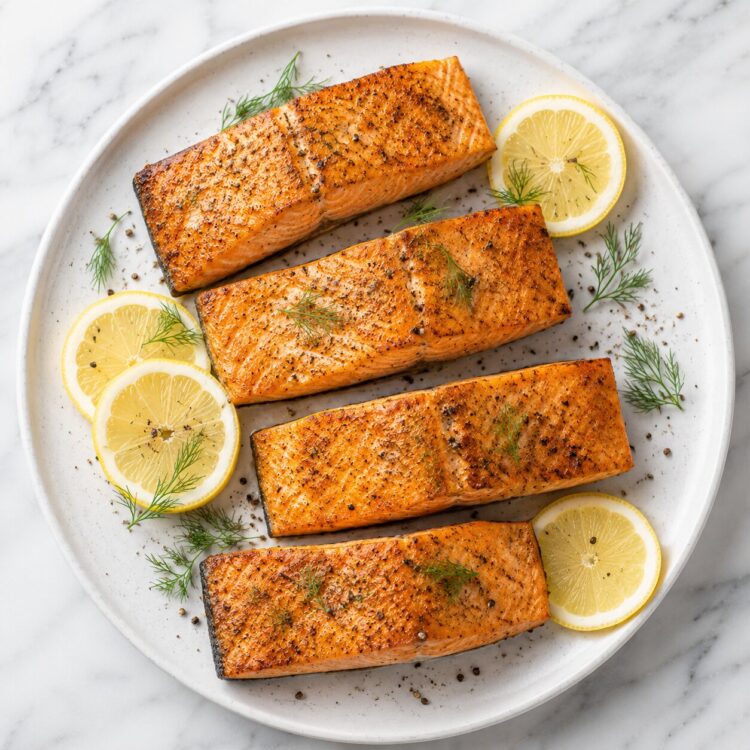
There is a version of salmon that most home cooks have never managed to produce consistently at home and it is not because the technique is difficult. It is because the method they are using is working against them.
Oven-baked salmon produces good results but requires 18-22 minutes and often leaves the skin flabby. Pan-seared salmon is excellent but demands active attention, constant temperature management, and a kitchen that smells like fish for two hours afterward. Poached salmon is the safest approach but produces a texture that is soft rather than properly firm and flaky.
Air fryer salmon solves all three problems simultaneously. In 10 minutes total including 3 minutes of prep you have a salmon fillet with a lightly crisped, golden surface on the flesh side, skin that has tightened and crisped from underneath, and a juicy, perfectly flaky interior that comes apart in the tender, cohesive layers that are the hallmark of properly cooked salmon.
No flipping. No watching. No smoke. Six ingredients. Four portions of genuinely excellent salmon in the time it takes to put something in the microwave and wait.
This guide covers everything you need: the right salmon to buy, the seasoning science behind a six-ingredient mix that works every time, the temperature and timing explained, six marinade and topping variations, serving ideas, and the complete answers to every question that comes up when making air fryer salmon for the first time.
Why the Air Fryer Is the Best Way to Cook Salmon at Home
This is a strong claim — and it is one worth substantiating, because home cooks who have struggled with salmon in the past may be sceptical that the appliance on their counter solves the problem.
The Moisture Problem (and How the Air Fryer Solves It)
Salmon is unusually high in intramuscular fat — up to 12-13g per 100g in Atlantic salmon — which is exactly what makes it so flavourful and forgiving compared to leaner fish. But that fat also means salmon can easily go from perfectly cooked to overcooked in a very short time window, because the fat transitions from making the fish moist and silky to making it greasy and dry as the proteins tighten and expel moisture under excessive heat.
The air fryer’s 400°F circulating hot air cooks a 6-oz salmon fillet in 7-9 minutes. That speed is the key: the fish reaches an internal temperature of 145°F (63°C) before the exterior has been exposed to heat long enough to over-cook. The result is a fillet that is cooked through but still moist, with a golden exterior that forms in the final minute of cooking rather than being the product of prolonged heat exposure.
No Flipping Required
This sounds like a minor convenience but it is actually a significant technique advantage. Salmon is a delicate protein that flakes readily once cooked — flipping a partially-cooked fillet requires either a spatula with enough surface area to support the full fillet or the risk of the fish breaking in half and ruining the presentation (and the cook’s confidence).
The air fryer’s circulating heat reaches the top and sides of the fillet throughout cooking — no contact with a hot surface is required on the flesh side. The skin-side-down orientation means the skin simultaneously protects the bottom of the fillet from direct contact heat and crisps slowly from the hot basket surface while the flesh cooks from above and around. The result: properly cooked salmon from skin to surface, without a single flip.
Salmon vs Cooking Methods: The Comparison
| Method | Time | Flipping Required | Skin Result | Smoke | Cleanup |
|---|---|---|---|---|---|
| Air fryer (this recipe) | 7-9 min active | No | Tight, slightly crisp | Minimal | Basket wipe |
| Oven baking | 18-22 min | No (but recomm.) | Flabby | None | Tray + parchment |
| Pan-searing | 8-10 min | Yes (carefully) | Very crispy | High | Pan scrub |
| Poaching | 12-15 min | No | N/A (no skin exposed) | None | Pot wash |
| Grilling | 10-14 min | Yes | Marked, crispy | Some | Grill cleaning |
The air fryer wins on every metric that matters for a weeknight dinner: time, smoke, skin quality, and cleanup effort.
Choosing the Right Salmon: An Important First Decision
The recipe specifies four 6-ounce salmon fillets — but the choice of salmon type makes a genuine difference to the finished result and is worth making deliberately.
Skin-On Is Non-Negotiable
The skin serves two functions in this recipe: it holds the fillet together as a structural unit during the entire cooking process (critical for a recipe that does not flip), and it protects the bottom of the fillet from the direct heat of the air fryer basket, acting as a natural insulator that prevents the bottom from overcooking before the centre is done.
The skin also crisps slightly against the hot basket surface, developing a tighter, slightly crackling quality that contrasts with the soft flakiness of the flesh. Whether you choose to eat the skin or remove it after cooking is entirely personal — the crisp, well-cooked skin of an air-fried salmon fillet is excellent and nutritious (it contains concentrated omega-3 fatty acids), but it is equally easy to slide off before eating if you prefer.
Salmon Variety Guide
| Variety | Fat Content | Flavour | Colour | Price | Notes |
|---|---|---|---|---|---|
| Atlantic (farmed) | High | Rich, mild | Deep orange-pink | Most affordable | Most widely available; most forgiving to cook |
| King/Chinook | Very high | Buttery, complex | Deep red | Premium | Best flavour; excellent for this recipe |
| Sockeye | Medium | Bold, pronounced | Bright red | Mid-range | Lower fat means slightly less forgiving timing |
| Coho | Medium | Mild, delicate | Salmon pink | Mid-range | Good everyday choice |
| Pink | Low | Mild, light | Pale pink | Budget | Less flavourful; more prone to dryness |
For this recipe: Atlantic salmon or King/Chinook produce the best results due to their higher fat content, which means a slightly longer cooking window before dryness becomes a concern. Sockeye or Coho work well but require careful timing — aim for the lower end of the 7-9 minute range.
Thickness Consistency Matters
All four fillets should be as close to the same thickness as possible — approximately 1-inch thick at the thickest point. Fillets of significantly different thickness will cook at different rates: the thin tail portions will be overcooked by the time the thick centre portions have reached temperature.
If your fillets include the thin tail section, either fold the thin portion under the fillet to create uniform thickness, or cook the tail pieces separately for a shorter time (4-5 minutes).
Ingredients: The Six-Ingredient Magic
This recipe uses six ingredients and one of them is cooking oil. That simplicity is intentional — and the seasoning blend is precisely calibrated to enhance rather than compete with the natural flavour of quality salmon.
- 1 tablespoon olive oil — distributes heat evenly across the fillet surface and carries the fat-soluble flavour compounds from the spices into the flesh; use high-quality extra-virgin olive oil since it is the primary flavour vehicle alongside the spices
- 4 salmon fillets, 6 oz each (skin-on) — the centre-cut portions cook most evenly; avoid tail pieces unless cooking separately
- ½ teaspoon salt — season the flesh generously; the salt draws a small amount of moisture to the surface during the 3-minute prep window, which then carries the other seasonings slightly deeper into the flesh
- ¼ teaspoon garlic powder — not fresh garlic, which would burn at 400°F; garlic powder distributes evenly across the entire fillet surface and produces a mild, even garlic note throughout
- ¼ teaspoon freshly cracked black pepper — freshly cracked rather than pre-ground; the essential oils in whole peppercorns are more potent and the coarser texture creates small flavour pockets in the seasoning layer
- ⅛ teaspoon paprika — sweet paprika for warmth and a subtle visual depth to the crust; smoked paprika for a slight smokiness that pairs particularly well with salmon’s fatty richness
Step-by-Step: How to Make Air Fryer Salmon
Step 1 — Preheat the Air Fryer
Set the air fryer to 400°F (204°C) and allow it to preheat for 3-5 minutes. A properly preheated air fryer creates an immediate burst of heat the moment the salmon enters the basket — this is what produces the lightly browned surface rather than simply heated grey flesh. A cold-start air fryer means the first 2-3 minutes of cooking are spent heating up rather than actually cooking the salmon.
Step 2 — Prepare and Season the Fillets
Pat each salmon fillet completely dry on both sides with kitchen paper. This is the single most impactful technique step in the recipe. Surface moisture on salmon creates steam as it evaporates, and steam prevents the browning Maillard reaction from occurring. Dry salmon browns; wet salmon steams. The difference in the surface texture of the finished fillet is immediately visible and tangible.
In a small bowl, combine the salt, garlic powder, black pepper, and paprika. Mix until evenly combined — loose spices that have settled separately will create patches of intense seasoning alongside bland areas.
Drizzle the olive oil over the flesh side of each fillet (the skin side should be facing down). The oil should be drizzled rather than rubbed in aggressively — you want a light, even film rather than an oil-saturated surface. Sprinkle the seasoning blend evenly over all four flesh surfaces.
Step 3 — Arrange in the Basket
Spray the air fryer basket lightly with cooking spray or brush with a small amount of oil. Place the seasoned salmon fillets skin-side down in the basket in a single layer, ensuring no pieces overlap or touch.
Single-layer arrangement is especially important here: salmon releases moisture as it cooks, and pieces that are crowded together will steam against each other at the contact points, preventing the surface from crisping and producing an uneven result.
Do not use foil under the salmon unless your basket has large gaps — the skin acts as a natural barrier between the flesh and the basket, making foil mostly unnecessary. If you choose to use foil, ensure there are gaps around the edges for air circulation.
Step 4 — Cook Without Flipping
Set the timer for 7 minutes. Do not open the air fryer during this time — each time you open the basket, you release accumulated heat that slows the cooking process.
At 7 minutes, check the salmon. The flesh should be lightly browned on the visible surfaces, the skin should look tightened and slightly crispy at the edges, and the colour of the flesh should have transitioned from translucent raw orange to an opaque, lighter colour from the outside in.
Doneness tests:
- Thermometer method (most reliable): Insert an instant-read thermometer into the thickest part of the largest fillet. The internal temperature should read 145°F (63°C) for fully cooked salmon. Note: many professional cooks and food safety-aware home cooks prefer 130-135°F for medium-cooked salmon — still safe for most healthy adults, but with a silkier, more restaurant-style interior.
- Fork test: Press a fork gently into the thickest part and twist slightly. The flesh should separate into distinct layers and flake easily. If it resists and looks wet and translucent in the centre, return for 1-2 more minutes.
- Visual test: The white, coagulated protein (albumin) that appears between the flakes should be visible on the surface and the flesh colour should be opaque rather than shiny and translucent throughout.
If more time is needed, continue in 1-minute increments and check after each.
Step 5 — Rest and Serve
Remove the salmon from the air fryer basket using a wide spatula and allow to rest for 2-3 minutes before serving. This brief rest allows the internal juices — pushed toward the edges during cooking — to redistribute back through the flesh, producing a juicier, more even result than serving immediately from the fryer.
Serve skin-side down on the plate. Add any desired finishing touches — a squeeze of fresh lemon juice, fresh herbs, a sauce, or a drizzle of compound butter — immediately before serving while the salmon is still hot.
Seasoning and Marinade Variations
The base recipe is designed to be a starting point. Here are six direction-changes that transform the same cooking method into completely different dishes:
1. Lemon-Herb Salmon
Replace the paprika with ½ teaspoon of dried dill (or 1 tablespoon of fresh dill, added after cooking). Add 1 teaspoon of lemon zest to the seasoning mix. Finish with a squeeze of fresh lemon juice after cooking. This is the most universally appealing variation and the best choice for first-time salmon cooks.
2. Honey Garlic Glazed Salmon
Mix 1 tablespoon of honey, 1 tablespoon of soy sauce, 1 teaspoon of sesame oil, and 1 minced garlic clove. Pour over the fillets rather than the olive oil mixture. Air fry at 380°F (slightly lower than standard to prevent the honey from burning) for 8-9 minutes. The result is a glossy, caramelised, sweet-savoury glaze that rivals any restaurant version.
3. Cajun Salmon
Replace the garlic powder and paprika with 1 teaspoon of Cajun seasoning blend. Increase the black pepper to ½ teaspoon. The Cajun seasoning’s combination of cayenne, onion powder, and herbs produces a bold, spiced crust. Serve with a cooling remoulade or ranch alongside.
4. Teriyaki Salmon
Marinate the fillets (uncooked) in a mixture of 3 tablespoons soy sauce, 2 tablespoons mirin, 1 tablespoon brown sugar, and ½ teaspoon sesame oil for 30 minutes before air frying. Pat lightly dry before placing in the basket — some of the teriyaki will remain on the surface and caramelise during cooking. Garnish with sesame seeds and sliced scallions.
5. Garlic Butter Salmon
Replace the olive oil with melted unsalted butter. Add 1 teaspoon of dried parsley to the seasoning mix. After cooking, immediately place a small knob of cold garlic butter (compound butter made with minced garlic, lemon zest, and parsley) on the hot flesh — it melts over the surface in about 90 seconds, creating a gloriously rich sauce.
6. Miso-Glazed Salmon
Whisk together 2 tablespoons of white miso paste, 1 tablespoon of sake or dry white wine, 1 tablespoon of mirin, and ½ teaspoon of sugar. Spread over the flesh of the fillets. Marinate for 30 minutes minimum (2 hours is better). Air fry at 375°F for 8-9 minutes. The miso caramelises into a deeply savoury, slightly sweet, slightly fermented glaze that is extraordinary alongside plain steamed rice.
What to Serve With Air Fryer Salmon
Salmon’s rich, slightly fatty character means it pairs best with sides that provide contrast — something fresh and bright, something lightly acidic, or something clean and starchy that absorbs the cooking juices.
For a light meal:
- Simple arugula salad with lemon vinaigrette — the peppery bitterness cuts through the fat perfectly
- Cucumber and dill salad with a light yogurt dressing
- A bowl of quinoa with lemon juice and fresh herbs
For a more substantial dinner:
- Roasted asparagus or broccolini — both cook at 400°F and can go in the air fryer in the same session
- Steamed brown rice or white rice — absorbs the cooking juices and finishing sauces beautifully
- Air fryer roasted potatoes alongside (cook the potatoes first, then the salmon)
- Couscous with roasted cherry tomatoes and fresh herbs
For a restaurant-quality presentation:
- Creamy dill sauce (sour cream, lemon juice, fresh dill, salt)
- Cucumber and yogurt raita — particularly good with the Cajun variation
- Mango or avocado salsa — the freshness and sweetness are excellent against the savoury spice rub
Storage, Reheating, and Using Leftovers
Refrigerator: Store cooled salmon fillets in an airtight container for 3-4 days. The skin will soften in the refrigerator — remove it before storing if you prefer not to deal with softened skin.
Reheating — the critical method: Reheat slowly at 300°F in the oven for 10-15 minutes, or in the air fryer at 300°F for 4-5 minutes. The slower, lower temperature prevents the salmon from drying out during reheating. High-temperature reheating forces additional moisture out of already-cooked salmon and makes it noticeably drier. The microwave is the fastest option but produces the driest result.
Leftover salmon uses:
- Flaked over a green salad with vinaigrette — the simplest and best leftover use
- Stirred into pasta with cream, lemon, and capers
- Mixed with cream cheese, lemon, and herbs to make a salmon spread for crackers or bagels
- Added to scrambled eggs or an omelette the next morning
- Flaked into fish tacos with cabbage slaw and sriracha mayo
- Added to fried rice as the protein component
Nutrition Information (Per Serving — 1 Fillet)
| Nutrient | Amount | Notes |
|---|---|---|
| Calories | 296 kcal | Primarily from protein and healthy fat |
| Protein | 29g | Complete protein with all essential amino acids |
| Fat | 19g | Majority from omega-3 fatty acids |
| Saturated Fat | 4g | |
| Cholesterol | 85mg | |
| Carbohydrates | 0g | Zero carbohydrates |
| Fiber | 0g | |
| Sodium | 381mg | |
| Omega-3 fatty acids | ~1,500-2,000mg | Well above daily recommended 250-500mg |
| Vitamin D | ~600-700 IU | ~75-87% of daily recommended value |
| Vitamin B12 | ~2.5 mcg | ~104% of daily recommended value |
| Selenium | ~36 mcg | ~65% of daily recommended value |
Diabetic Exchanges: 4 lean meat, 1 fat
Salmon is one of the most nutritionally complete foods available in a single ingredient. The omega-3 fatty acids (EPA and DHA) at 1,500-2,000mg per serving are significantly above what most Americans consume daily, and research consistently associates regular salmon consumption with improved cardiovascular markers, reduced inflammation, and cognitive health benefits. This recipe adds zero carbohydrates and a minimal amount of added fat (1 tablespoon olive oil shared across 4 portions), making it an exceptional choice for low-carb, diabetic-friendly, and high-protein dietary approaches.
Expert Tips for Perfectly Cooked Salmon Every Time
Pat completely dry before oil and seasoning. Surface moisture is the primary barrier to browning. This step takes 30 seconds and is responsible for approximately 30-40% of the quality difference in the finished result.
Room temperature fish cooks more evenly. Take the salmon out of the refrigerator 15 minutes before cooking. Cold fish entering a hot air fryer cooks unevenly — the exterior heats quickly while the cold interior takes longer to come up to temperature.
Always preheat. The immediate temperature impact of a properly preheated basket is what creates the browning. A cold-start air fryer produces a fillet that heats gradually without ever achieving proper surface browning.
Do not open during the first 7 minutes. Every opening releases heat and extends the cooking time. Trust the process.
Use an instant-read thermometer. Cooking by sight and fork alone produces variable results. A $15 thermometer takes the guesswork out of every fish recipe you will ever make.
Less seasoning than you think. Salmon’s flavour is distinctive and excellent — the seasoning in this recipe is minimal by design, supporting rather than masking. Adding more seasoning rarely improves the result; it often overwhelms it.
Frequently Asked Questions
Q1. Can I cook frozen salmon in the air fryer without thawing it?
Yes — frozen salmon can go directly into the air fryer from the freezer. Increase the cooking time to approximately 12-15 minutes at 400°F and check the internal temperature at 12 minutes. Season after the first 4-5 minutes of cooking (the surface needs to defrost slightly before seasoning adheres properly). Alternatively, rinse the frozen fillets briefly under cold water, dry them, season, and cook immediately — the brief rinse removes any ice glaze and allows seasoning to stick.
Q2. What temperature should air fryer salmon be cooked at?
The recommended temperature is 400°F (204°C) for skin-on salmon fillets approximately 1 inch thick. This temperature produces a lightly browned surface in the 7-9 minute cooking window without drying the interior. For salmon that is thinner than 1 inch (particularly tail sections), reduce to 375°F and check at 6 minutes. For very thick centre-cut portions (over 1.5 inches), keep at 400°F and allow 10-12 minutes.
Q3. How do I know when the salmon is done without a thermometer?
Two reliable visual tests: first, the colour test — the flesh transitions from translucent orange-pink to an opaque, lighter colour as it cooks; the fish is done when this colour change has reached the centre when you press gently on the thickest point. Second, the fork test — press a fork into the thickest part and twist gently; properly cooked salmon separates into distinct, clean layers (flakes). Undercooked salmon resists the fork and looks shiny and wet in the centre.
Q4. Why does white liquid appear on my salmon during cooking?
The white substance that oozes from salmon during cooking is albumin — a protein that is naturally present in the fish and liquefies during cooking, then coagulates on the surface as it exits through the cooking flesh. It is completely normal and safe. It appears more prominently on fish that has been cooked from a cold state (refrigerator temperature rather than room temperature) or cooked at too high a temperature. Taking the fish to room temperature before cooking and using the 400°F temperature specified in this recipe minimises (but does not eliminate) albumin expression.
Q5. Do I need to spray the air fryer basket for salmon?
Yes — a light spray or brush of oil on the basket before adding the salmon prevents the skin from sticking. The skin contains proteins that will bond to an ungreased basket surface during cooking and can tear when you attempt to remove the finished fillet. Even with a non-stick basket, this precaution is worth taking for fish specifically. A well-seasoned cast-iron or stainless basket in an oven-type air fryer needs more attention to greasing than a standard non-stick basket-type air fryer.
The 10-Minute Dinner That Belongs on Every Weeknight Menu
Salmon is often thought of as a restaurant dish — something for a Friday night out, a celebration meal, a dish that requires a level of technical confidence most home cooks do not quite feel they have.
Air fryer salmon disproves that completely. Six ingredients. Three minutes of prep. Seven to nine minutes of hands-off cooking. A result that is genuinely better — in terms of juiciness, surface texture, and consistency — than most stovetop and oven approaches that ask more of you.
Make it tonight alongside a simple green salad. Make it tomorrow with the honey garlic glaze. Make it at the end of a long Thursday with nothing but salt, pepper, and a squeeze of lemon, because even in its most stripped-down form, this recipe produces something worth making.
Try it and share your results in the comments below! Tell us which salmon variety you used, which seasoning variation you tried, and what side dish made the full plate. And if this became your new regular weeknight protein — we would genuinely love to hear that story.
Pairs perfectly with: Roasted Asparagus | Lemon Quinoa | Green Salad | Garlic Butter Rice | Cucumber Dill Sauce | Steamed Broccoli
Also explore: Air Fryer Chicken Tikka | Air Fryer Roast Potatoes | Air Fryer Shrimp | Air Fryer Chicken Strips