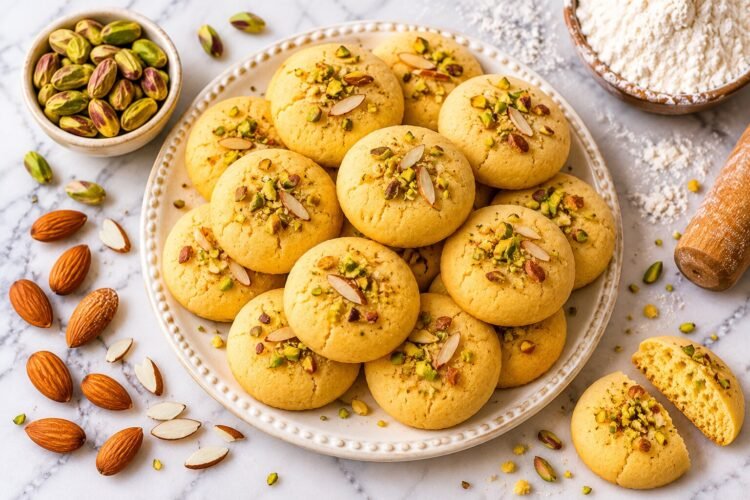
There are very few biscuits on the Indian subcontinent that carry as much quiet affection as naan khatai. No celebration required, no special occasion needed — just a batch of these pale golden rounds cooling on a wire rack, their cardamom and ghee fragrance drifting through the kitchen, and a cup of chai. That is the entire setting, and it is completely sufficient.
Naan khatai has been a fixture of North Indian and Pakistani bakeries for well over a century. The original recipe is remarkably minimal — ghee, sugar, flour, cardamom, a touch of besan — and the magic is entirely in the proportion and technique. Add almonds and you have badami naan khatai, a version that brings a toasty, nutty depth to the classic flavour and a slight textural variation that makes the crumble even more satisfying.
This recipe makes 10 generous biscuits and comes together in under 30 minutes of active work. It is the kind of bake that scales effortlessly — double or triple the batch for Eid, Diwali, Muharram, or the kind of large gathering where people always find their way back to the biscuit tin.
The Story Behind Naan Khatai
The name naan khatai is a linguistic relic. Naan refers to bread in Persian and Urdu, and khatai derives from khata — sour or acidic — referencing, historically, the use of acidic leavening agents in early versions of the biscuit. Over centuries of adaptation, the recipe moved from the Persian-influenced Mughal courts into the bakeries of Lahore, Delhi, Hyderabad, Surat, and eventually into home kitchens across the subcontinent.
What set naan khatai apart from European shortbread — which it superficially resembles — is the inclusion of besan (gram flour) alongside the maida. Besan absorbs fat differently from wheat flour, produces a denser crumb, and adds a distinctive earthy depth to the flavour that plain flour cannot replicate. It is also what gives naan khatai its characteristic slightly coarse texture versus the finer, more uniform crumb of a plain shortbread.
The other distinctive element is ghee as the sole fat. Where European shortbread uses butter, naan khatai uses ghee — clarified butter with the milk solids removed. Because ghee contains no water (butter is approximately 16–18% water), naan khatai bakes drier and crumbles more readily, producing the signature melt-in-the-mouth texture that makes the first bite so distinctive.
Why This Naan Khatai Works: The Ingredient Science
Before the recipe, understanding what each component does clarifies why the proportions matter and what can and cannot be substituted.
| Ingredient | Function | What Happens if Changed |
|---|---|---|
| Ghee | Fat that creates the crumbly, melt-in-mouth texture | Butter adds water → slightly less crumbly, slightly softer; oil → too greasy, won’t hold shape |
| Caster sugar | Sweetness + fine crystal size for even mixing | Granulated sugar works but may leave gritty spots; icing sugar creates a denser, moister texture |
| Cardamom powder | Signature aromatic flavour | Cannot be skipped or directly substituted — it is the defining spice note |
| Maida (all-purpose flour) | Structure, body, light crumb | Wholemeal wheat → heavier texture; self-raising → excess rise, cracks surface |
| Besan (gram flour) | Earthy depth, coarser crumb, traditional texture | Skipping it → milder flavour, uniform texture; more besan → heavier, denser biscuit |
| Baking powder | Gentle lift and slight spread | Too much → biscuits spread flat; too little → dense, hard discs |
| Baking soda | Additional leavening, slight browning | Works with the natural acidity of besan; keep the quantity precise |
| Crushed almonds | Nutty flavour, textural contrast | Can be replaced with pistachios, cashews, or skipped entirely for plain naan khatai |
| Egg yolk (for brushing) | Golden colour, slight sheen | Skip for eggless version → brush with milk or saffron-milk; colour will be paler |
Why Ghee Must Be Set, Not Liquid
The most important technique in this recipe is melting the ghee, then allowing it to cool until it re-solidifies to a butter-like consistency before beating. Liquid ghee does not cream with sugar — the mixture stays loose and oily, the dough is too soft to hold shape, and the biscuits spread flat during baking. Ghee at a soft-solid consistency creams with sugar exactly as butter does, trapping small air pockets that give the biscuit its lift and crumble. This step is not optional.
In warm kitchens, refrigerating the melted ghee for 15–20 minutes is the fastest way to reach the right consistency.
Ingredients (Makes 10 Biscuits)
| Ingredient | Amount | Notes |
|---|---|---|
| Ghee | 7 oz / 200g | Melt, then cool to butter-like consistency before using |
| Caster sugar | 6 oz / 170g | Fine-grain sugar; not granulated, not icing sugar |
| Cardamom powder | ½ tsp | Freshly ground from green cardamom pods gives the best flavour |
| Maida (all-purpose flour) | 8 oz / 225g | Sifted |
| Besan (gram flour) | 2 oz / 55g | Sifted; use fresh besan — stale besan has a bitter aftertaste |
| Baking powder | 2 tsp | Level, not heaped |
| Baking soda | ½ tsp | Level |
| Roasted almonds, crushed | ¾ cup / ~90g | Lightly roasted in a dry pan; roughly crushed, not powdered |
| Egg yolk | 1 | For brushing — beaten with 1 tsp milk; or use saffron milk for eggless |
Optional garnish: Halved almonds or pistachio slivers pressed into the top of each biscuit before baking.
How to Make Naan Khatai: Complete Step-by-Step
Prep time: 15 minutes (plus ghee cooling time)
Bake time: 15 minutes
Total time: 35–40 minutes
Stage 1 — Prepare the Ghee
Melt the ghee completely in a saucepan or microwave. Pour into a wide bowl and allow to cool. In a cool kitchen, this takes 20–30 minutes at room temperature. In a warm kitchen, refrigerate for 15–20 minutes.
The ghee is ready when it has re-solidified to a soft, butter-like consistency — it should hold a finger impression easily but not be liquid. It should feel like slightly softened butter.
Stage 2 — Cream Ghee, Sugar, and Cardamom
Add the caster sugar and cardamom powder to the set ghee. Beat with a hand whisk or electric mixer on medium speed for 2–3 minutes until the mixture is pale, creamy, and has increased slightly in volume. The sugar should be fully incorporated with no visible granules.
This step is the same as creaming butter and sugar in Western baking — it incorporates air into the fat that provides the lift and crumble in the finished biscuit.
Stage 3 — Sift and Add the Dry Ingredients
In a separate bowl, sift together the maida, besan, baking powder, and baking soda. Sifting breaks up lumps in the besan and distributes the leavening agents evenly.
Add the sifted dry mixture to the ghee-sugar bowl. Mix by hand using your fingertips or a spatula — do not use an electric mixer at this stage. Overmixing develops gluten in the maida, which makes the biscuit tough rather than crumbly. Mix only until just combined — the dough will be soft, slightly crumbly, and not sticky.
Fold in the crushed roasted almonds. Mix gently until distributed throughout the dough.
Dough consistency check: The dough should hold together when pressed but have a slightly sandy, crumbly feel. If it feels too dry to hold shape, add 1 tsp of milk. If it feels too sticky, refrigerate for 10 minutes.
Stage 4 — Shape the Biscuits
Preheat the oven to 190°C / 375°F. Line a large baking tray with parchment paper.
Divide the dough into 10 equal portions. Roll each portion between your palms into a smooth ball, then press gently to flatten to approximately 1.5–2cm thickness. The biscuits should be roughly the size and shape of a large coin — about 6–7cm diameter.
Place on the lined baking tray with at least 3cm space between each biscuit — they will spread slightly during baking.
Stage 5 — Brush and Garnish
Beat the egg yolk with 1 tsp of milk. Brush the top surface of each biscuit lightly with the egg wash. This produces the characteristic golden colour and slight sheen on the finished biscuit.
Optional: Press a halved almond or a few pistachio slivers into the centre of each biscuit for a decorative finish and to identify the flavour when serving a mixed assortment.
Stage 6 — Bake
Place the tray in the preheated oven. Bake for 15 minutes.
The biscuits are done when the edges and base are lightly golden and the top surface is set — they will feel slightly soft to the touch when warm but will firm up as they cool. Do not wait for them to turn deeply golden in the oven; naan khatai continues to cook from residual heat after it comes out.
Stage 7 — Cool and Store
Leave the biscuits on the tray for 5 minutes, then carefully transfer to a wire rack using a palette knife or flat spatula. They are fragile when warm.
Cool completely — at least 20 minutes — before storing or serving. Storing warm biscuits creates condensation inside the container, which softens the texture within hours.
Store in an airtight container at room temperature. They keep well for 10–14 days.
Naan Khatai Troubleshooting
| Problem | Cause | Fix |
|---|---|---|
| Biscuits spread flat | Ghee too liquid when mixed; too much baking powder | Re-melt and re-set ghee to firm consistency; measure leavening precisely |
| Biscuits too hard / dry | Overbaked; too much flour; ghee undermeasured | Check at 13 minutes; spoon flour into cup (don’t pack); measure ghee by weight |
| Biscuits crack on the surface | Dough too dry; oven temperature too high | Add 1–2 tsp milk to dough; use oven thermometer to verify temperature |
| No golden colour | Egg wash skipped; oven too cool | Always brush with egg yolk; check oven calibration with thermometer |
| Grainy, gritty texture | Granulated sugar used instead of caster; besan lumps not sifted | Use caster sugar only; always sift besan before adding |
| Raw flavour / dense texture | Underbaked; ghee not properly creamed with sugar | Bake full 15 minutes; cream ghee-sugar until pale and increased in volume |
| Cardamom flavour too faint | Pre-ground cardamom powder is stale | Grind fresh from green cardamom pods; replace store-bought powder every 3 months |
Variations and Adaptations
Classic Plain Naan Khatai
Omit the crushed almonds entirely. This is the pure, bakery-style version — the cardamom and besan flavours come through without any distraction. Garnish the top of each biscuit with a pinch of cardamom sugar (1 tsp sugar + ¼ tsp cardamom powder mixed together) before baking.
Pista Naan Khatai (Pistachio)
Replace the crushed almonds with roughly crushed roasted pistachios and add ½ tsp of kewra water (screwpine essence) to the ghee-sugar mixture. The green pistachio pieces through the pale biscuit make a visually striking festive version.
Naan Khatai Without Oven (Stovetop / Pan Method)
For kitchens without an oven: heat a heavy-bottomed pan or pressure cooker (without the whistle) with a layer of coarse salt at the base. Place a small wire rack or ring inside. Preheat covered on high heat for 10 minutes. Place the shaped, brushed biscuits on the rack. Cover and cook on medium-low heat for 20–25 minutes until set and lightly golden on the base. The texture is slightly different — denser and less evenly golden — but the flavour is fully achieved.
Eggless Naan Khatai
Skip the egg yolk brush and replace with one of the following:
- Saffron milk: A pinch of saffron dissolved in 1 tbsp warm milk — produces a beautiful golden colour and a subtle saffron fragrance
- Plain milk: Paler colour but neutral flavour
- Ghee brush: A very light brush of melted ghee — produces a soft, matte finish with a slight sheen
Chocolate Naan Khatai (Fusion)
Replace 2 tbsp of the maida with 2 tbsp of unsweetened cocoa powder. Reduce the cardamom to ¼ tsp and add ½ tsp vanilla extract. Top each biscuit with a chocolate chip pressed into the centre. The result is a modern fusion version that keeps the ghee-besan shortbread base while adding a cocoa note.
Coconut Naan Khatai
Replace the crushed almonds with ¾ cup of desiccated coconut, lightly toasted. Add ½ tsp of vanilla. The coconut adds a chewier edge to the crumble and a tropical warmth that pairs particularly well with the cardamom.
Festive and Gifting Ideas
Naan khatai is one of the most gifting-appropriate home-baked items in the South Asian tradition. The biscuits keep at room temperature for two weeks, travel well, and are universally enjoyed across age groups.
Festive occasions where naan khatai is traditionally made:
- Eid ul-Fitr / Eid ul-Adha — Large batches are made and distributed to neighbours and guests
- Muharram — The original author specifically mentioned making a large batch for Muharram distribution
- Diwali — Often included in mithai boxes alongside ladoo, barfi, and namkeen
- Holi — Tea-time snack during festive gatherings
Gifting presentation:
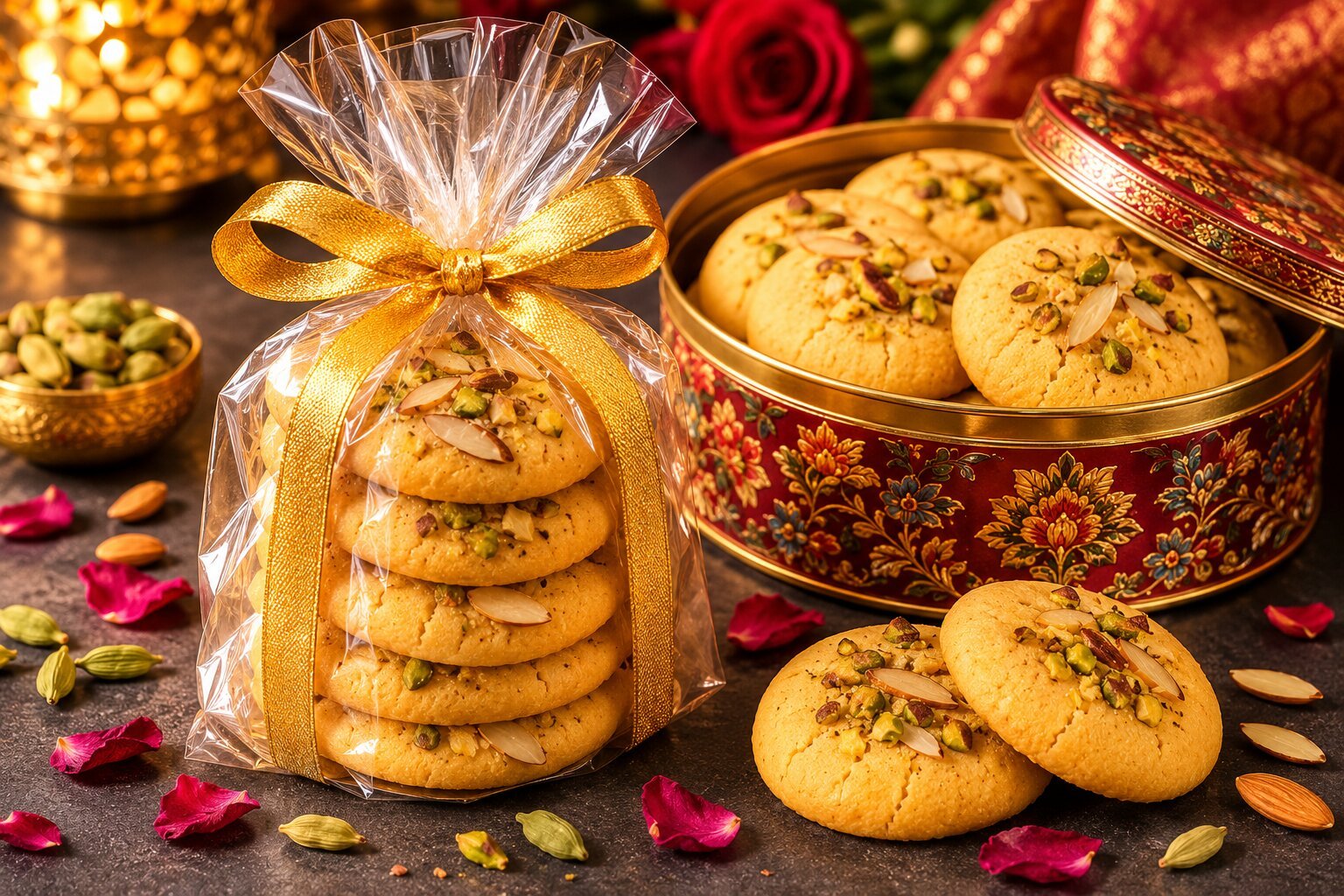
- Stack 6–8 biscuits and wrap in cellophane with a tied ribbon for individual gifts
- Layer in a decorative tin between sheets of parchment paper
- Include in a mixed hamper alongside namkeen, dry fruits, and other festive sweets
Storage Guide
| Method | Duration | Notes |
|---|---|---|
| Airtight container at room temperature | 10–14 days | Keep away from moisture and direct sunlight |
| Refrigerator | Up to 3 weeks | Bring to room temperature before serving — cold naan khatai loses its melt texture |
| Freezer (unbaked dough) | Up to 1 month | Freeze shaped balls on a tray; bake from frozen at 190°C for 18–20 minutes |
| Freezer (baked biscuits) | Up to 1 month | Thaw at room temperature for 30 minutes; refresh in a 160°C oven for 5 minutes |
Nutrition Profile (Per Biscuit — Based on 10 Biscuits)
| Nutrient | Amount |
|---|---|
| Calories | 285 kcal |
| Carbohydrates | 28g |
| Protein | 4g |
| Fat | 18g (Saturated: 10g) |
| Dietary Fibre | 1.5g |
| Sugar | 14g |
| Calcium | 20mg |
| Iron | 0.8mg |
Values are estimates. Actual values vary with ghee brand and almond quantity.
Naan khatai is an occasional-treat item. The gram flour (besan) contributes meaningful plant protein compared to plain flour biscuits. The almonds add healthy monounsaturated fat, vitamin E, and additional protein. The ghee provides fat-soluble vitamins A, D, E, and K.
Frequently Asked Questions
Q1. What is the difference between naan khatai and shortbread?
Both are shortbread-style biscuits — high fat, low moisture, crumbly texture — but naan khatai has three distinctive differences from European shortbread. First, it uses ghee instead of butter, which contains no water and produces a drier, more crumbly crumb. Second, it includes besan (gram flour) alongside maida, which adds an earthy flavour depth and coarser texture. Third, it is flavoured with cardamom rather than vanilla. These three differences produce a biscuit that is recognisably its own thing — not better or worse than shortbread, simply distinct.
Q2. Can I replace ghee with butter?
Yes, with a few adjustments. Use the same weight of unsalted butter (200g), softened to room temperature — do not melt and re-set it as you would ghee. The finished biscuit will be slightly less crumbly and will stay slightly softer because butter contains approximately 16–18% water. The flavour will be milder and less rich. If you want to get closer to the ghee version using butter, clarify the butter yourself first: melt it gently, skim the foam, and use only the clear golden liquid — this is homemade ghee, and it will work exactly as the recipe describes.
Q3. Why does my naan khatai spread flat during baking?
Flat, spread biscuits almost always come from ghee that was too warm or too liquid when beaten with the sugar. If ghee is liquid when you cream it, there is no fat structure to hold the dough together — it spreads in the heat of the oven before it sets. The fix is reliable: melt the ghee completely, then let it cool and re-solidify to a firm-soft consistency before beating. Refrigerating for 15–20 minutes works well in warm kitchens. If your dough still feels too soft after mixing, refrigerate the shaped biscuits for 20 minutes before baking.
Q4. Can I make naan khatai without an oven?
Yes — the stovetop method works well. Use a large, heavy-bottomed pot (a pressure cooker without the whistle works well). Spread 1–2 cups of coarse salt across the base and place a small wire rack or metal ring inside to elevate the baking plate. Preheat covered on high heat for 10 minutes. Place the shaped biscuits on a greased plate on the rack. Cover tightly and cook on medium-low heat for 20–25 minutes. The base will be slightly more coloured than the top — flip the biscuits gently for the last 2–3 minutes if you want more even colour. The texture is excellent; only the colour distribution differs from an oven-baked version.
Q5. My naan khatai tastes bland despite using cardamom. What went wrong?
Three possible causes: stale cardamom powder (pre-ground cardamom loses most of its flavour compounds within 2–3 months of opening — replace regularly or grind fresh from pods); not enough cardamom (½ tsp gives a subtle background note — increase to ¾ tsp for a more pronounced flavour); or the besan is old (old besan has a muted, slightly bitter flavour that can dull every other flavour in the biscuit — use fresh, stored besan from a sealed bag). If the flavour is there but faint after baking, the issue is cardamom freshness — this is by far the most common cause.
The Biscuit That Needs No Occasion
Naan khatai does not wait for festivals. The dough takes 15 minutes, the bake takes another 15, and you have a tin of crisp, melt-in-mouth, cardamom-scented shortbread that will be gone before anyone intended.
The badami version — with roasted almonds folded in — adds a layer of nuttiness that makes an already excellent biscuit feel considered and special. It scales effortlessly for large batches, keeps for two weeks, and travels well for gifting. All of which makes it one of the most practical and rewarding things you can bake.
Tried this recipe? Leave a comment — tell us whether you kept them plain or added almonds, and what occasion you made them for. If you used the stovetop method, we especially want to hear how they turned out.
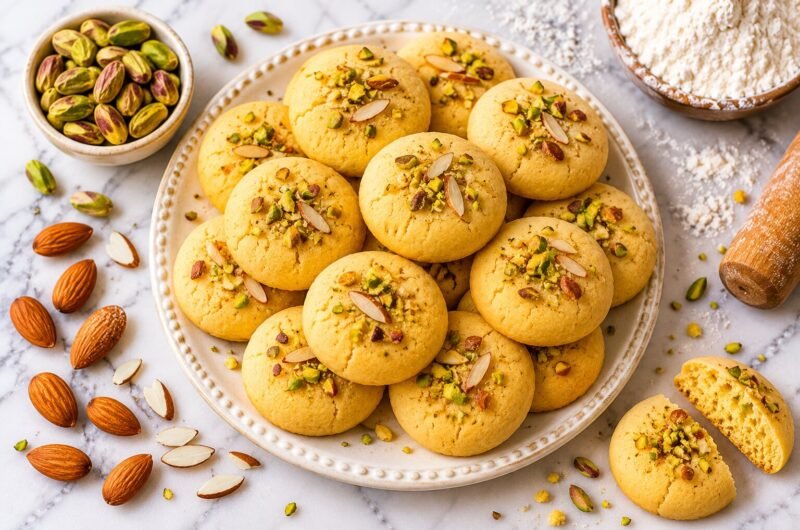
Badami Naan Khatai (Almond Shortbread Biscuits)
4
servings15
minutes40
minutes285
kcalIngredients
7 oz / 200g ghee — melted, then cooled to soft-solid consistency
6 oz / 170g caster sugar
½ tsp cardamom powder (freshly ground preferred)
8 oz / 225g maida (all-purpose flour), sifted
2 oz / 55g besan (gram flour), sifted
2 tsp baking powder (level)
½ tsp baking soda (level)
¾ cup / ~90g roasted almonds, roughly crushed1 egg yolk + 1 tsp milk, beaten (Eggless: 1 tbsp saffron milk or plain milk)
Halved almonds or pistachio slivers
Directions
- Set the ghee: Melt ghee completely, then cool at room temperature (or refrigerate 15–20 min) until firm-soft like butter.
- Cream: Beat the set ghee with caster sugar and cardamom powder for 2–3 minutes until pale and creamy.
- Mix dry ingredients: Sift maida, besan, baking powder, and baking soda together. Add to the ghee-sugar mixture and mix by hand until just combined — do not overwork.
- Add almonds: Fold in the crushed roasted almonds.
- Preheat oven to 190°C / 375°F. Line a baking tray with parchment paper.
- Shape: Divide dough into 10 equal balls. Flatten each to ~1.5–2cm thickness. Place on the tray with 3cm spacing.
- Brush: Brush each biscuit with the beaten egg yolk mixture. Press an almond half into the centre if using.
- Bake: 15 minutes at 190°C until edges are lightly golden and the top is set.
- Cool: Rest on the tray 5 minutes, then transfer carefully to a wire rack. Cool fully before storing.
- Store: Airtight container at room temperature for up to 14 days.
Recipe Notes
- Ghee consistency is critical: Must be firm-soft (like softened butter) before creaming — liquid ghee causes flat biscuits.
- Do not overmix: Mix dry ingredients in by hand only. Overmixing develops gluten and makes biscuits tough rather than crumbly.
- Cardamom freshness matters: Use freshly ground from green pods for best flavour. Replace pre-ground powder every 3 months.
- Fresh besan only: Old besan develops a bitter aftertaste that affects the whole biscuit.
- They set as they cool: Biscuits feel slightly soft when hot — this is normal. They firm up completely within 20 minutes.