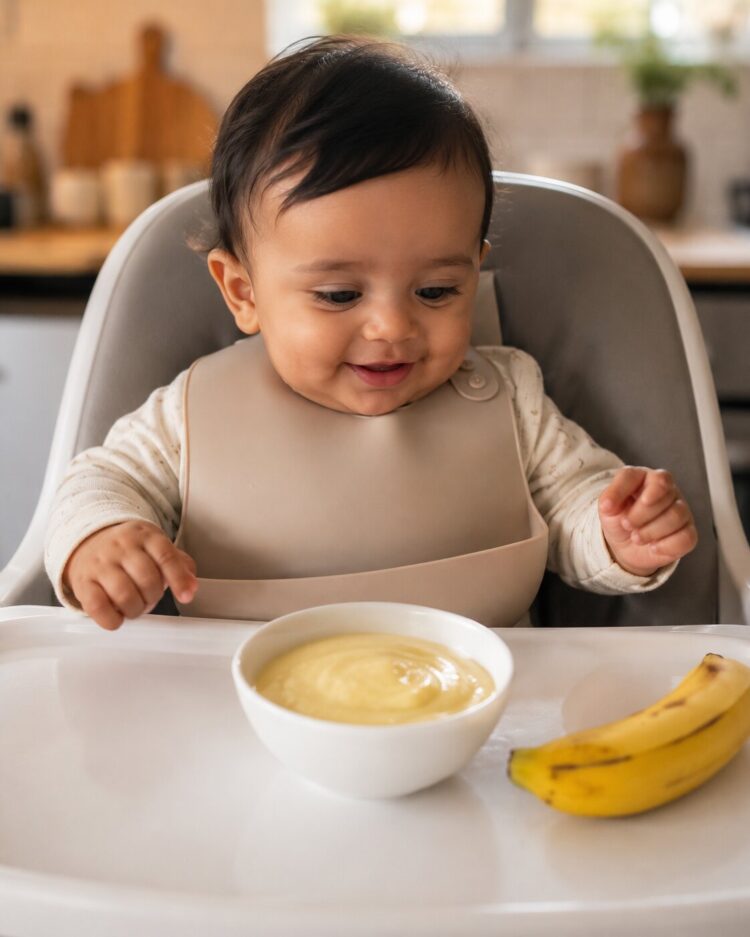
You’ve been watching it for weeks — your baby eyeing your plate at dinner, reaching for your spoon, smacking their lips when you take a bite. That magical window has arrived: your baby is ready for solid food.
And if you’re like most parents, you’re equal parts excited and overwhelmed. What do you feed them first? Is it safe? What if they hate it? What if they choke?
Take a breath. We’re starting simple — with a banana.
Banana puree is arguably the most popular first food for babies around the world, from the bustling kitchens of South India where mashed banana has been given to babies for generations, to American pediatric clinics where it tops the list of doctor-recommended starter foods. And for very good reason.
It’s soft. It’s naturally sweet. It doesn’t require cooking. It’s packed with nutrition. And most babies? They absolutely love it.
In this guide, we’ll walk you through everything you need to know — from when to start, how to make it perfectly, what the science says about banana nutrition, how to store it, and how to level it up as your baby grows. By the end, you’ll be a confident, prepared banana-puree-making parent.
Let’s dig in.
Why Banana Puree Is the Gold Standard First Food
The Pediatrician’s Favourite
According to the American Academy of Pediatrics (AAP), babies can begin solid foods around 6 months of age — when they can hold their head steady, show interest in food, and have lost the tongue-thrust reflex. While the AAP now says there’s no specific order in which foods must be introduced, banana consistently remains one of the top recommended first choices across the globe.
Why? Because bananas tick every box:
- No cooking required — a ripe banana is already naturally soft
- Naturally sweet — babies are born preferring sweet tastes (breast milk is sweet), so banana is a gentle, familiar flavour
- Hypoallergenic — banana allergy is extremely rare (less than 0.1% of infants)
- Easily digestible — the starch in ripe bananas is highly digestible for developing guts
- Nutrient-dense — one small banana contains meaningful amounts of potassium, vitamin B6, vitamin C, and fibre
- Portable and affordable — no prep, no mess, available everywhere
What the Research Says
A 2021 study published in the Journal of Nutrition highlighted that iron, zinc, and potassium are among the most critical nutrients for brain and physical development in the 6–12 month window. Banana, while not high in iron, delivers excellent potassium and B6 — supporting nerve function and energy metabolism during one of the most rapid growth periods of a child’s life.
When Can Babies Start Banana Puree? (Age Guide)
4 Months — Too Early
Despite what some older parenting books suggest, 4 months is too early for solids. The baby’s gut is still developing its microbiome and digestive enzymes. Introducing solids too early is linked to increased risk of allergies, obesity, and digestive discomfort.
6 Months — The Green Light
Most health authorities — including the WHO, AAP, and NHS (UK) — recommend starting solids at around 6 months. This is the ideal time for banana puree.
Signs your 6-month-old is ready:
- Sits up with minimal support
- Shows interest in your food
- Can move food to the back of their mouth
- Has lost the tongue-thrust reflex (no longer automatically pushes things out of the mouth)
- Doubled their birth weight (a general milestone)
8–10 Months — Texture Upgrade Time
By 8–10 months, you can move from smooth puree to mashed banana (with small soft lumps). This is critical for developing chewing muscles, even before teeth arrive.
12 Months+ — Finger Food Stage
Soft banana slices or small pieces work beautifully as finger foods. Babies can practise pincer grip and self-feeding confidence.
Banana Nutrition: What You’re Actually Feeding Your Baby
Let’s get specific. Here’s what a half a medium banana (roughly 50g) — a typical serving for a 6-month-old — contains:
| Nutrient | Amount | Why It Matters for Babies |
|---|---|---|
| Calories | ~44 kcal | Energy for rapid growth |
| Carbohydrates | ~11g | Primary energy source |
| Natural Sugars | ~6g | Gentle energy release |
| Dietary Fibre | ~1.3g | Supports gut health |
| Potassium | ~210mg | Heart and muscle function |
| Vitamin B6 | ~0.2mg | Brain development |
| Vitamin C | ~4.4mg | Immunity + iron absorption |
| Magnesium | ~13mg | Bone development |
| Folate | ~10mcg | Cell growth |
Expert Insight: Paediatric dietitian Dr. Aarti Kapoor (Delhi, India) notes: “Banana is one of the most complete natural fast foods for infants. Its combination of fast and slow-release carbohydrates makes it suitable for both energy and satiety.”
A Note on Sugar
Parents often worry: Is banana too sugary? The answer is no — not for babies. The natural sugars in banana come packaged with fibre, which slows absorption. This is fundamentally different from added sugars in processed foods. Banana’s glycaemic impact is moderate when the fruit is ripe-but-not-overripe.
How to Choose the Right Banana for Your Baby
Not all bananas are created equal for baby food. Here’s what to look for:
The Perfect Ripeness Spectrum
🟢 Underripe (green): Too starchy and hard to digest. Skip.
🟡 Just Ripe (yellow, firm): Okay, but lower in natural sugar and harder to mash smoothly.
🟡🟤 Perfectly Ripe (yellow with a few brown spots): This is your sweet spot. Easiest to digest, naturally sweet, smooth to mash.
🟤 Overripe (mostly brown/black): Very sweet, extremely easy to mash, still nutritious — fine for purees but a bit stronger in flavour.
Organic vs. Conventional
Bananas have a thick peel, which makes them one of the lower-pesticide fruits (they appear on the “Clean Fifteen” list in the USA). Organic is a personal choice, but not strictly necessary for bananas specifically.
Variety Matters
| Variety | Taste | Best For |
|---|---|---|
| Cavendish (standard) | Mild, sweet | Most common, excellent for puree |
| Red Banana | Sweeter, creamier | Great for older babies |
| Baby Banana / Lady Finger | Very sweet, smaller | Perfect size for finger foods at 10+ months |
| Plantain | Starchy, less sweet | Best cooked first; not ideal for puree at 6 months |
In India, the Nendran banana (Kerala/South India) is traditionally used in baby food, especially mashed with a little ghee. It’s slightly firmer and more starchy but highly nutritious and a beloved regional choice.
How to Make Banana Puree for Baby — Step-by-Step
What You’ll Need
- 1 ripe banana (yellow with brown spots)
- A fork or a blender/food processor
- A small bowl
- Breast milk, formula, or water (optional, to thin)
Method 1: Fork-Mash (No Equipment Needed)
This is the easiest method, perfect for a quick feed.
Steps:
- Wash your hands thoroughly.
- Peel the banana and break off a small piece (about 1/3 of the banana).
- Place it in a clean bowl.
- Mash firmly with a fork, pressing in circular motions until you reach a smooth consistency.
- If it seems too thick, add 1–2 teaspoons of breast milk or formula to loosen.
- Serve immediately.
⏱ Time: 2 minutes. Literally.
Method 2: Blender Puree (Smoothest Texture)
Best for batch preparation or if your baby prefers an ultra-silky texture.
Steps:
- Peel and slice 2–3 ripe bananas.
- Add to a blender or small food processor.
- Add 2–3 tablespoons of breast milk, formula, or water.
- Blend on high for 30–45 seconds until completely smooth.
- Taste and adjust consistency.
- Serve immediately or store.
⏱ Time: 5 minutes.
Method 3: Steamed Banana Puree (For Younger Babies or Firmer Bananas)
If your banana isn’t fully ripe or your baby has a very sensitive stomach, light steaming can help.
Steps:
- Slice the banana into thick rounds.
- Steam over boiling water for 3–4 minutes until very soft.
- Cool completely.
- Mash or blend until smooth.
- Thin with breast milk or formula if needed.
⏱ Time: 10 minutes.
Note: Steaming does reduce some vitamin C content, but it makes the banana easier to digest for very young or sensitive babies.
Regional Banana Baby Food Traditions 🌍
Banana baby food isn’t just a Western trend — it’s a global tradition.
🇮🇳 Indian (South Indian) Tradition
In Kerala and Tamil Nadu, mashed Nendran banana with a tiny drop of ghee is the first food given at the Annaprashana ceremony (baby’s first rice/food ceremony at 6 months). It’s considered sacred and deeply nourishing. South Indian mothers often mix it with a teaspoon of rice gruel (kanji) for added iron.
🇮🇳 Indian (North Indian) Tradition
In North India, ripe banana is mashed plain or combined with ragi (finger millet) porridge for an iron-boosted first meal. Some families add a pinch of cardamom for flavour — though spices should generally be delayed until 8+ months.
🇺🇸 American Tradition
In the United States, banana puree is often mixed with baby oatmeal or rice cereal to create a more filling meal. American pediatricians frequently recommend banana-oatmeal combos as an iron-rich, fibre-dense first solid.
🇬🇧 British Tradition
In the UK, banana is often combined with pureed pear or apple to create gentle flavour combinations. British health visitors typically recommend starting with single-ingredient purees first.
🌏 Southeast Asian Tradition
In the Philippines, Indonesia, and Thailand, lakatan bananas are commonly given to babies. In the Philippines, banana is often cooked into lugaw (rice porridge) and mashed in for babies starting solids.
🌍 African Tradition
In East and West Africa, banana is frequently mashed with avocado — a beautiful, healthy fat-rich combination that’s gaining global popularity. In Uganda, a dish called matoke (cooked green banana/plantain) is a common early food, cooked soft and mashed.
Banana Puree Combinations to Try (By Age)
6–8 Months: Single Ingredient or Simple Combos
- Pure banana puree (start here)
- Banana + breast milk or formula
- Banana + avocado puree
- Banana + sweet potato puree
- Banana + pureed mango
8–10 Months: Texture and Flavour Expansion
- Mashed banana + whole-milk yoghurt
- Banana + blueberry puree
- Banana + oatmeal porridge
- Banana + pear puree
- Banana + cooked and pureed lentils (dal) — Iron boost!
10–12 Months: More Complex Combos
- Banana + nut butter (if no allergy)
- Banana pancakes (1 egg + 1 banana, pan-fried)
- Banana + soft-cooked apple + cinnamon
- Banana smoothie with full-fat yoghurt
Paediatric Note: Always introduce one new ingredient at a time and wait 3–5 days before adding another. This is called the 4-day wait rule and helps you identify any allergic reactions or sensitivities.
How to Store Banana Puree
Banana oxidises quickly (turns brown) when exposed to air — this is completely safe but may put you off visually.
Refrigerator Storage
- Store in a sealed airtight container
- Keeps for 1–2 days in the fridge
- A squeeze of lemon juice slows browning (don’t add for babies under 8 months)
Freezer Storage
- Freeze in ice cube trays lined with cling film
- Once frozen solid, pop out and store in labelled zip-lock bags
- Keeps for up to 1–2 months in the freezer
- Thaw overnight in fridge or for a few hours at room temperature
- Never refreeze once thawed
Pro Tip: Banana puree is one of the few foods that actually freezes less well than others due to texture change. Fresh is always best. Many parents find it easier to simply mash a banana fresh at each mealtime since it takes under 2 minutes.
How Much Banana Puree Should a Baby Eat?
Serving Sizes by Age
| Age | Serving Size | Frequency |
|---|---|---|
| 6 months | 1–2 teaspoons | 1x daily to start |
| 7 months | 2–4 tablespoons | 1–2x daily |
| 8–9 months | 4–6 tablespoons | 2x daily |
| 10–12 months | 6–8 tablespoons | 2–3x daily |
Start tiny. The goal at 6 months is exploration, not nutrition — breast milk or formula still provides 90%+ of nutritional needs. Think of first foods as taste and texture education.
Safety Guide: Is Banana Safe for All Babies?
Common Concerns
❓ Can banana cause constipation? This is a common myth. Ripe banana is actually helpful for digestive regularity due to its fibre and fructooligosaccharides. Unripe banana can be more constipating because of resistant starch — another reason to use ripe bananas.
❓ Is banana a choking hazard? When properly pureed or mashed, banana is one of the least likely foods to cause choking. In finger food stage (10–12 months), cut into small, soft pieces rather than large rounds.
❓ Can my baby be allergic to banana? Banana allergy is rare but exists, particularly in children with latex allergy (latex-fruit syndrome). Signs of a reaction: rash around mouth, vomiting, hives. If you notice any symptoms, stop feeding and consult your paediatrician.
❓ What if my baby refuses banana puree? Completely normal. Research shows babies may need 8–15 exposures to a new food before accepting it. Don’t give up after one refusal. Try again in a few days.
Pros and Cons of Banana as a First Food
| ✅ Pros | ⚠️ Cons |
|---|---|
| No cooking required | Oxidises quickly (browns fast) |
| Naturally sweet — baby-approved | Can be constipating if unripe |
| High in potassium and B6 | Not high in iron (needs pairing) |
| Hypoallergenic | Can cause gas in some babies |
| Cheap and widely available | Freezes with texture change |
| Perfect smooth texture | Strong taste may overpower combos |
| Portable — travel-ready | — |
Tips from Paediatric Nutritionists
- Always start with a single-ingredient puree before combining flavours
- Time it right — offer solids when baby is alert but not ravenous (mid-morning works well)
- Let baby lead the pace — if they turn away, stop. Forcing food creates negative feeding associations
- Sit upright at 90° — always feed solids with baby sitting as upright as possible
- Make it social — eat alongside your baby whenever possible; they learn by watching
- Skip salt, sugar, and honey — these have no place in baby food before 12 months
- Offer water in an open cup — from 6 months, small sips of water with meals is fine and helps develop cup-drinking skills
Conclusion: Start Simple, Start Strong
The journey to feeding your baby real food doesn’t need to be complicated. A ripe banana and a fork is genuinely all you need to make a beautifully nutritious first meal — one that’s been trusted by parents across continents and cultures for generations.
Banana puree is your best friend at 6 months. It’s fast, safe, nutritious, and — most importantly — babies love it. From Kerala to Kansas City, from Lagos to London, this humble yellow fruit has been welcoming little ones to the world of food for as long as anyone can remember.
Start with a teaspoon. Smile at your baby. Watch their face when the flavour hits for the first time. There is honestly nothing quite like it.
🍼 Ready to Get Started?
Try this this week: Pick up a bunch of ripe bananas, mash a teaspoon for your 6-month-old, and note their reaction in a little journal. Repeat daily for a week. By day 7, you’ll likely have a tiny banana enthusiast on your hands.
Have questions? Drop them in the comments — we’re here to help every step of your feeding journey.
Frequently Asked Questions (FAQs)
Q1. Can I give banana puree to my 4-month-old baby?
No. Health organisations including the WHO and AAP recommend waiting until 6 months before introducing any solid food. A 4-month-old’s digestive system is not yet mature enough for solids, and early introduction is linked to increased risk of allergies, obesity, and digestive issues. Stick to breast milk or formula until 6 months.
Q2. How do I prevent banana puree from turning brown?
Banana oxidises quickly due to a natural enzyme called polyphenol oxidase. To slow browning, store in an airtight container and press cling film directly against the surface of the puree to minimise air contact. For older babies (8+ months), a small squeeze of lemon juice also helps. Brown banana puree is completely safe — it’s just aesthetics.
Q3. Should I mix banana puree with breast milk or formula?
At first, yes — especially if your baby is very new to solids. Adding 1–2 teaspoons of breast milk or formula makes the puree thinner, more familiar in taste, and easier to swallow. As your baby gets used to solids over weeks, you can thicken the consistency gradually.
Q4. Is it okay to give banana every day?
Yes, banana can be offered daily in age-appropriate amounts. However, for nutritional variety and to expand your baby’s palate, aim to rotate different fruits and vegetables each week. Think of banana as a reliable standby, not the only food in rotation.
Q5. Does banana puree cause gas or constipation in babies?
Ripe banana is generally gentle on baby’s digestive system. Some babies may experience mild gas when starting any new food, including banana — this is normal as their gut adjusts. Unripe or green bananas contain more resistant starch, which can contribute to constipation. Always use ripe (yellow with brown spots) bananas for babies.
This article is for informational purposes only and does not constitute medical advice. Always consult your paediatrician before introducing any new food to your baby or making significant changes to your pregnancy diet. Every child and pregnancy is different.