Most weight loss breakfast advice falls into one of two traps: either it is so bland you cannot face it by day three, or it is so calorie-restricted it leaves you hungry again by mid-morning.
Moong Dal Chilla is the exception to both rules — and it is the reason nutritionists and fitness coaches across India increasingly recommend it as a cornerstone of any fat-loss meal plan.
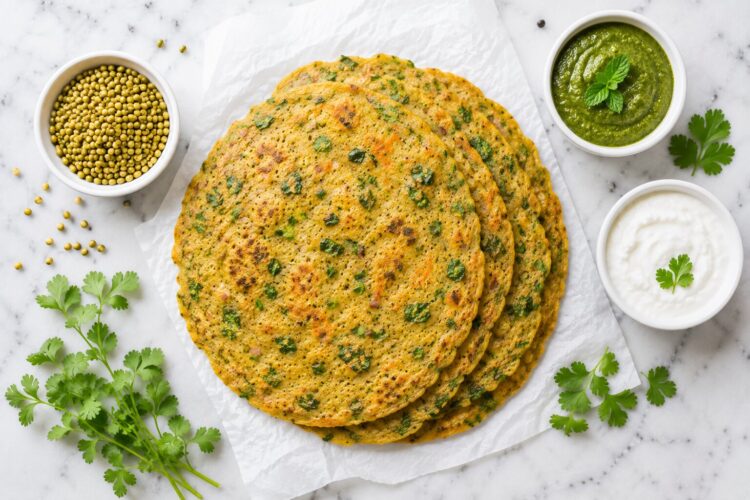
It is a thin, lightly spiced Indian savoury pancake made from soaked green moong dal (whole mung beans) or yellow moong dal. It requires no fermentation, no overnight preparation, and comes together in about 20 minutes. One medium chilla provides 7-9 grams of high-quality plant protein at just 104-150 calories — making it one of the most impressive protein-to-calorie ratios of any traditional Indian breakfast food.
This is not trendy diet food invented to capitalise on weight loss culture. Moong dal chilla has been a staple morning meal in North Indian kitchens for generations — particularly in Rajasthan, UP, and Delhi — where families have intuitively recognised what nutrition science now confirms: that a meal built on legumes, vegetables, and minimal fat keeps you full, keeps your energy stable, and fuels your morning without loading unnecessary calories.
This guide gives you the complete recipe, the science behind why it works for weight loss, detailed nutritional data, six high-protein variations, and practical tips for making it a sustainable part of your weekly routine.
Why Moong Dal Chilla Is One of India’s Best Weight Loss Breakfasts
Before we get into the recipe, it helps to understand exactly why this dish performs so well for fat loss — because the benefits go well beyond just being “low calorie.”
The Protein Advantage
One medium-sized moong dal chilla made from about 50-60 grams of soaked moong dal batter provides approximately 6-8 grams of protein per serving. This plant protein comes from moong dal’s impressive amino acid profile — moong is one of the richest vegetarian sources of essential amino acids available in Indian cuisine.
Why does protein matter so much for weight loss specifically? Three mechanisms:
- Satiety: Protein triggers the release of satiety hormones (GLP-1, PYY) and suppresses ghrelin (the hunger hormone), meaning you feel full longer and are less likely to snack between meals
- Thermogenesis: The body burns 20-35% of protein calories just in the process of digesting and metabolising it — significantly higher than carbohydrates (5-10%) or fat (0-3%)
- Muscle preservation: During a calorie deficit, the body can break down muscle tissue for fuel. Adequate protein intake prevents this, preserving metabolic rate during weight loss
The Glycemic Index Factor
Moong dal chilla has a low glycemic index of 48, which is well below the 55-threshold that classifies a food as low-GI. This means the carbohydrates in the chilla digest slowly, causing a gradual rise in blood sugar rather than a sharp spike. The practical benefit: sustained energy for 3-4 hours after eating, without the mid-morning crash and subsequent hunger that high-GI breakfasts like white bread toast or poha cause.
For anyone managing diabetes alongside weight loss, this low GI profile makes moong dal chilla a particularly valuable food.
The Fiber Effect
Each serving provides 2.6 grams of dietary fiber — and when you add chopped vegetables into the batter (as this recipe does), that number rises further. Dietary fiber slows gastric emptying, adds physical bulk to the meal without adding calories, feeds beneficial gut bacteria, and supports the hormonal signals that regulate appetite. It is one of the most evidence-backed tools in sustainable weight management.
Calorie Density
Moong dal chilla is relatively low in calories, making it a suitable option for weight management without loading up on excessive calories. Two moong dal chillas contain approximately 240-260 calories — a figure that represents a genuinely satisfying breakfast at a calorie level that leaves meaningful room in most people’s daily targets for lunch and dinner.
Nutritional Profile: Full Data Per Chilla
| Nutrient | Per 1 Chilla (Medium) | Per 2 Chillas |
|---|---|---|
| Calories | 104–150 kcal | 240–260 kcal |
| Protein | 7–9g | 14–18g |
| Carbohydrates | 13–15g | 26–30g |
| Fat | 2–4g | 4–8g |
| Fiber | 2.6–4g | 5–8g |
| Glycemic Index | 48 (Low) | — |
| Sodium | ~280mg | ~560mg |
| Iron | ~1.5mg | ~3mg |
| Folate | Significant | — |
Cooking method matters: Chillas cooked with 1 teaspoon of oil on a non-stick pan stay close to the lower calorie range. Using more oil or ghee increases fat and calorie content — adjust based on your goals. For maximum weight loss benefit, use an oil spray or minimal brush of oil rather than pouring.
Ingredients for High Protein Moong Dal Chilla (Makes 4–5 chillas, Serves 2)
Base Batter
- 1 cup green moong dal (whole or split — both work; whole provides slightly more fiber and a nuttier flavour) — soaked 3-4 hours in cold water
- 1-inch piece fresh ginger, roughly chopped
- 2 green chilies, roughly chopped (adjust to spice preference)
- ½ teaspoon cumin seeds
- ¼ teaspoon turmeric powder
- ½ teaspoon salt (black salt preferred — adds chaat-like character)
- Water — 3-4 tablespoons when blending, to achieve correct batter consistency
Vegetable Mix-Ins (for maximum nutrition and protein boost)
- 1 small onion, very finely chopped
- ½ medium carrot, grated
- ¼ cup baby spinach, finely shredded (or 1 tablespoon fenugreek/methi leaves)
- ¼ cup fresh coriander leaves, finely chopped
- 1 medium tomato, finely chopped, seeds removed
- ¼ cup capsicum, any colour, very finely diced
For Cooking
- Oil spray or minimal oil — 1 teaspoon maximum per chilla for weight loss
- Non-stick tawa or cast-iron skillet
Protein Boost Options (choose one or more)
- 2 tablespoons paneer, grated (+3-4g protein per chilla)
- 2 tablespoons tofu, crumbled (for vegan version, +2-3g protein)
- 1 tablespoon besan (chickpea flour) added to batter (+2g protein per chilla)
- 2 tablespoons Greek yogurt stirred into batter (+2g protein, also improves fluffiness)
Step-by-Step Recipe
Step 1 — Soak the Moong Dal (3-4 Hours or Overnight)
Rinse 1 cup of green moong dal thoroughly under cold water — 2-3 rinses until the water runs clear. Place in a bowl, cover generously with cold water, and soak for a minimum of 3-4 hours. Overnight soaking (6-8 hours) is perfectly fine and requires zero active effort.
Why soak? Soaking does three important things: it softens the dal for smooth blending, reduces phytic acid (which can inhibit mineral absorption), and starts the germination process that slightly increases the protein and vitamin content. Soaking also makes the dal significantly more digestible — reducing the bloating that some people experience from raw legumes.
Can you skip the soak? Technically yes, if you use split yellow moong dal (which is softer). But whole green moong soaked is nutritionally superior and produces a more flavourful, textured batter. Plan the soak time into your morning routine: soak before bed, blend in the morning.
Step 2 — Blend the Batter
Drain the soaked moong dal and rinse once more with fresh water. Transfer to a blender. Add the ginger, green chilies, and cumin seeds. Add 3-4 tablespoons of fresh water — start with less and add more if the blender struggles.
Blend to a slightly coarse, thick paste — not completely smooth. Some texture is desirable; a fully smooth batter produces a denser, less appealing chilla. Think of the texture you want: slightly rough, like a thick cake batter with very small flecks, not silky smooth like a puree.
Transfer to a large mixing bowl. Add turmeric and salt. Stir to combine.
Step 3 — Add Vegetables and Protein Boosters
Fold all the finely chopped vegetables into the batter: onion, grated carrot, shredded spinach, coriander, tomato, and capsicum. Add any protein boosters you are using (grated paneer, crumbled tofu, besan, or yogurt).
Stir until all vegetables are evenly distributed throughout the batter. The batter should be thick — when you drop a spoonful into the bowl, it should hold its shape for 1-2 seconds before spreading. If it is too thick, add 1-2 tablespoons of water. If too thin, let it rest for 5 minutes and it will thicken slightly as the lentil starch absorbs moisture.
Step 4 — Cook on a Non-Stick Tawa
Heat a non-stick tawa or cast-iron skillet over medium heat. Once hot, lightly spray with cooking spray or brush with ½ teaspoon of oil using a silicone brush.
Test readiness: sprinkle a few drops of water — if they sizzle and evaporate immediately, the pan is ready.
Pour one ladleful of batter (approximately ¼ cup) onto the centre of the pan. Immediately use the back of the ladle to spread it in gentle, outward, circular motions — working from the centre outward to create a thin, even round approximately 17-18 cm (7 inches) in diameter.
Drizzle a few drops of oil around the edges of the chilla — this edge oil creates the slightly crisp, golden rim characteristic of a well-made chilla.
Cook on medium heat for 2-3 minutes until:
- The surface looks dry and no longer shiny or wet
- The edges begin to lift naturally from the pan surface
- The underside is visible at the edges as golden to light golden-brown
Use a spatula to check the underside — it should be evenly golden. Flip carefully.
Cook the other side for 1-2 minutes until golden and cooked through.
Remove from the pan and serve immediately, or keep warm in a roti box lined with a clean cloth while you make subsequent chillas.
Best Accompaniments for Weight Loss
The chutney and accompaniment you choose significantly impacts the total calorie and nutritional profile of your meal. Here are the smartest options:
Highest Protein Pairing (Best for Weight Loss):
- 1 cup plain low-fat curd (yogurt) — adds 5-6g protein, probiotics for gut health, calcium
- A small bowl of mint-coriander chutney — near-zero calories, adds vitamins and freshness
Good Fiber Addition:
- A bowl of sprouted moong or a simple cucumber-tomato salad alongside the chillas
- This fiber addition further slows digestion and extends satiety
Avoid:
- Heavy coconut chutneys (high fat, high calorie)
- Butter or ghee on top of the chillas for weight loss purposes
- Sugary ketchup or sauces
The Weight Loss Ideal Plate: 2 chillas + 1 cup low-fat curd + mint-coriander chutney + ½ cup sprout salad = approximately 380-420 calories | 20-22g protein | 8-10g fiber This combination will keep the average adult satiated for 4-5 hours.
6 High-Protein Variations to Beat Boredom
One of the biggest barriers to sustainable weight loss is food monotony. Rotating through these variations keeps your moong dal chilla routine interesting for weeks:
Variation 1 — Paneer Moong Dal Chilla (Highest Protein)
Add 3-4 tablespoons of crumbled, lightly spiced paneer as a stuffing inside the folded chilla. After cooking one side, place the paneer filling on half, fold over, and cook for another 60 seconds. Protein boost: +5-6g per chilla. Best for active individuals with higher protein needs.
Variation 2 — Tofu Vegetable Chilla (Best Vegan Option)
Crumble 50g of firm tofu directly into the batter and add an extra ½ cup of mixed vegetables — broccoli, zucchini, bell peppers. The tofu integrates completely during cooking and adds a slightly denser, more substantial texture. Protein boost: +4-5g per chilla. Excellent for vegan weight loss diets.
Variation 3 — Sprouted Moong Chilla (Maximum Nutrition)
Use sprouted moong dal (soak for 8 hours, drain, and allow to sprout in a warm, covered container for 12-16 hours) instead of plain soaked moong. Sprouting increases the bioavailability of protein, iron, and folate significantly, and reduces the carbohydrate content slightly. The chilla has a slightly different, nuttier texture. This is the nutritionally superior version of the recipe.
Variation 4 — Spinach Moong Dal Chilla (Iron + Protein)
Blend 1 cup of fresh baby spinach leaves into the batter with the moong dal. The chilla turns a beautiful deep green and provides a significant iron and folate boost alongside the protein. Excellent for women, especially those with anaemia or pregnancy-related nutritional needs.
Variation 5 — Besan-Moong Combination Chilla
Use ½ cup moong dal + ½ cup besan (chickpea flour) as the batter base. Besan adds extra protein and makes the chilla slightly crispier. This combination is particularly popular as a gym-goer’s breakfast — the two lentil proteins together create a more complete amino acid profile. Protein per chilla: 10-12g.
Variation 6 — Egg-Topped Moong Dal Chilla
Make the standard chilla and, while it is still on the tawa after flipping, break one egg directly onto the top surface. Cover the pan for 60 seconds — the egg sets on top of the chilla, creating a combined protein powerhouse. Protein per chilla with egg: 13-15g. Suitable for non-vegetarians with high protein targets.
Weight Loss Meal Plan: How to Use Moong Dal Chilla
Incorporate moong dal chilla 3-4 times a week alternating with other high-protein, fiber-rich meals to maintain diversity and nutritional balance.
Here is a practical weekly framework:
| Day | Breakfast Role | Best Version |
|---|---|---|
| Monday | Primary breakfast | Standard vegetable chilla |
| Tuesday | Rest — have oats or eggs | — |
| Wednesday | Post-workout breakfast | Paneer or egg-topped variation |
| Thursday | Rest — have pesarattu or idli | — |
| Friday | Primary breakfast | Sprouted moong variation |
| Saturday | Brunch | Besan-moong combination |
| Sunday | Rest or celebratory meal | — |
Meal timing for weight loss:
- Best eaten 30-45 minutes after waking
- Pair with activity: on days when you exercise, eat 2 chillas (higher protein need); on rest days, 1-2 is sufficient
- Can also be eaten as a mid-afternoon snack (1 chilla) to prevent the 4 PM hunger that leads to poor snack choices
Who Should Eat Moong Dal Chilla?
Moong dal chilla is genuinely suitable for most people, but it is particularly well-suited for:
✅ Weight loss: Low calorie, high protein, high fiber — the ideal combination ✅ Diabetics: GI of 48 supports insulin sensitivity — suitable for both Type 1 and Type 2 diabetics ✅ Vegetarians and vegans: One of the best plant-based complete protein breakfasts available ✅ Athletes and gym-goers: High protein for muscle recovery, complex carbs for sustained energy ✅ PCOS management: Anti-inflammatory ingredients like turmeric and ginger are especially beneficial for PCOS, and the high fiber content supports hormone balance by aiding estrogen metabolism ✅ Children: Mild, nutritious, and can be made very thin and crispy (which most children prefer) ✅ Elderly: Easy to digest, soft in texture, and extremely nutritious
Who should exercise caution: ⚠️ People with kidney disease or those on protein-restricted diets should check with their doctor before increasing moong dal consumption significantly, as the protein content adds to daily intake.
Expert Tips for the Perfect Chilla Every Time
Batter consistency is everything. Too thick and the chilla will be dense and raw in the centre; too thin and it will tear when you try to spread it. The correct consistency: thick but just pourable. It should fall off a ladle in a thick, slow stream.
Medium heat throughout. High heat causes the surface to set before you finish spreading. Too low and the chilla steams rather than crisping. Medium heat for the full cooking time — do not adjust the flame up and down.
Use a non-stick pan for zero-oil cooking. If you want to genuinely minimise oil for weight loss, a high-quality non-stick pan with just an oil spray is the most effective approach. Cast iron works beautifully too but requires a thin layer of oil to prevent sticking.
Chop vegetables very finely. Large vegetable pieces prevent the chilla from spreading evenly and create weak points where it tears during flipping. The finer the chop, the better the batter integrates.
Make fresh batter daily. Moong dal batter can be stored in the refrigerator for up to 24 hours but is best used fresh. After 24 hours, the batter may turn slightly sour — this is not harmful, but the flavour profile changes.
Serve immediately. Like all Indian flatbreads, moong dal chilla loses its crispness within minutes of cooking. Make and eat — do not try to batch-cook and reheat.
Storage and Meal Prep Tips
Soaked dal: After soaking, drain and refrigerate in an airtight container for up to 24 hours before blending. This makes the morning process faster.
Blended batter: Refrigerate in a covered bowl for up to 24 hours. Bring to room temperature and stir before using — the batter may separate slightly in the fridge.
Cooked chillas: Can be refrigerated for up to 1 day and reheated in a dry tawa for 1-2 minutes per side. They lose some crispness but are still nutritionally complete and perfectly edible for a quick meal.
Batch prep strategy: Soak a larger quantity of moong dal on Sunday. Blend and refrigerate the batter divided into 2-3 portions. Use one portion Monday morning, one Tuesday — making the weekday breakfast routine faster and more sustainable.
Frequently Asked Questions
Q1. How many moong dal chillas should I eat per day for weight loss?
For most adults targeting weight loss, 2 medium moong dal chillas at breakfast is the ideal serving — providing approximately 240-260 calories and 14-18g of protein. This is satisfying enough to prevent mid-morning snacking while staying well within weight loss calorie targets. If adding protein-boosted versions (paneer, egg), one extra chilla may be appropriate on active days. Never exceed 3-4 per sitting as part of a weight loss plan.
Q2. Is moong dal chilla better than oats for weight loss?
Both are excellent weight loss foods, but moong dal chilla has a meaningful advantage in protein content. A bowl of plain oats (80g) provides approximately 5g protein at 300 calories. Two moong dal chillas provide 14-18g protein at 240-260 calories — significantly more protein at fewer calories. Oats have a slight advantage in soluble fiber (beta-glucan), which is particularly beneficial for cholesterol management. The ideal approach: rotate between both throughout the week for nutritional variety.
Q3. Can I make moong dal chilla without soaking?
You can use split yellow moong dal without soaking — it is soft enough to blend dry. However, the result is less nutritious (soaking reduces phytic acid and improves mineral bioavailability), less flavorful, and has a slightly different texture. For whole green moong, soaking is non-negotiable — unsoaked whole moong dal will not blend smoothly and produces a gritty, unpleasant batter. If pressed for time, even 1-2 hours of soaking is better than no soak at all.
Q4. Is moong dal chilla good for dinner for weight loss?
Yes — moong dal chilla is light enough for dinner at 104.2 kcal per serving, and having a lighter dinner 2-3 hours before sleep supports better digestion and weight management. For dinner, reduce the quantity to 1-2 chillas and pair with a generous bowl of vegetable soup or salad to increase volume without significantly increasing calories. The high protein content also supports overnight muscle recovery, which is particularly valuable if you exercise in the evenings.
Q5. Can I use yellow moong dal instead of green moong dal for the chilla?
Yes, and it is actually a very popular variation. Yellow moong dal (split and hulled) produces a smoother, slightly thicker batter that requires no long soak (30-60 minutes is sufficient), has a milder, more delicate flavor, and is considered easier to digest than whole green moong. The protein content is slightly lower than whole green moong but still excellent. For maximum nutrition and fiber, whole green moong is the preferred choice. For maximum convenience and digestibility, yellow moong dal is a perfectly valid alternative.
Your High-Protein Breakfast Routine Starts Here
Moong Dal Chilla is not a compromise food. It is not something you eat reluctantly because you are on a diet and it is “the healthy option.” It is genuinely, straightforwardly delicious — spiced with ginger and green chili, packed with vegetables, golden and slightly crisp from the tawa, ready in 20 minutes.
The fact that it happens to be one of the most effective weight loss breakfasts available is almost a secondary point. The primary point is that it is a breakfast you will actually want to eat — tomorrow morning, and the morning after that.
Start with the standard version. Master the batter consistency. Then try the paneer variation for extra protein, the sprouted moong version for maximum nutrition, or the egg-topped version on gym mornings. Build a rotation that keeps breakfast interesting while your waistline moves in the right direction.
Try this recipe tomorrow morning and drop your results in the comments below! Tell us which variation you tried, what vegetables you added, and how it compared to your usual breakfast. And if you found a combination that worked particularly well for your weight loss routine — share it. Someone else’s morning routine will thank you.
Pairs beautifully with: Mint-Coriander Chutney | Low-Fat Curd | Sprouted Moong Salad | Fresh Lime Water | Masala Chai (no sugar)